
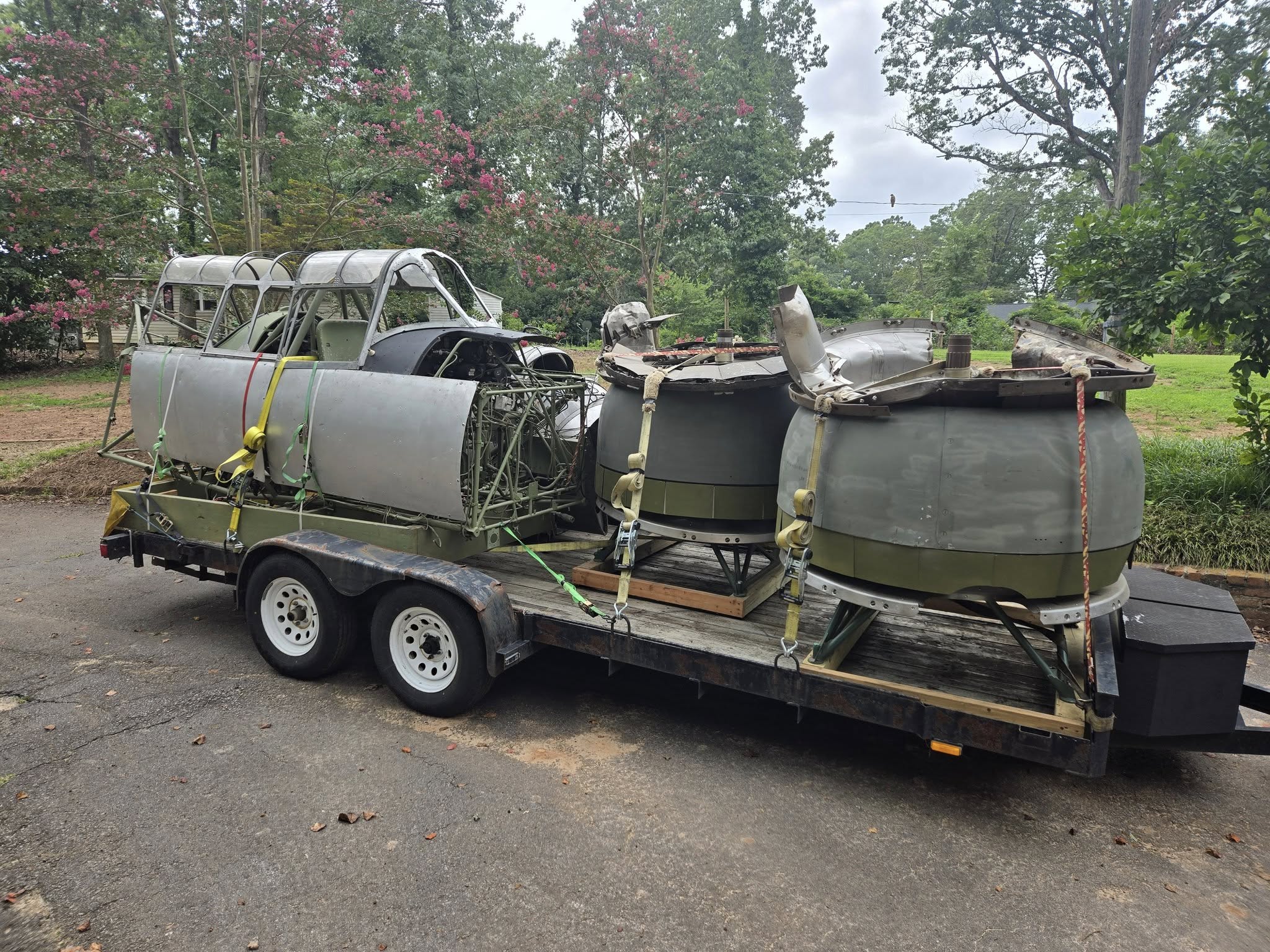
Parts loaded for the trip west. Included are static engines for a Boeing B-17G and the fuselage to an early Vultee BT-13.
Photo taken 9 August 2025.
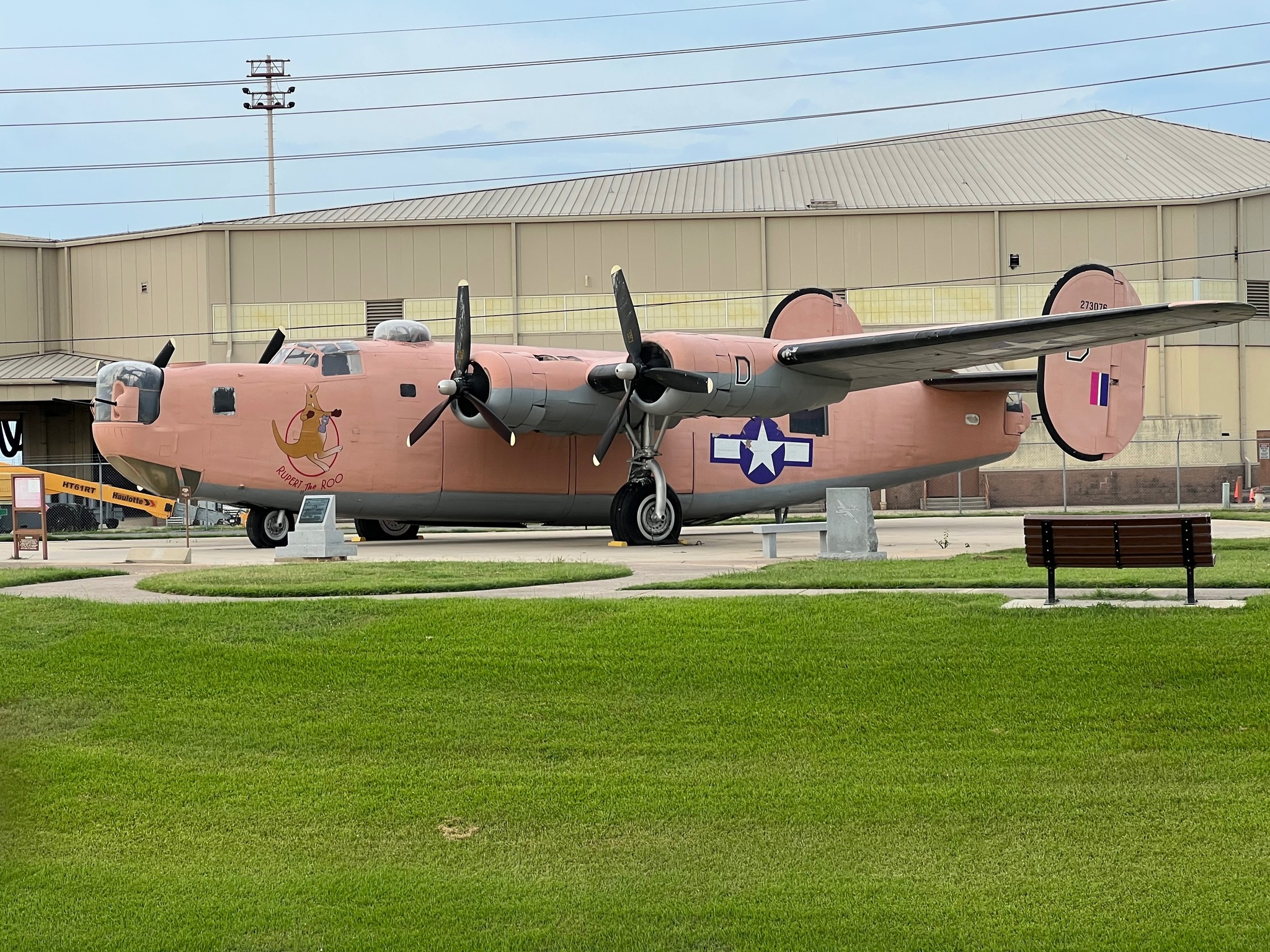
On the first day’s drive we stopped by Barksdale AFB near Bossier City, Louisiana, home of Air Force Global Strike Command.
Because the base is closed on weekends, we had to peek through the fence to see Boeing B-17G Miss Liberty (44-83884) and Consolidated B-24J Rupert the Roo II (44-48781).
One of four surviving Ford-built B-24s and the only one in the United States, Rupert is scheduled to be transferred to the National Museum of the Mighty Eighth Air Force in Savannah, Georgia.
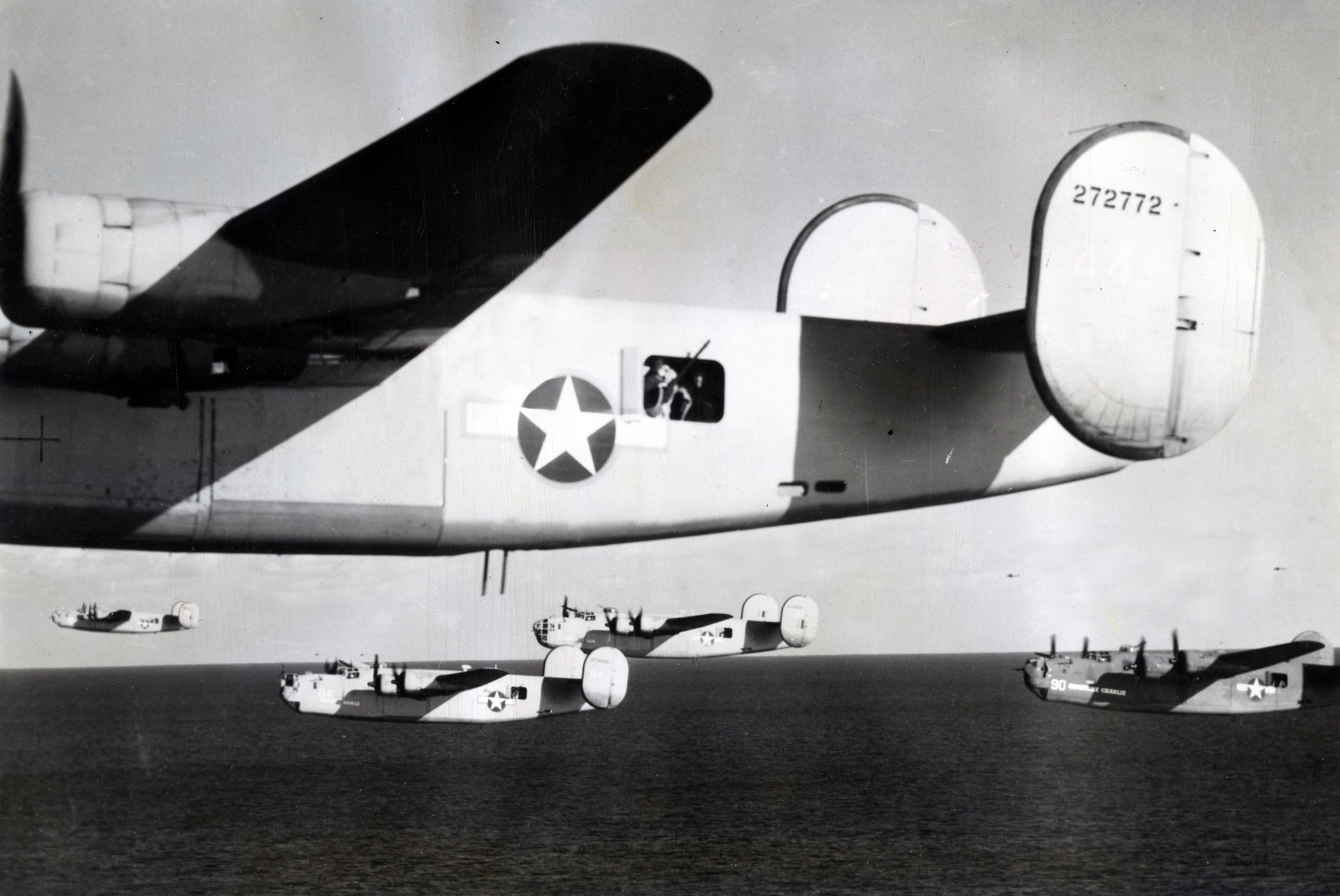
As strange as it is to see a nose-turreted B-24 with a desert pink paint scheme, this is not entirely without precedent.
This photo, taken 3 January 1944, shows the 376BG in flight over the Mediterranean, and two of the nose-turreted B-24s in the formation have desert paint schemes. Now, this photo was taken after the unit moved to Italy with the 15AF, and it is worth noting that said paint scheme could only have occurred in a tight window. Nose-turreted B-24s started rolling off the lines in August 1943. The British liberated the Foggia airfield complex in October, with 15AF B-24s flying their first mission out of Italy on 2 November. So, as unlikely as it was, it was possible and this photo proves that there were a few.
The B-24D closest to the camera, 42-72772, was lost on 23 May 1944 attempting to return from an interdiction strike on Frascati, Italy. The B-24J below, Harry the Horse (42-73090) was lost over Steyr, Austria on 23 February 1944. The camouflaged B-24J on the far right is Goodtime Charlie (42-73139), who survived the war.
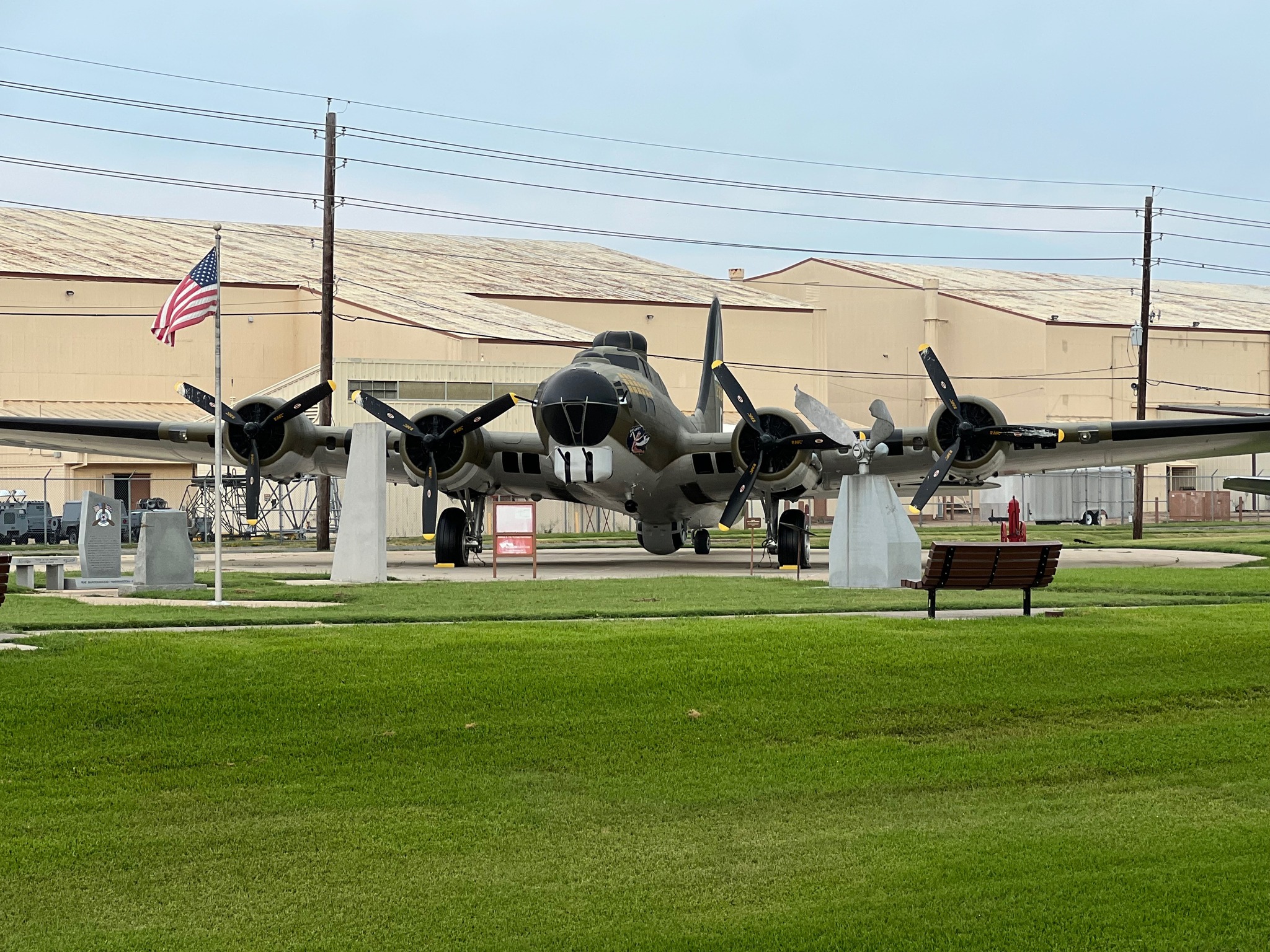
The Boeing B-17G on display at Barksdale, Miss Liberty (44-83884), is in actuality a former Navy PB-1W.
As such, she was a sister ship to Texas Raiders (44-83872) under Project CADILLAC II.
Photos taken 9 August 2025.
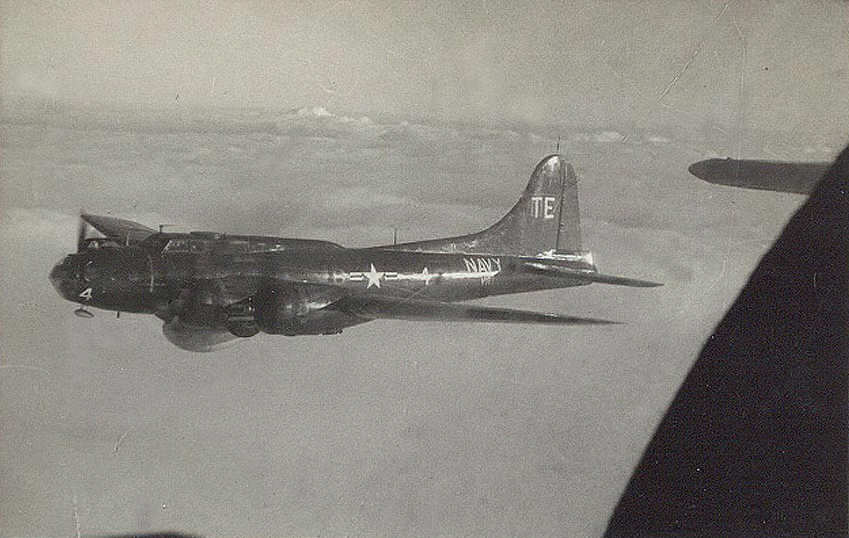
As discussed in our Oddballs article, CADILLAC II was a response to the need for better early-warning systems in the latter part of the Second World War. Equipped with the gigantic APS-20 radar and originally using converted TBM Avengers, the idea behind CADILLAC II was to make the entire Combat Information Center airborne. In doing so, Navy PB-1Ws were, in effect, the first AWACS (Airborne Warning And Control System).
In a perfect world, at least one surviving Navy PB-1W would be preserved in its original configuration.
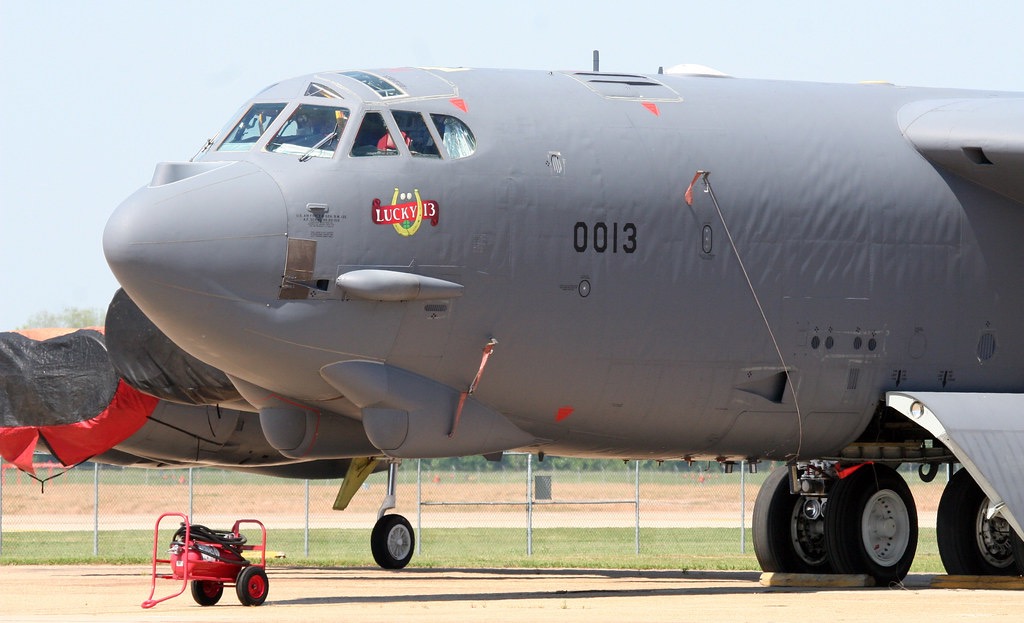
Boeing B-52H Lucky 13 (60-013) which is based at Barksdale AFB. Considering her namesake, it would be awesome to get a visit one day.
Maybe, when we are finished with Lucky Thirteen, we can park them beside one another…
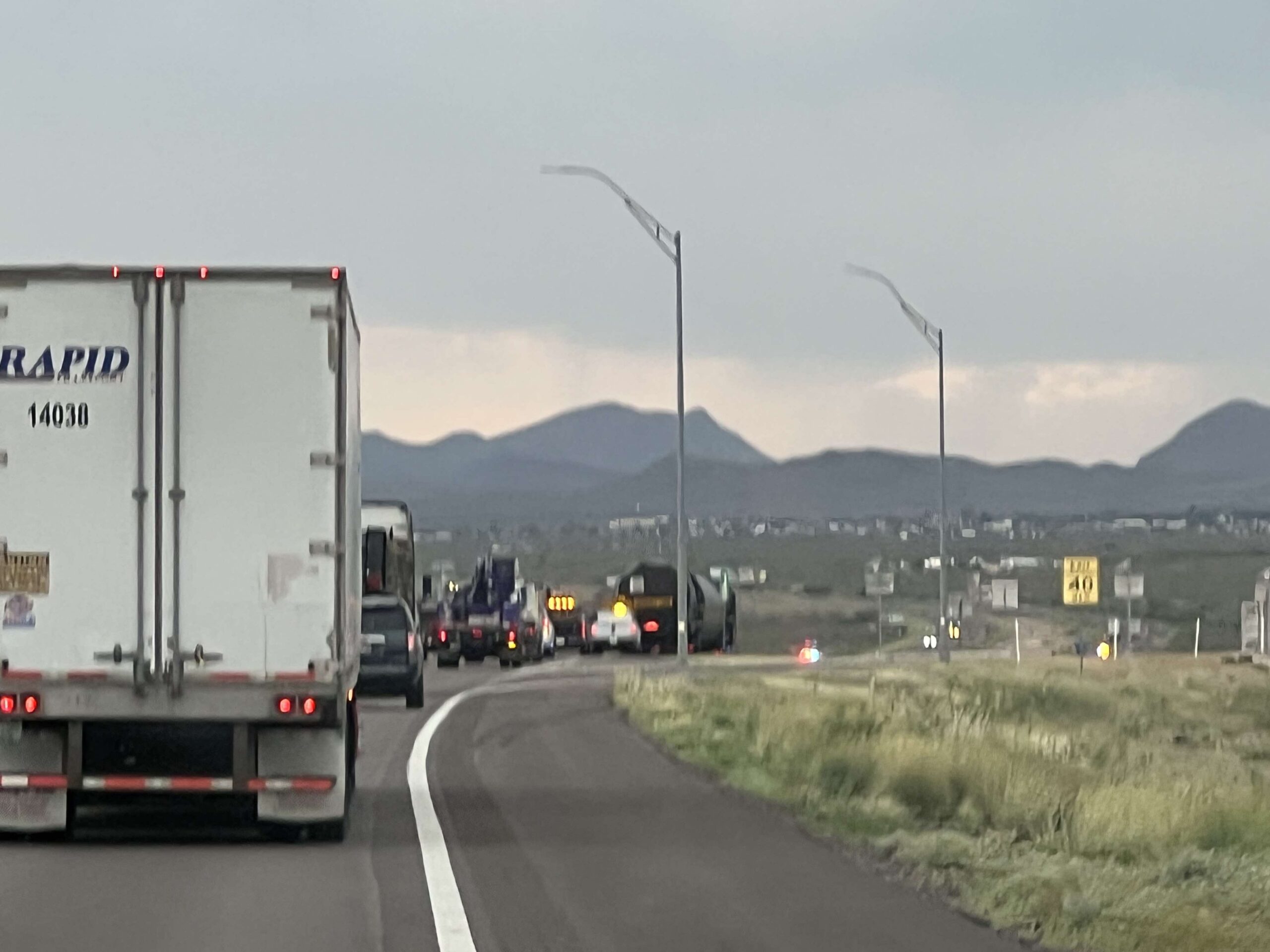
The entirely of the trip’s second day was spent driving across Texas. Similar to the previous day, we briefly stopped by Dyess AFB to try and see the Boeing B-17G on display there and, again, the area was closed. (But we did try again another day…)
Of more interest was the large black object which slowed traffic that evening.
It was the booster to a SpaceX rocket.
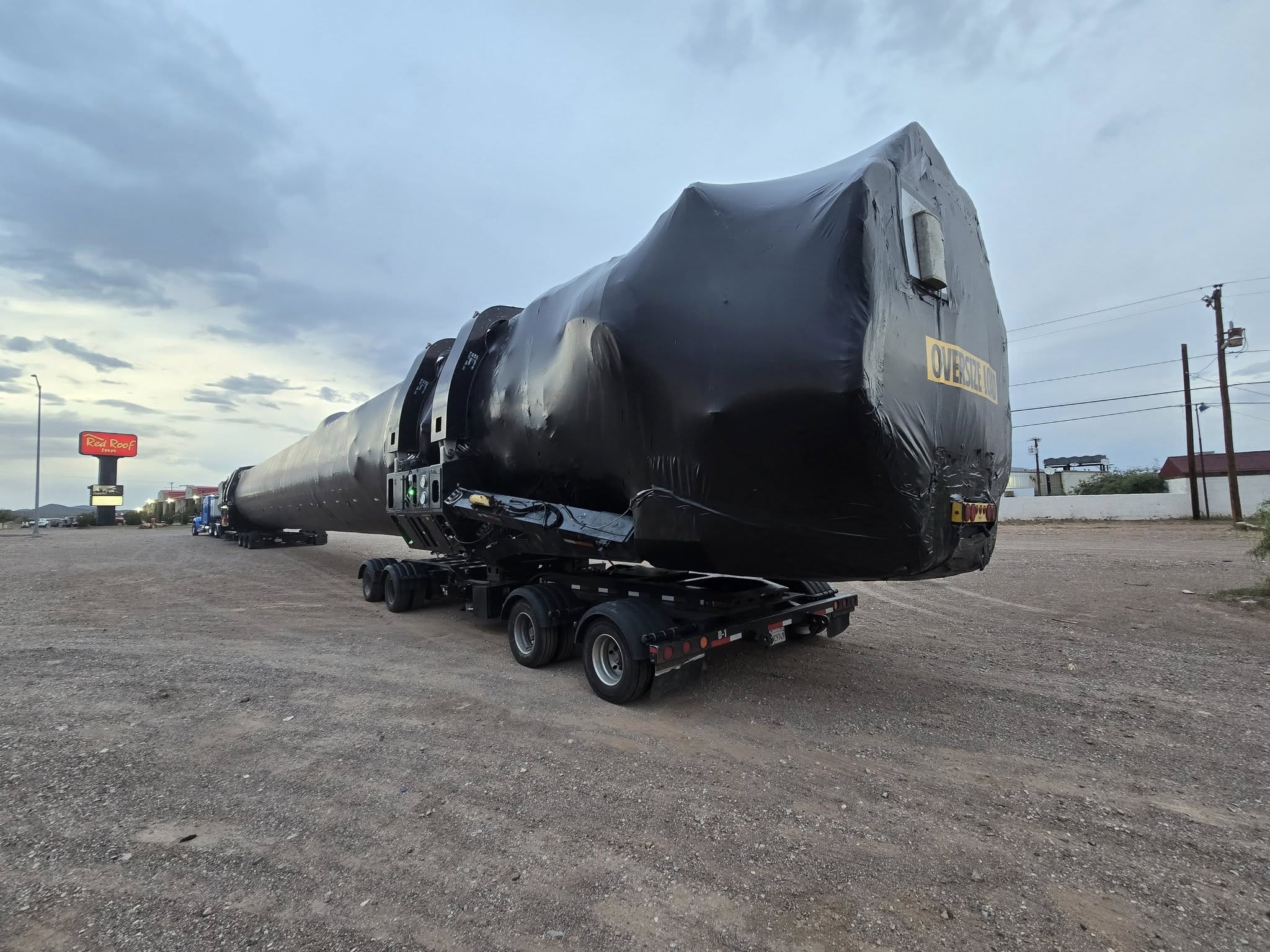
Turns out, they were having issues with one of the trailer’s tires. And it just so happened that they pulled over for the night directly across from our hotel.
So, we walked over to check it out.
The SpaceX guys were friendly but the police escort were not too amused by my opening question: “So, um, you guys like old airplanes?”
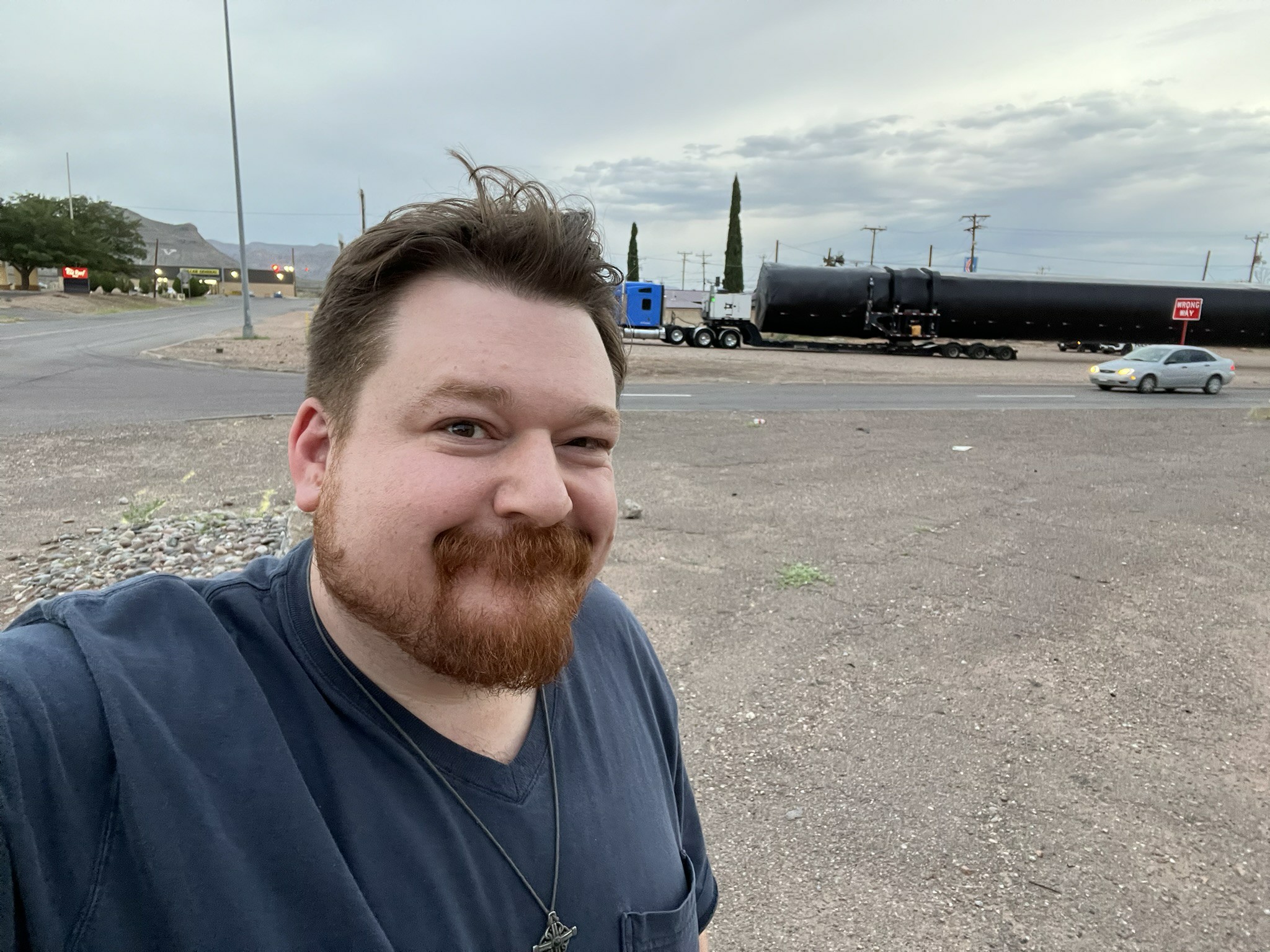
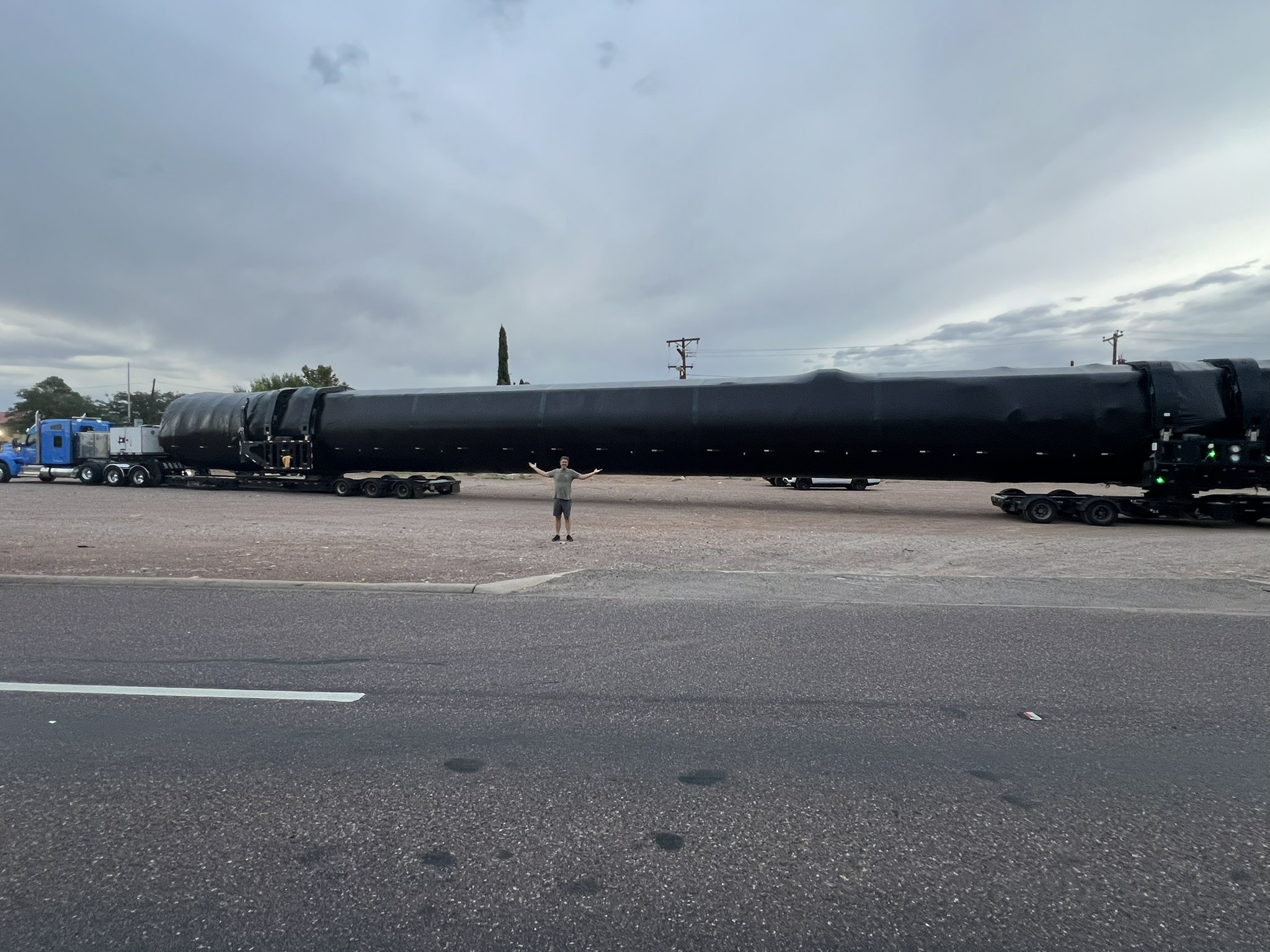
Naturally, Eric and I had to get our pictures taken with the rocket.
Photos taken 10 August 2025.
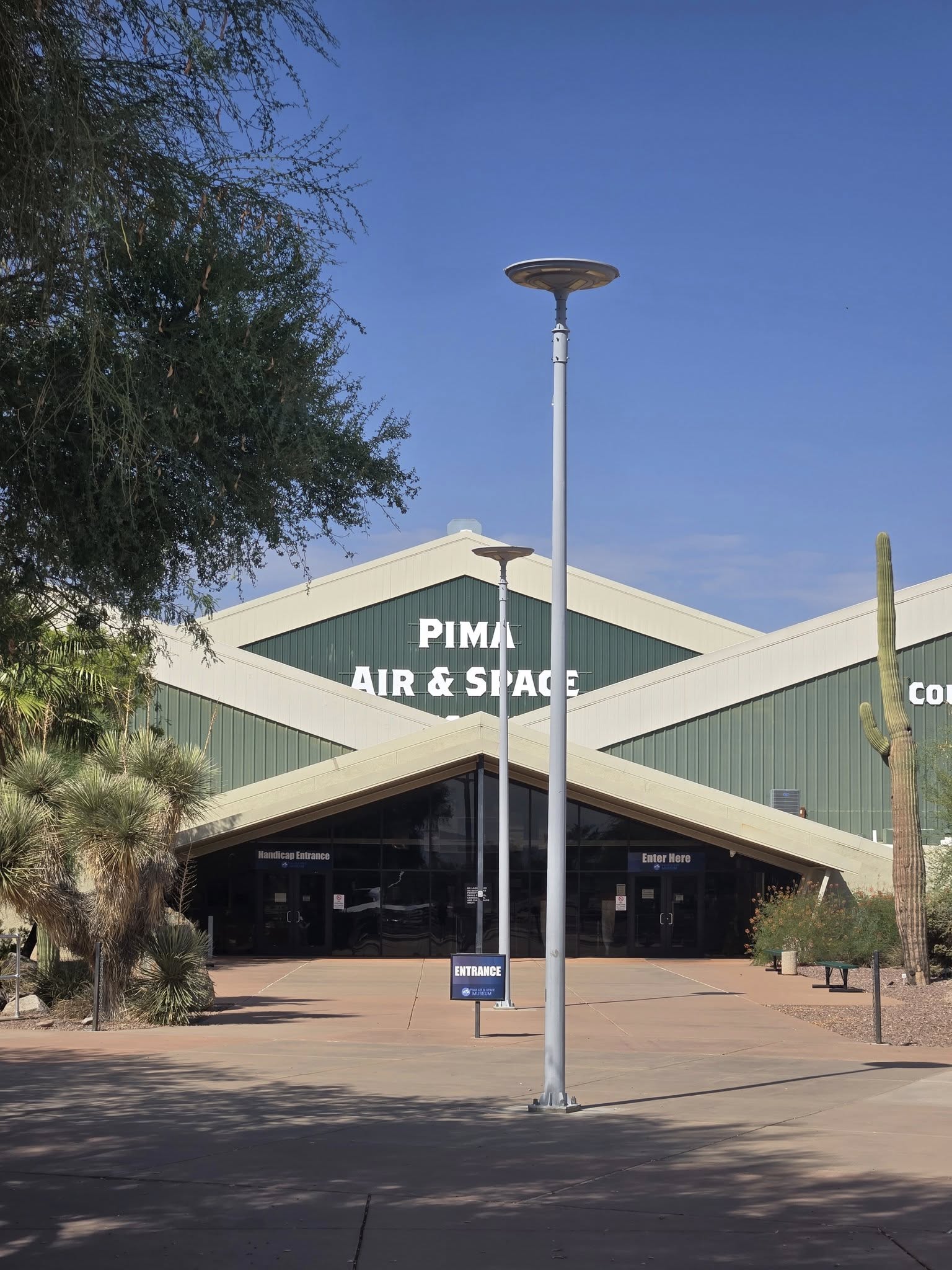
The next day saw us visit the Pima Air & Space Museum in Tucson, Arizona.
One of the largest air museums in the world, the desert helps preserve large aircraft that might have rapidly deteriorated in other environments.
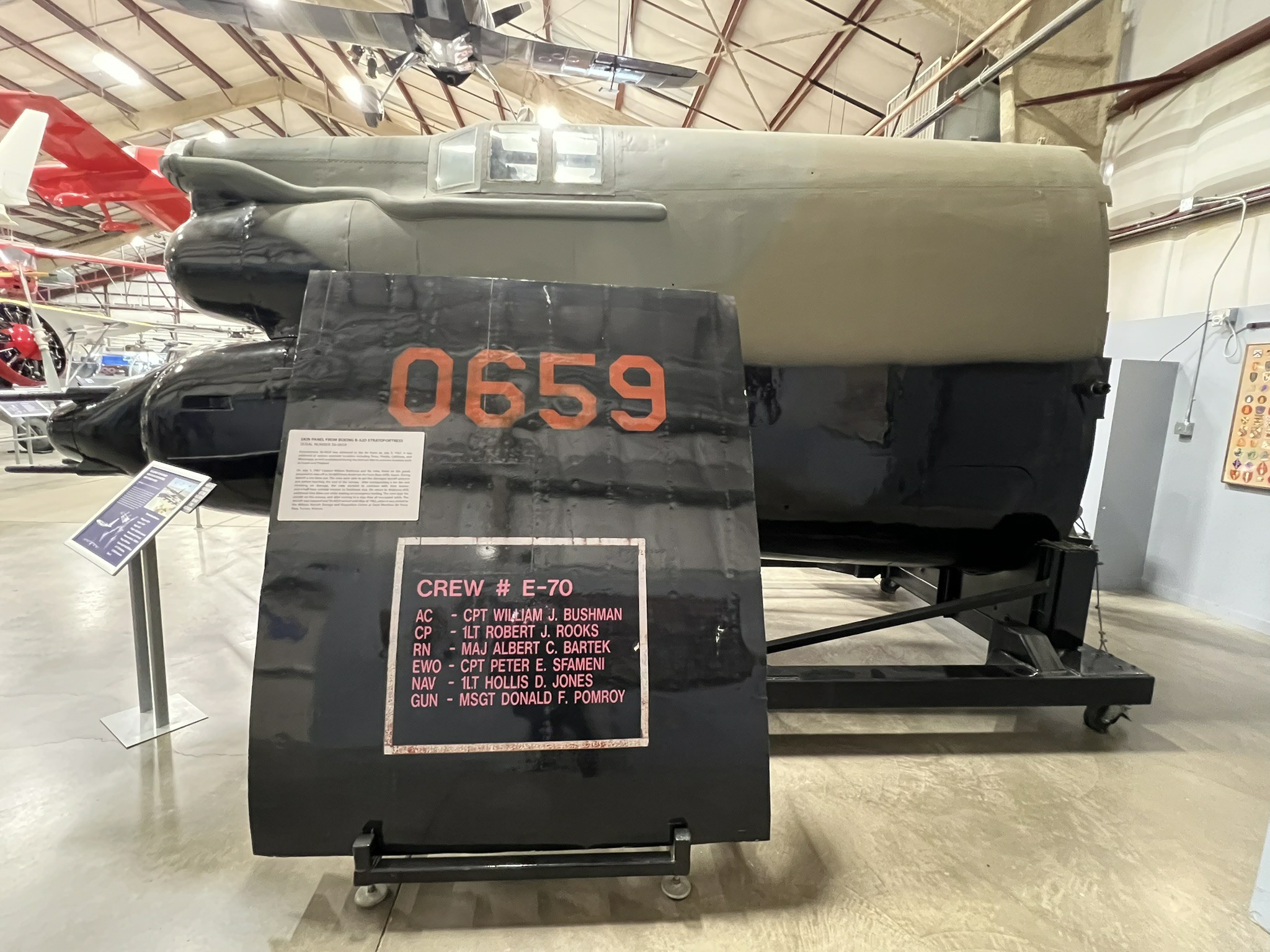
The tail turret to Boeing B-52D 56-0659. Formerly displayed at the nearby Davis-Mothan AFB air park, 56-0659 was scrapped in 2011.
The B-52D holds the distinction of being the last heavy bomber whose gunners shot down enemy fighters.
During the week-long Operation LINEBACKER II – the sole strategic bombing of North Vietnam by US heavy bombers throughout the entire war – SSgt Samuel O. Turner, aboard B-52D “Brown 3” (56-0676, 307BW) and A1C Albert E. Moore, aboard B-52D “Ruby 3” (55-0083, 307BW), managed to each down a MiG-21 Fishbed on the nights of 18 December and 24 December 1972, respectively. At altitude, the MiGs were no more maneuverable than the bombers, and with the vast array of electronic countermeasures in the air, VPAF interceptors were forced to rely on traditional pursuit curves. Unfortunately for the MiGs, they were in range of the B-52’s guns long before they could return fire.
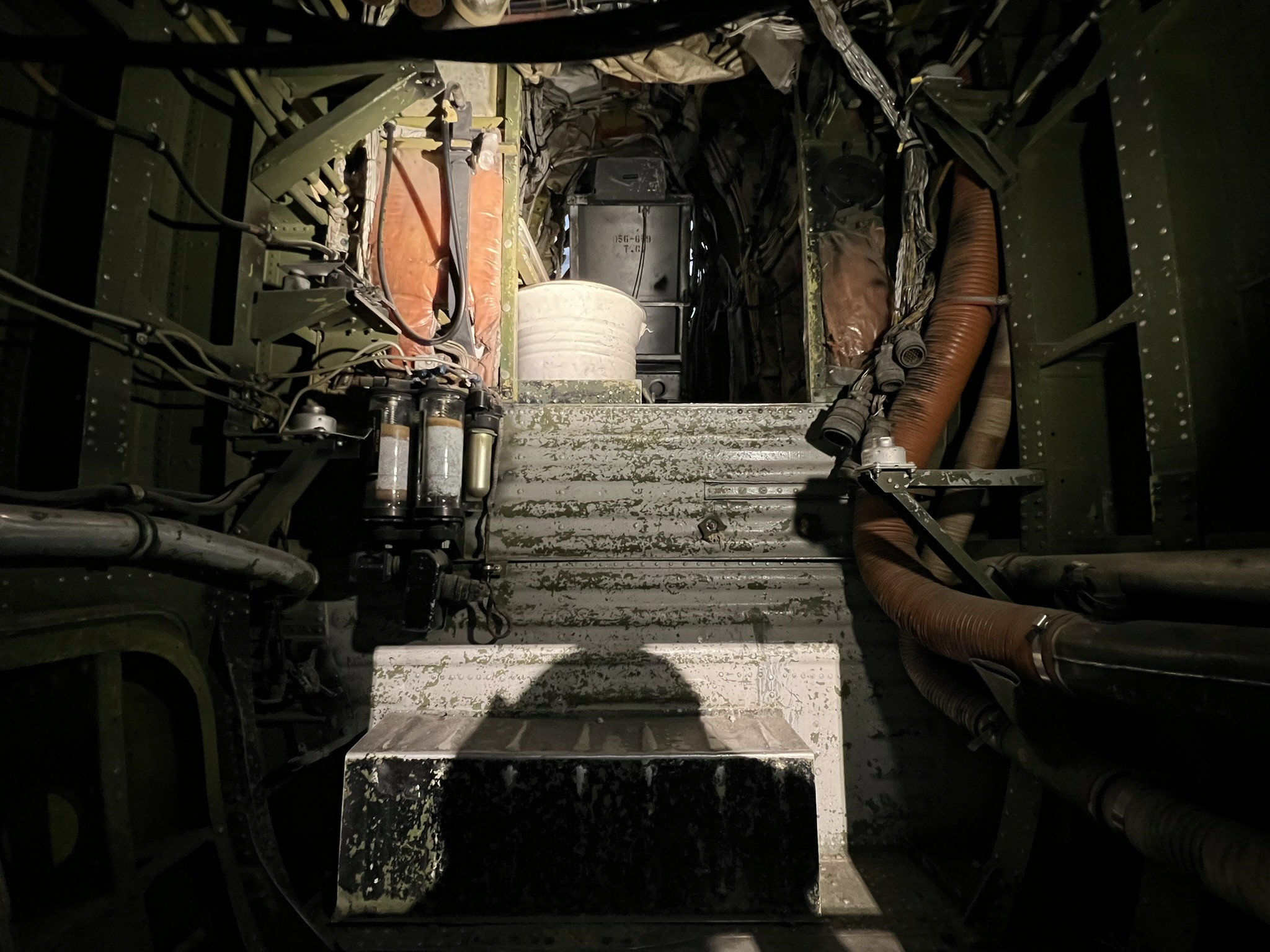
Looking inside the tail turret to Boeing B-52D 56-0659. Does that chemical toilet look familiar? It is amazing how little things changed.
The B-52G saw the gunner moved to the nose compartment, firing his guns remotely. More importantly, this gave the gunner an ejection seat, something the B-52D lacked.
The B-52H replaced the four .50 caliber MGs with a single 20mm M61 Vulcan rotary cannon. After a friendly-fire incident during the Gulf War, the B-52H’s tail gun was officially removed from service on 16 September 1991.
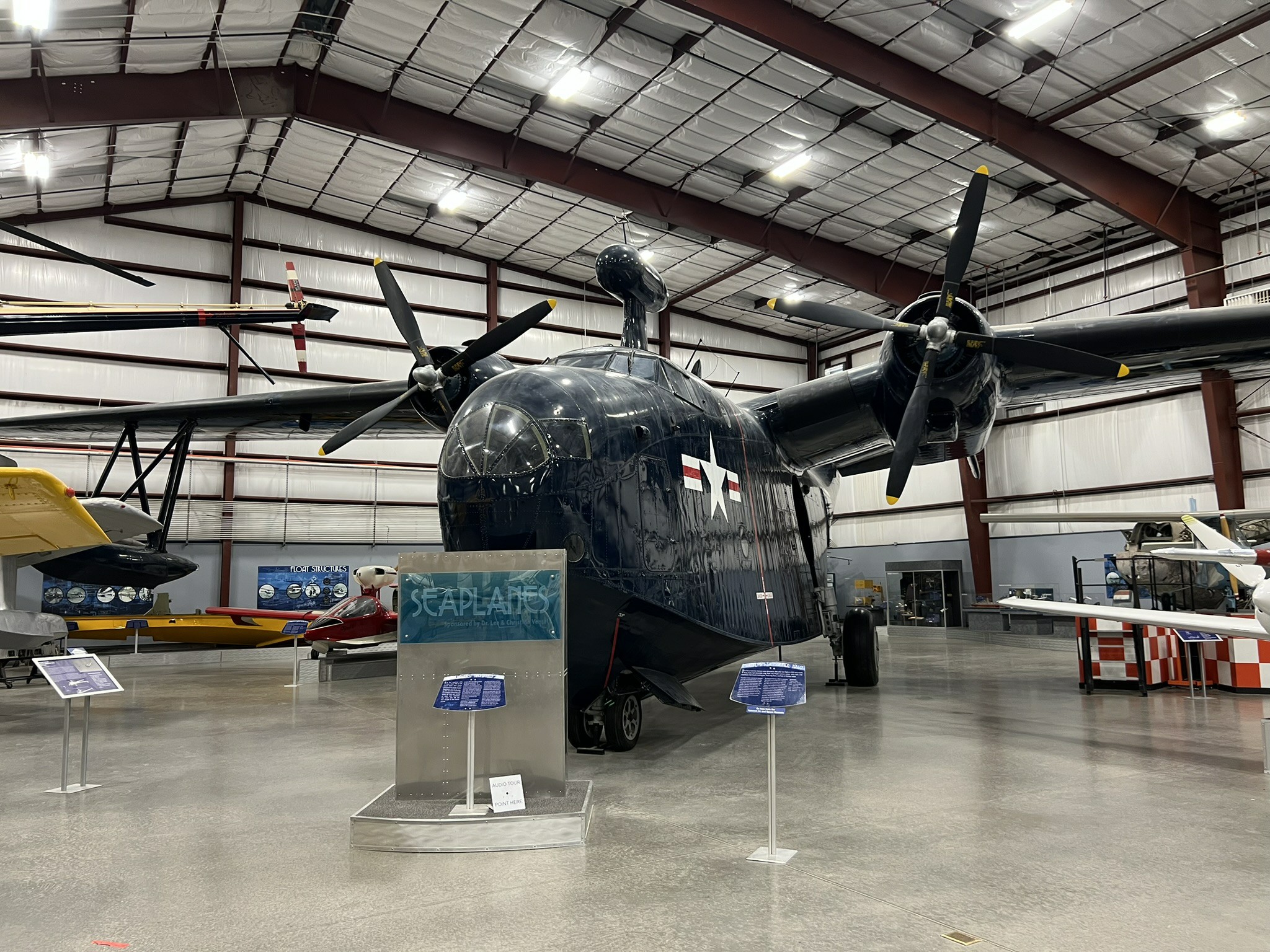
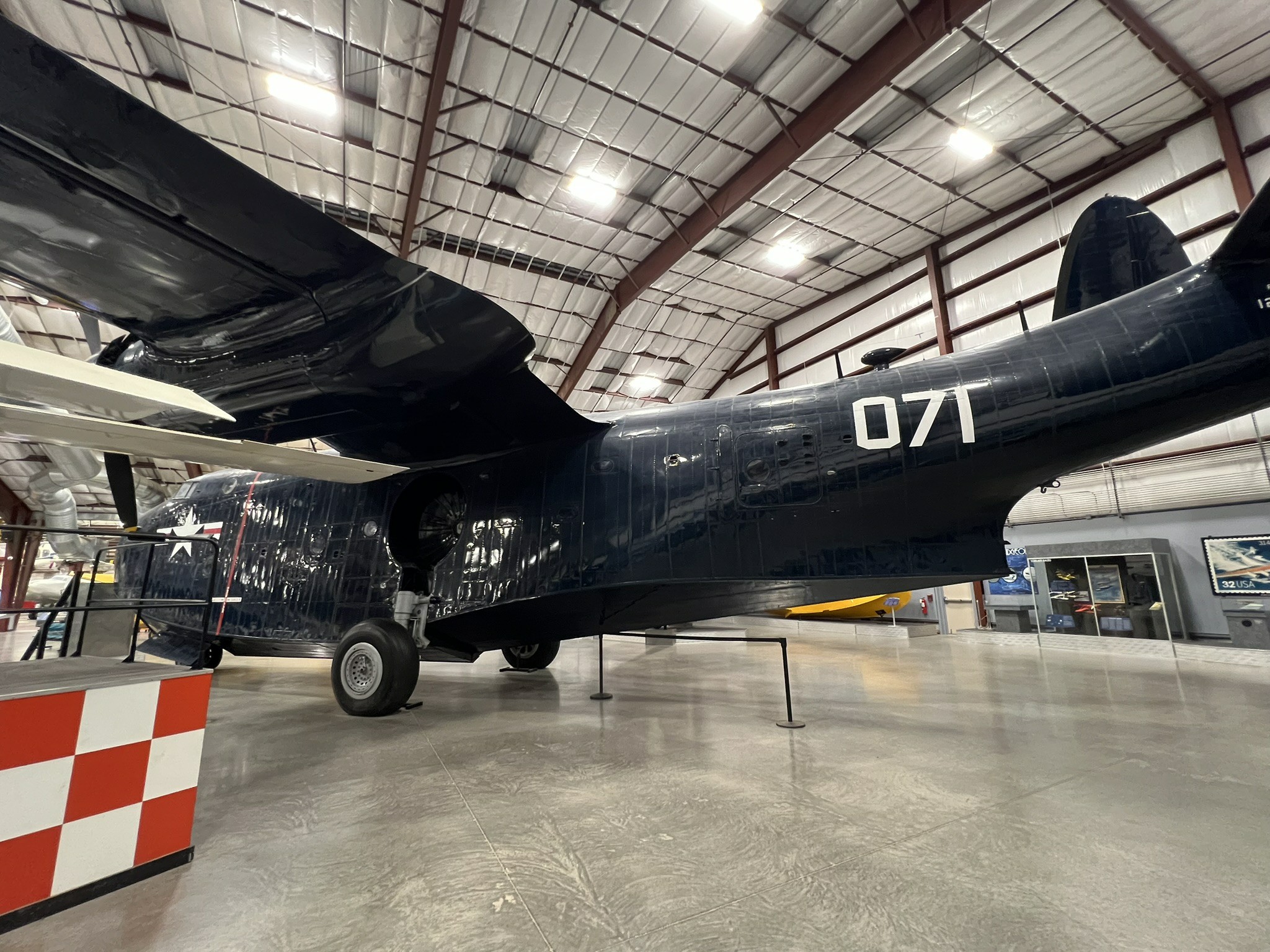
An aircraft I badly wanted to see: the PBM Mariner. On loan from the Smithsonian, this is the sole surviving example of its type.
Designed to supplement and eventually replaced the PBY Catalina, the Mariner’s role in the Second World War is today largely forgotten. Which is unfortunate, as the Mariner was the dominant flying boat in the Pacific Theater at the end of the war. In fact, it was a pair of Mariners – BuNos 59031 and 59046 of the USS Chandeleur (AV-10) – which located and trailed the battleship Yamato for its destruction off the coast of Okinawa on 7 April 1945.
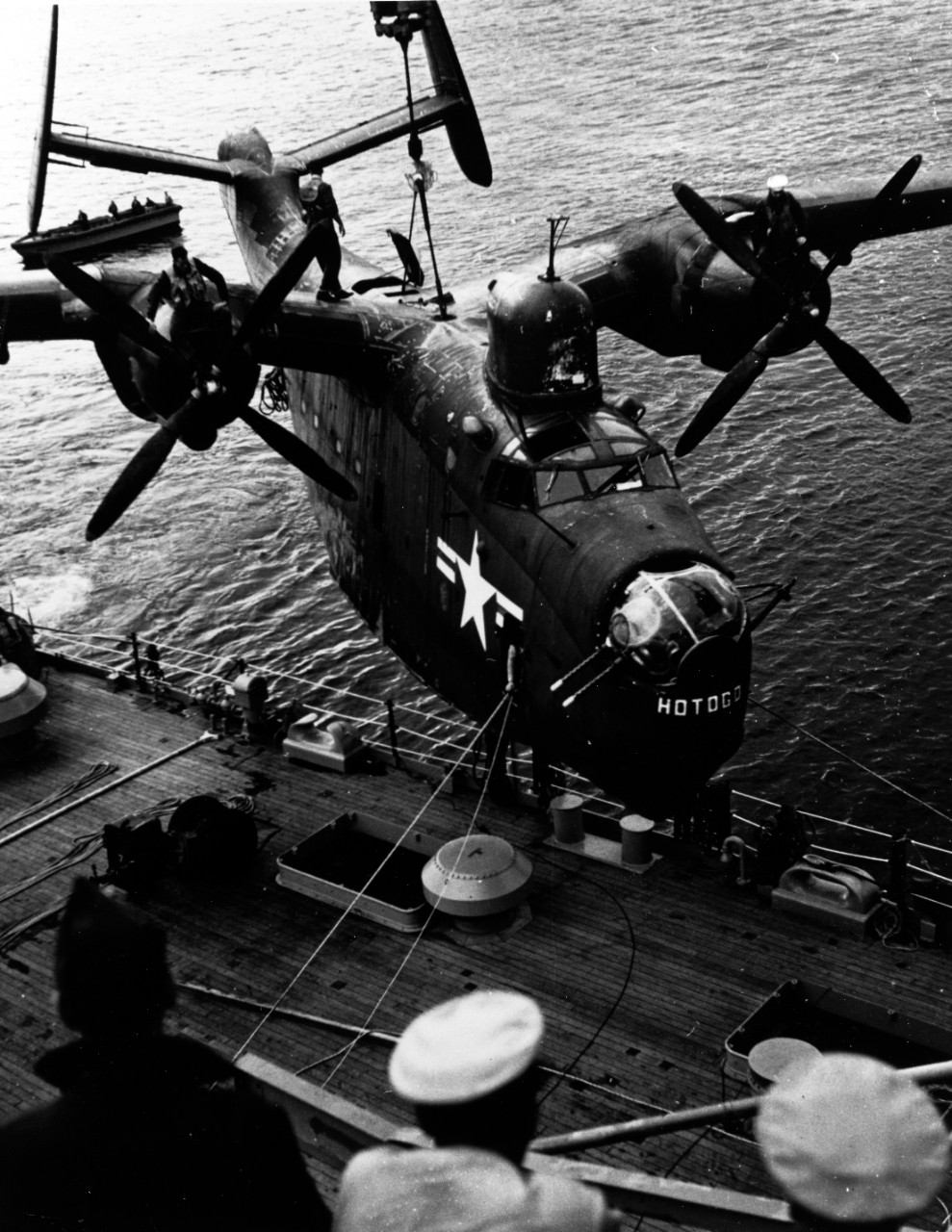
A Mariner is hoisted aboard the tender USS Custiss (AV-4) during the Korean War. Typically, the Mariner is only remembered for its connection to the Bermuda Triangle, as BuNo 59225 exploded from a fuel leak while attempting to locate the missing TBM Avengers of Flight 19 on 5 December 1945.
The Mariner was phased out in the early-1950s and ultimately replaced by the P5M Marlin. The Marlin remained in service until 1967, being the last flying boat operated by the US Navy. The sole surviving Marlin can be seen at the National Naval Aviation Museum in Pensacola, Florida.
The preservation of the Mariner and Marlin are both largely thanks to the Mariner/Marlin Association, whose efforts are to be commended.
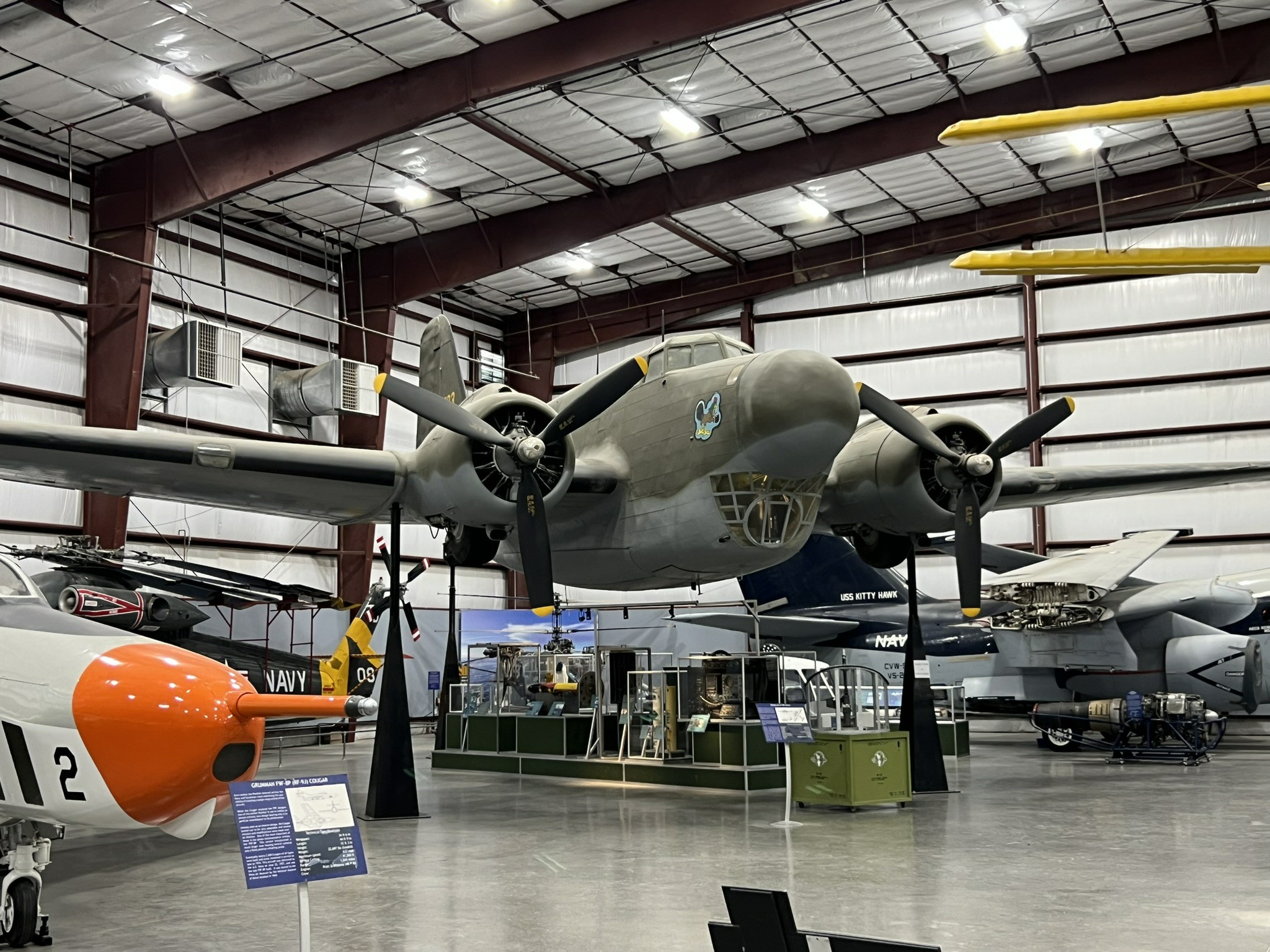
A Douglas B-18 Bolo, with a Lockheed S-3 Viking displayed nearby on the right.
The B-18 was the aircraft which the Boeing B-17 was passed in favor of in 1935. Based on the Douglas DC-2 airliner, the medium bomber was thought more appropriate (and cheaper) for coastal patrol. The example shown here, one of five still in existence, still retains its Magnetic Anomaly Detector (MAD) equipment for submarine hunting – which is why the Viking is displayed nearby. The Viking was specifically designed for anti-submarine patrols, being introduced in 1974.
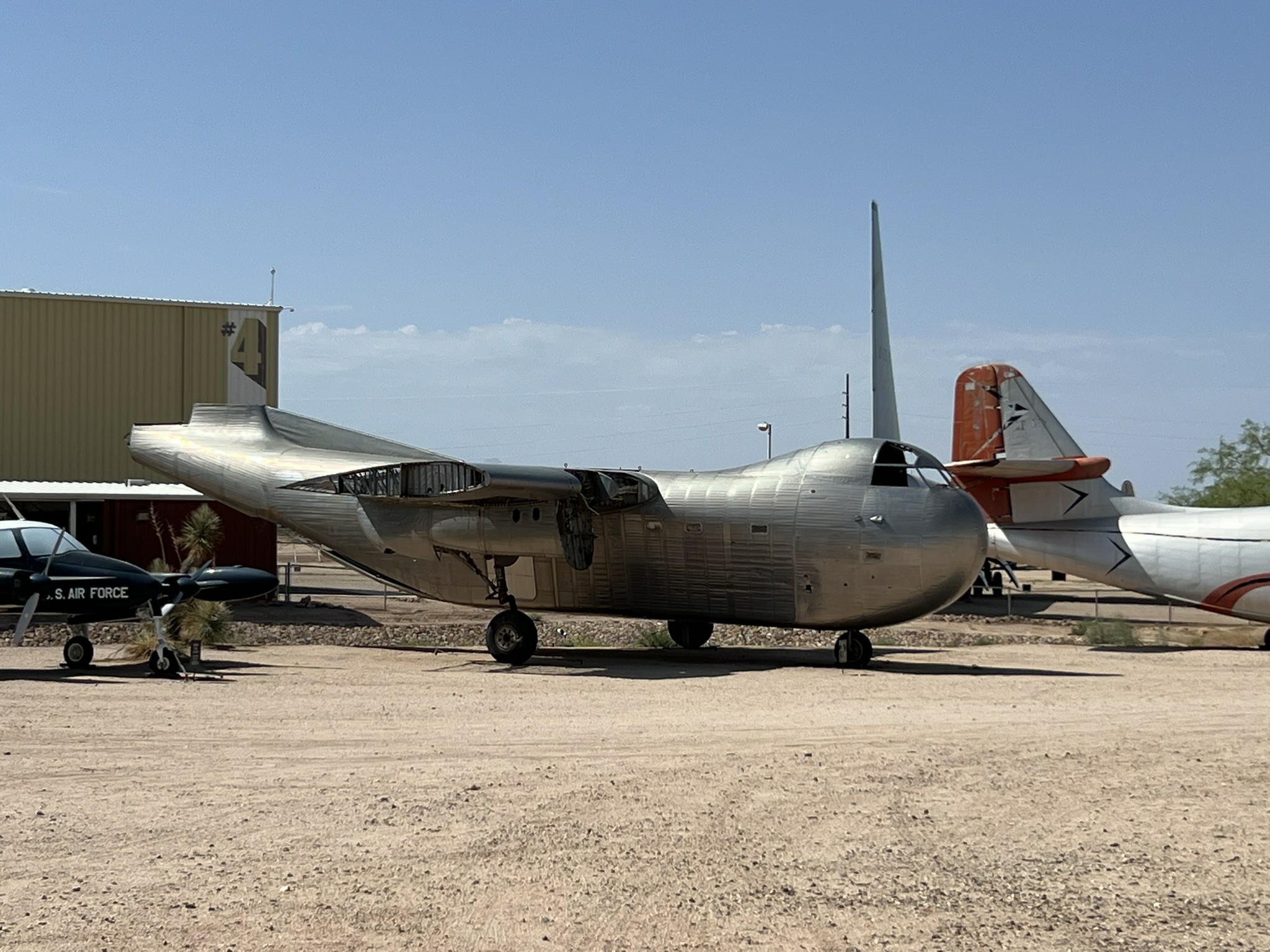
Another sole-surviving example: The Budd RB-1 Conestoga.
The aircraft is almost entirely made of stainless steel. Designed by the Budd Company using their original shotweld process, it was hoped during the Second World War that a transport could be produced with as little strategically important aluminum as possible. Twenty were built and they reportedly handled terribly. However, the aircraft nevertheless pioneered many traits later made standard, featuring one of the first loading-ramp style fuselages, for example.
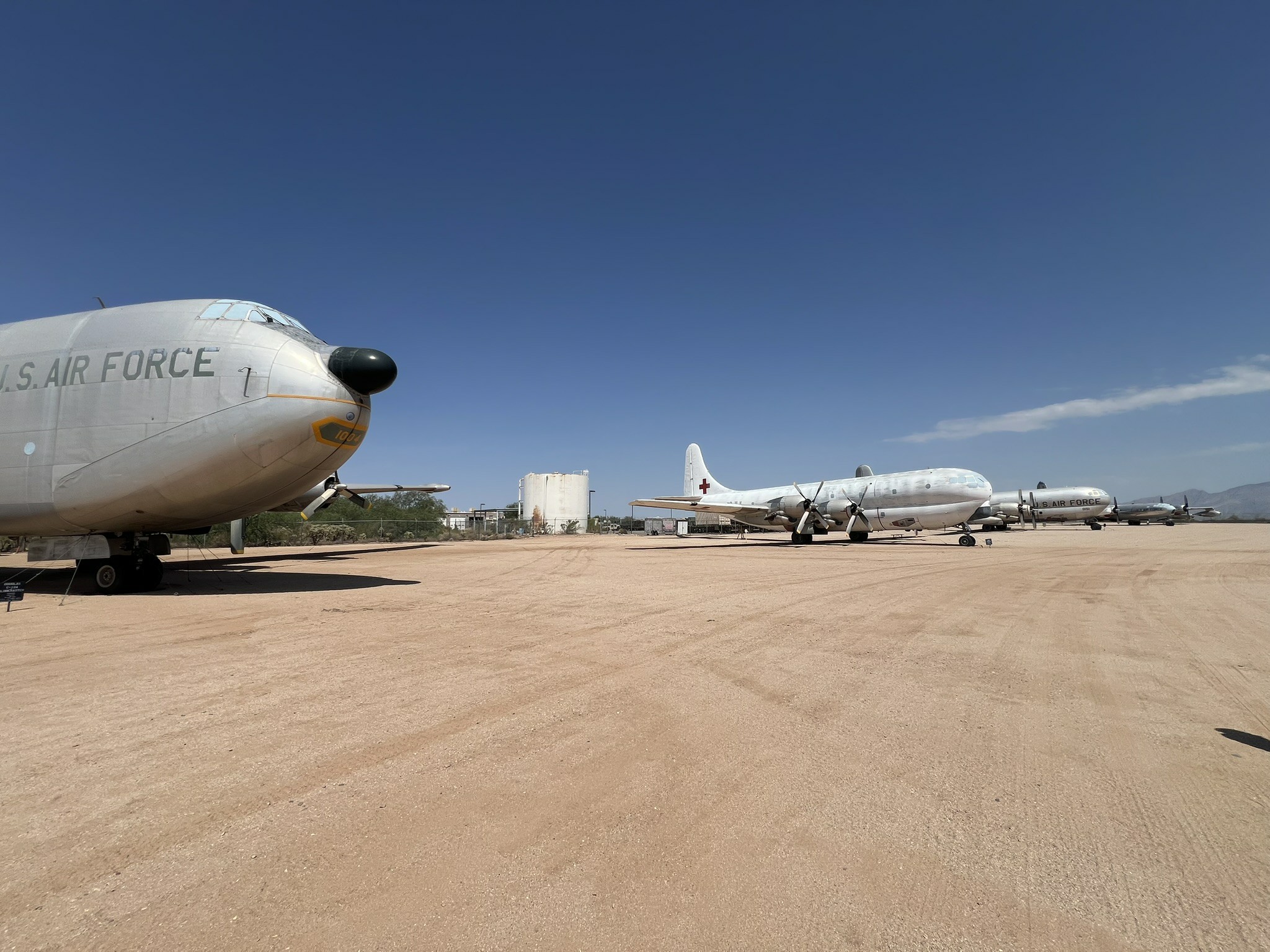
This picture is more for me than our supporters.
It is three of favorite aircraft in a neat little row: a Douglas C-124, two Boeing C-97s, and a Boeing B-50.
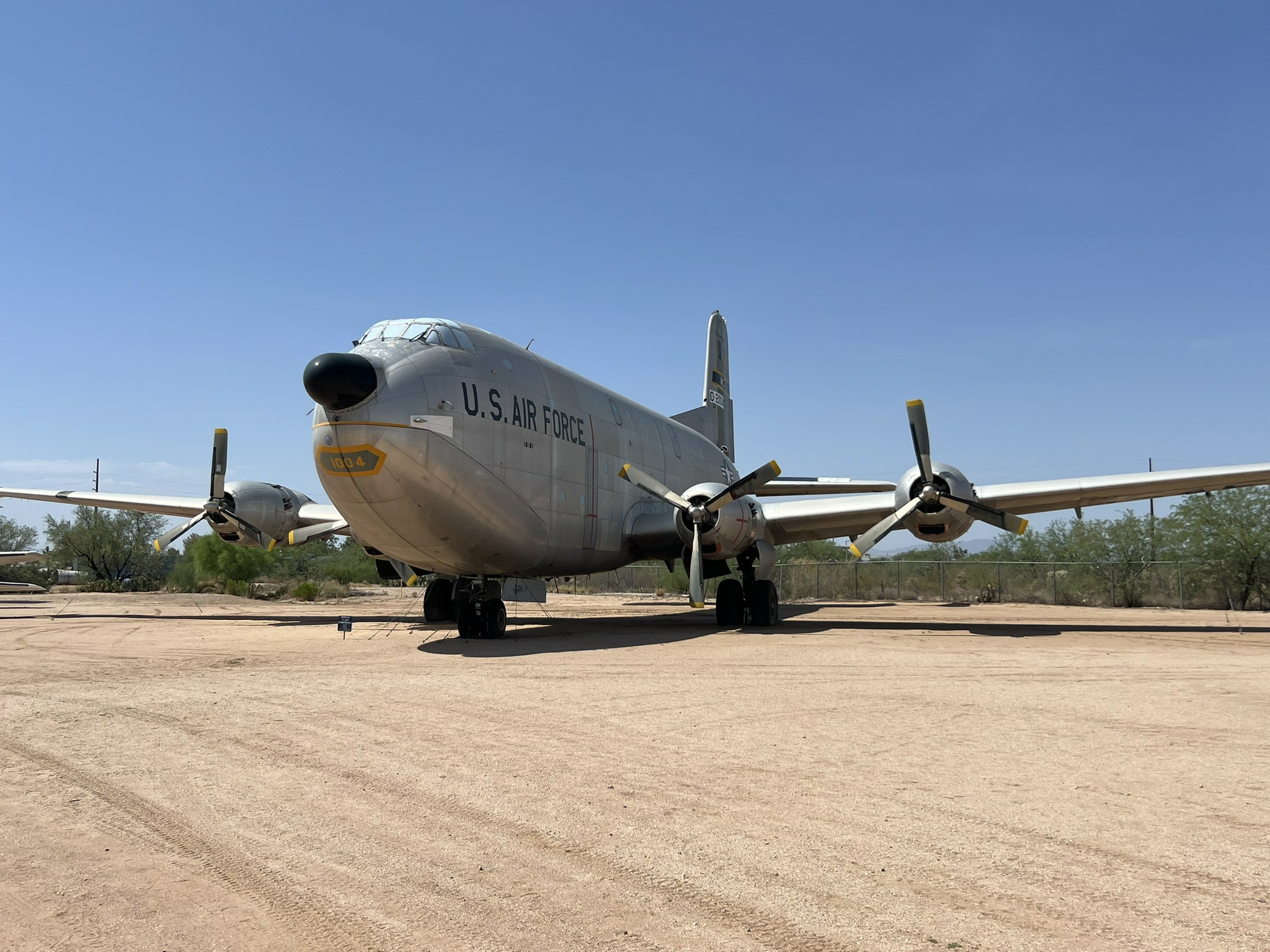
The Douglas C-124 Globemaster II was designed in response to the Berlin Airlift, applying lessons learned from the event. A massive, double-decker design, the Globemaster II is best remembered for its nose mounted clamshell doors.
“Old Shaky” entered service in 1950 and remained in use until 1974. The last flight of a C-124 occurred on 9 October 1986 (three days before I was born), delivering the old cargo plane to McChord Air Museum, Washington.
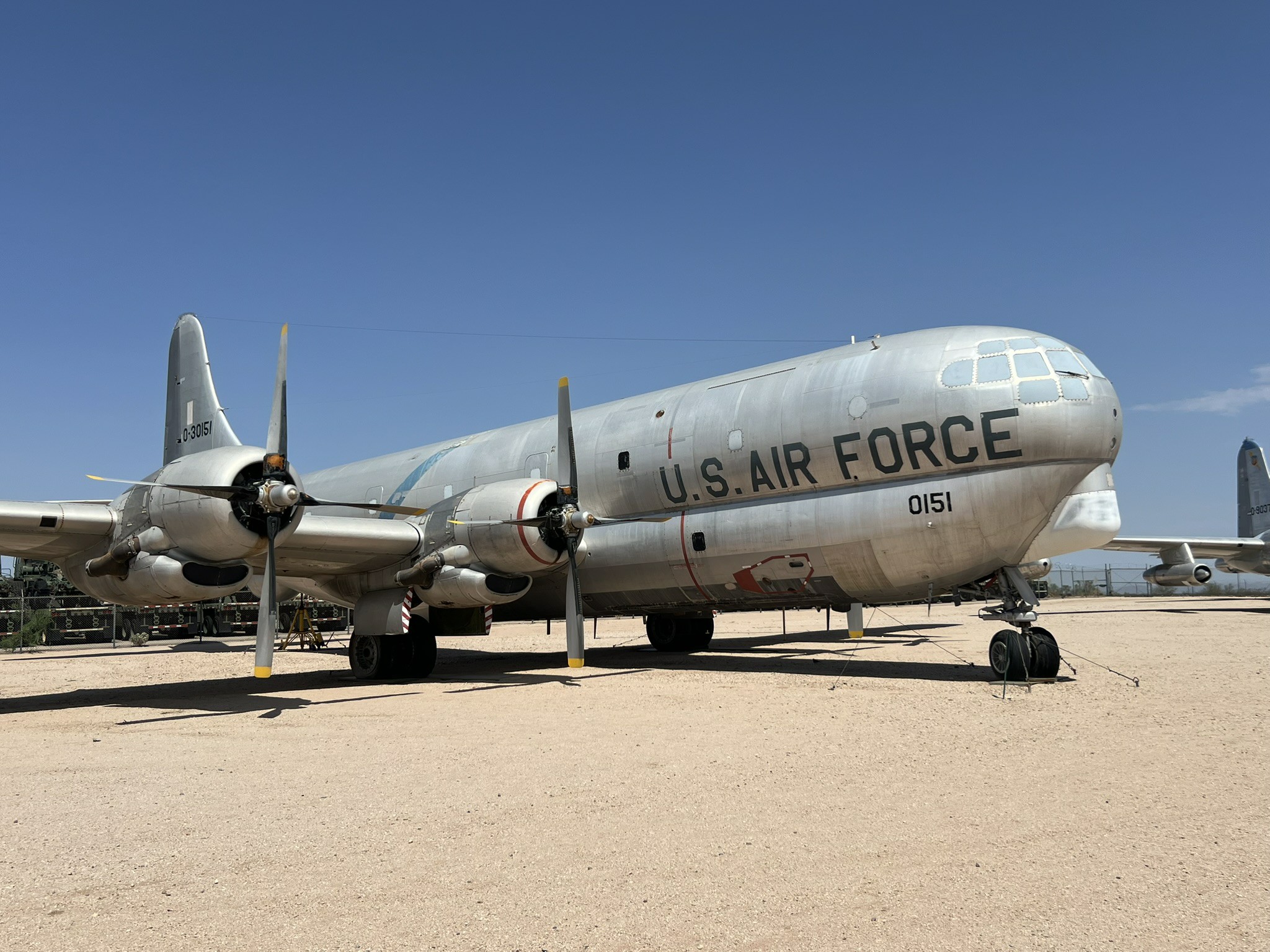
Longtime followers might recall the C-97 from our visit to the Berlin Airlift Historical Foundation‘s Angel of Deliverance.
The museum at Pima has a pair of C-97s parked beside one another. One is the aircraft in its cargo configuration and the other in its tanker configuration (the latter is shown here).
Most surviving C-97s are Stratotankers, as Boeing found great success with its “flying boom” design. Conversely, only four Stratofreighters still remain today. No Stratocruisers (the civilian variant) remain in existence.
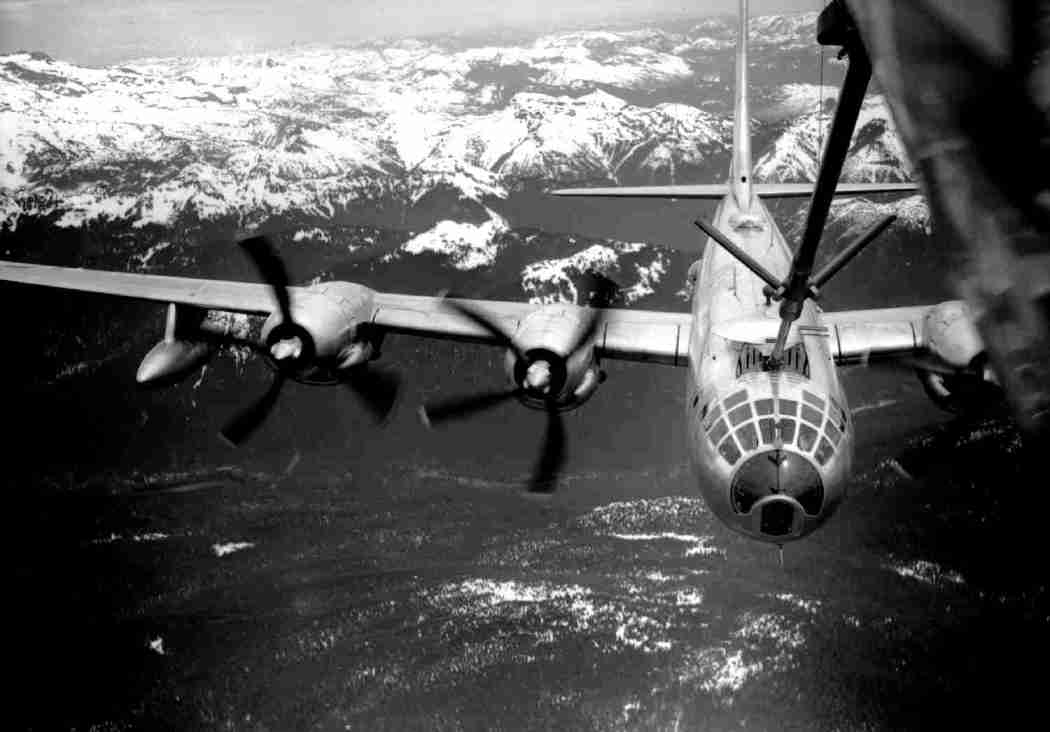
A Boeing B-50 Stratofortress II being refueled by a KC-97 Stratotanker.
The “flying boom” was designed by Boeing to supplement the older “probe and drogue,” which was difficult for large aircraft to use.
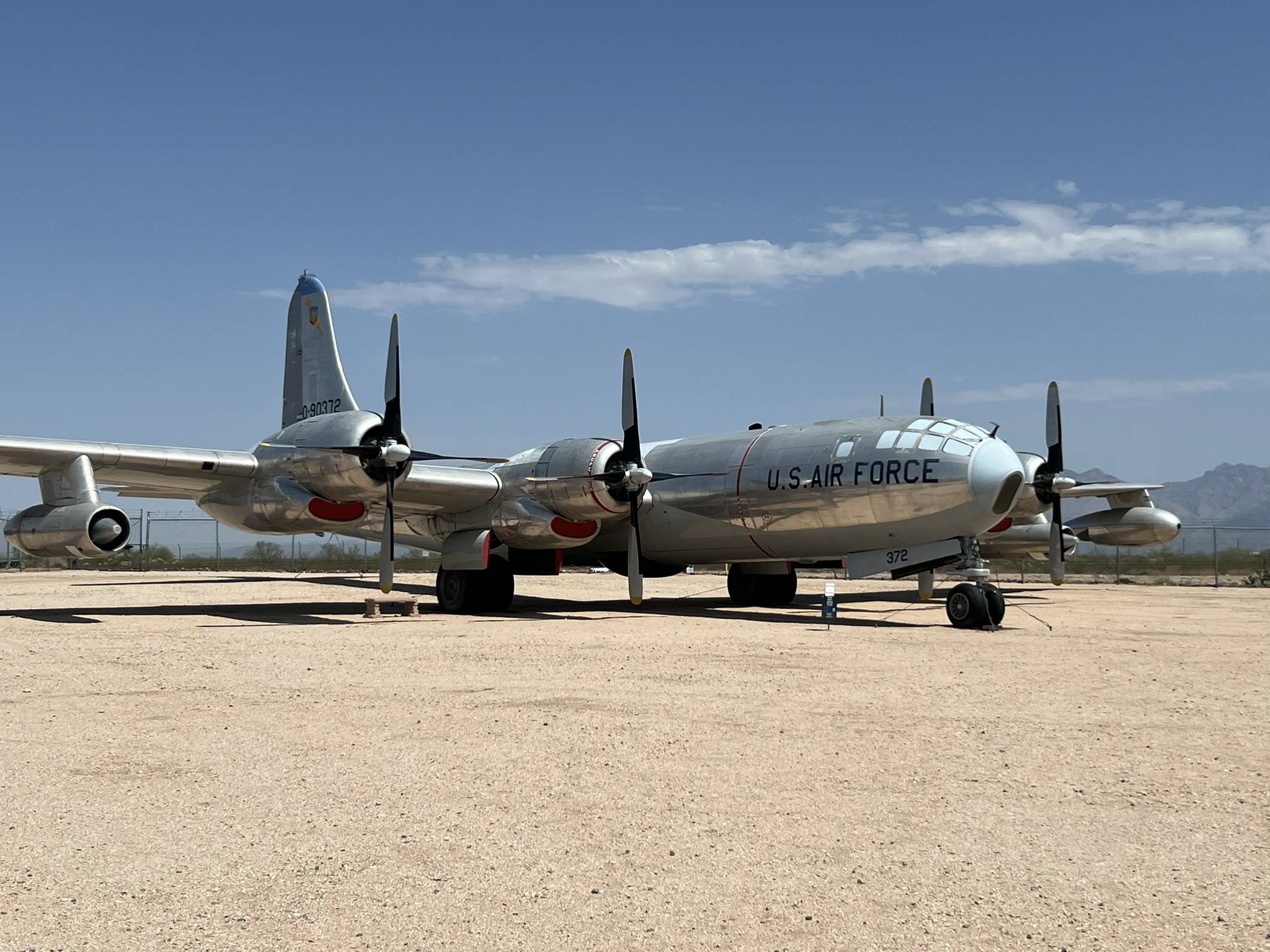
The museum’s Boeing B-50 Stratofortress II is, in actuality, a converted tanker.
The B-50 was little more than a redesignation of the B-29D variant. And like the B-17 beforeit, the B-29/B-50 saw extensive use by the military outside its traditional bombardment role. As such, our nation’s first dedicated tanker aircraft were KB-29/KB-50s.
One of five surviving B-50s, this is one of two KB-50 tankers still in existence (no B-29 tankers remain) and, of the two, the only one fully intact.
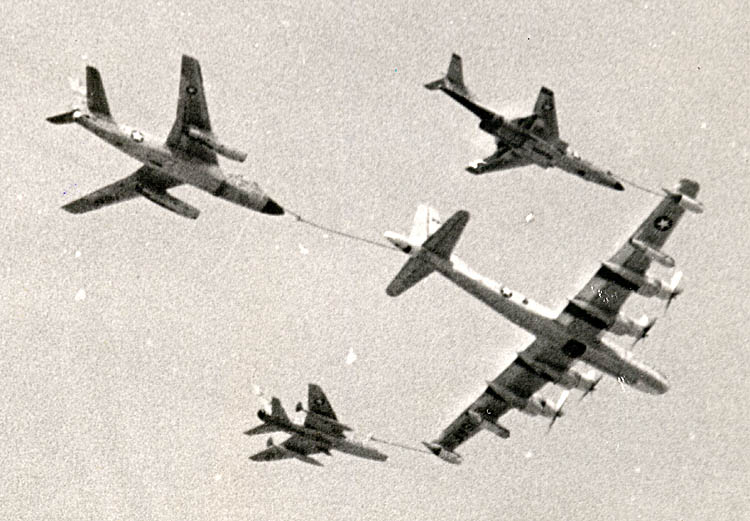
A KB-50 refuels an McDonnell F-101, Douglas B-66, and a North American F-100 during a 1963 demonstration over RAF Waterbeach.
Note how all three aircraft are being refueled using the probe and drogue system.
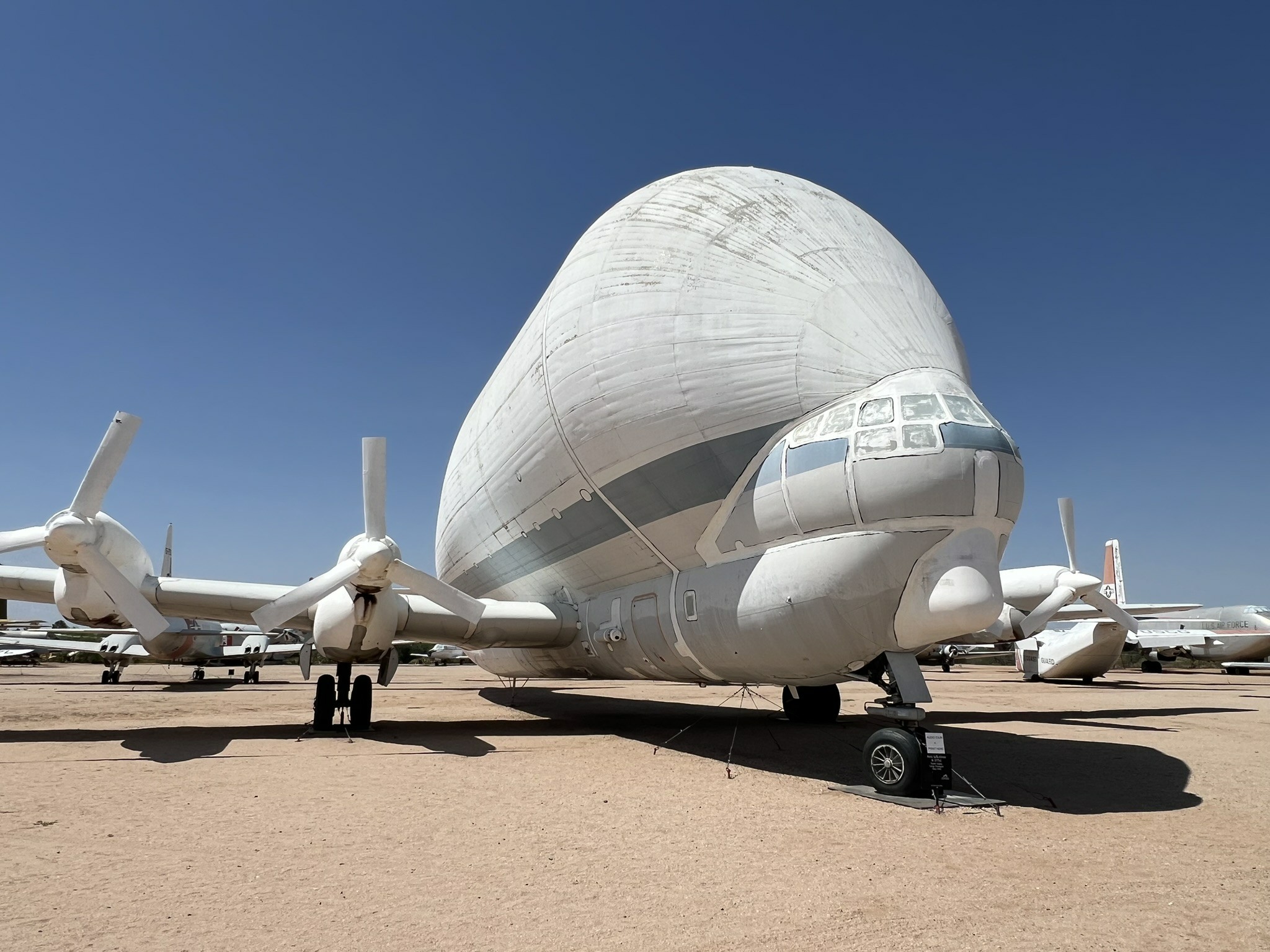
Who would have guessed, another Boeing C-97?
This example is one of five that were converted into “Super Guppys” for hauling NASA space equipment.
One Super Guppy remains in active service.
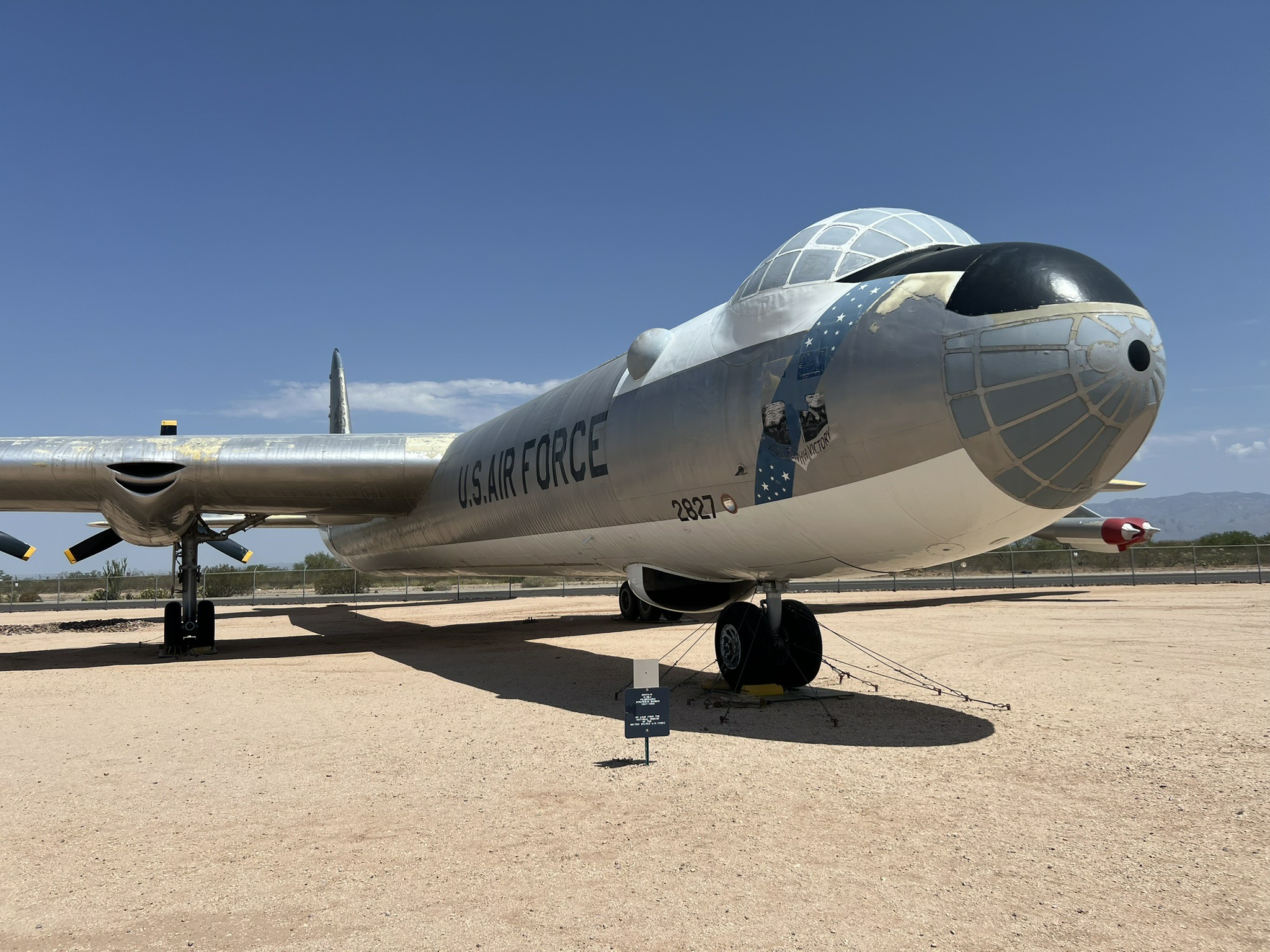
The biggest of the big, the Convair B-36 Peacemaker.
This example, City of Fort Worth (52-2827), was the final B-36 built and, for a time, was displayed in the city of her birth. Plans to keep her there fell through and the B-36 was moved to Pima in 2009.
She is one of four in existence.
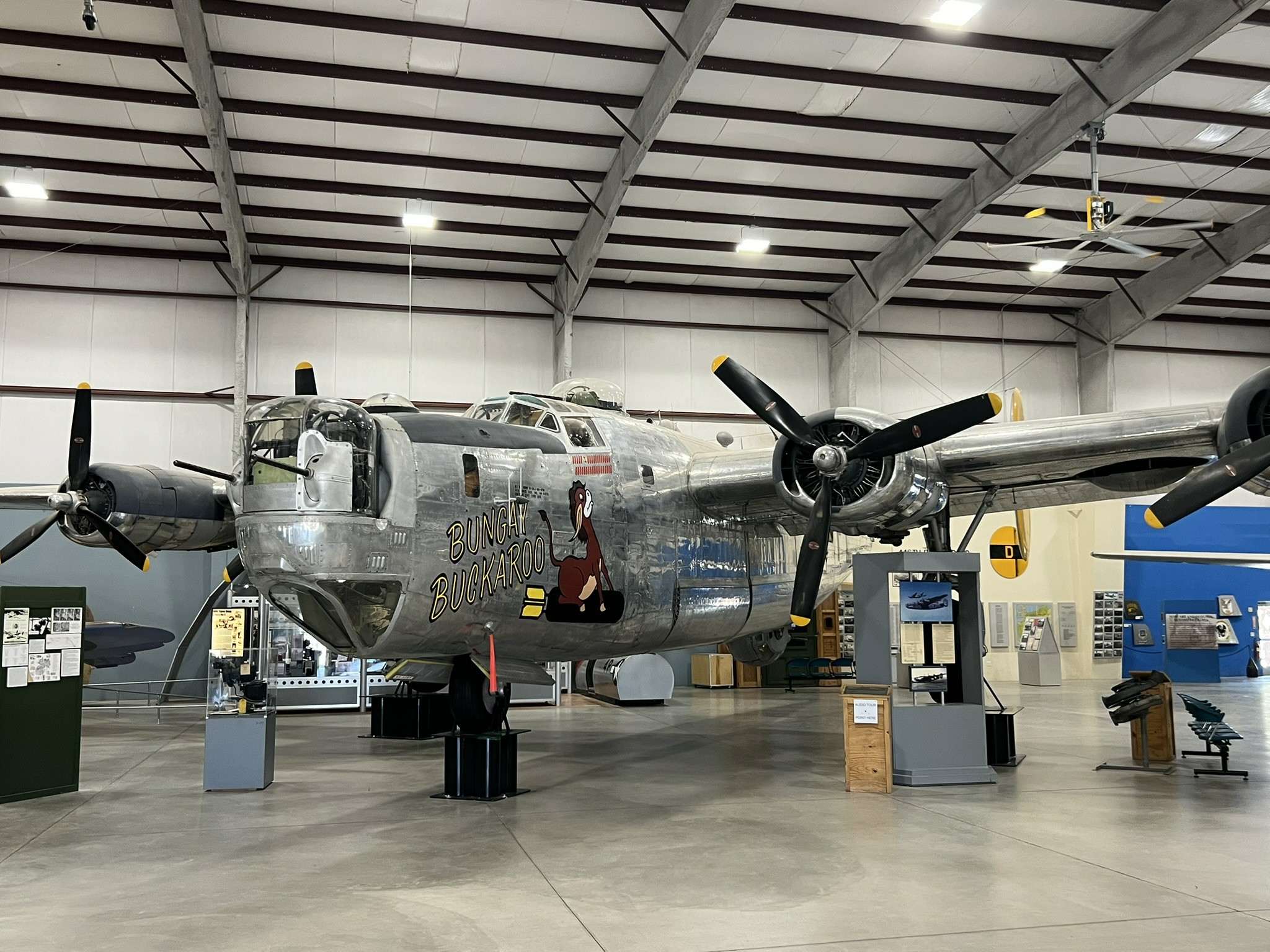
Bungay Buckaroo (44-44175), one of five surviving Consolidated B-24s that served with the Indian Air Force until the type’s retirement in 1968.
Because of our work with Project Warbird, surveying this aircraft was of great interest to us. Her interior is practically untouched.
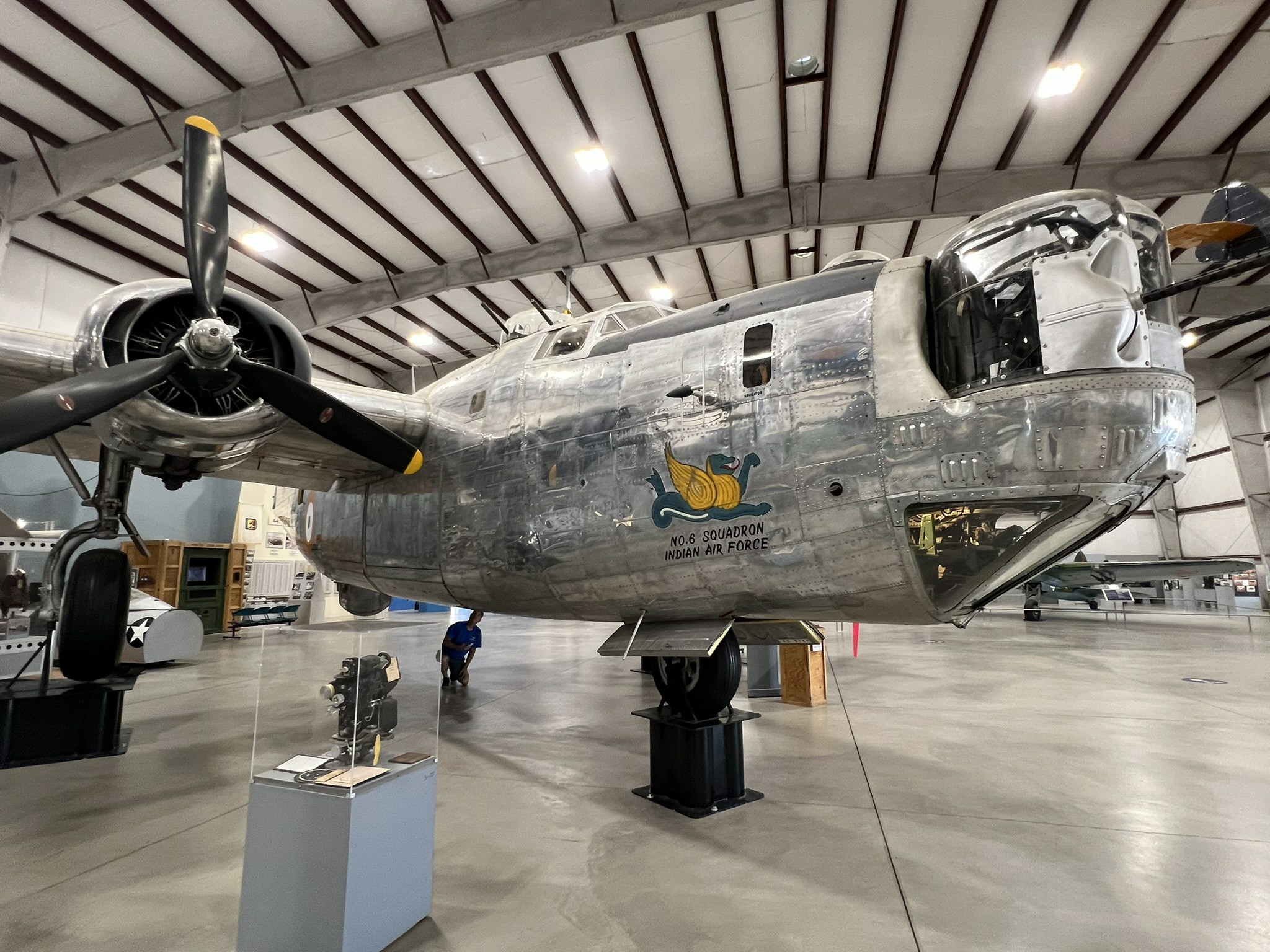
The right side of Bungay Buckaroo (44-44175) retains her original Indian Air Force markings.
In Indian service, she flew as HE877 with 6 Maritime Reconnaissance Squadron.
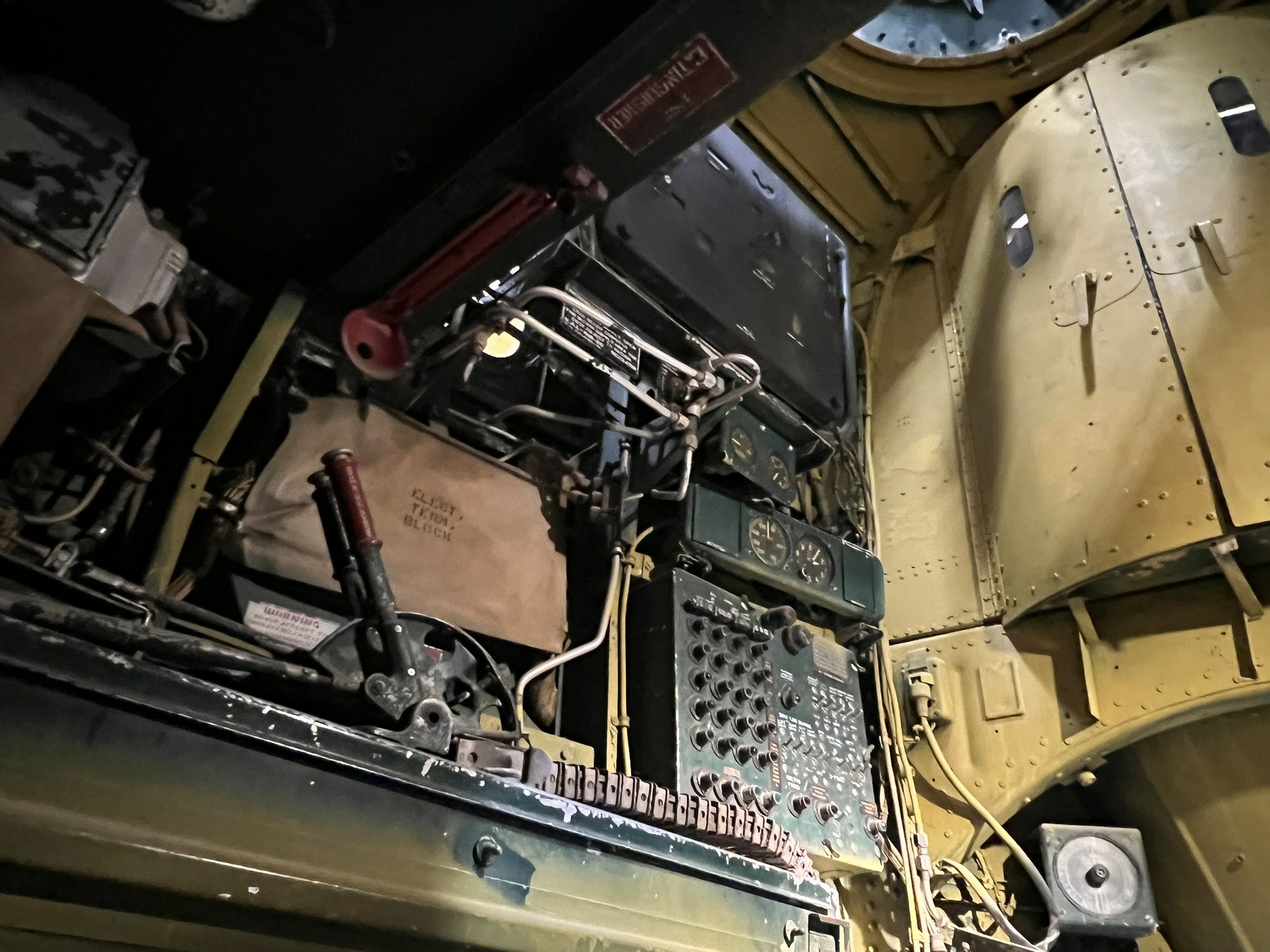
The nose compartment of Bungay Buckaroo (44-44175), looking up from the nose wheel.
The silver object at the extreme left is the vertical gyro to the aircraft’s C-1 autopilot. The autopilot is not however, connected to the bombsight. This aircraft carries an RAF Mk. XIV Bombsight, also produced under US license as the Sperry T-1. Optimized for altitudes under 20,000 ft, the computer for this system is the large black object at the top, just left of the bow turret.
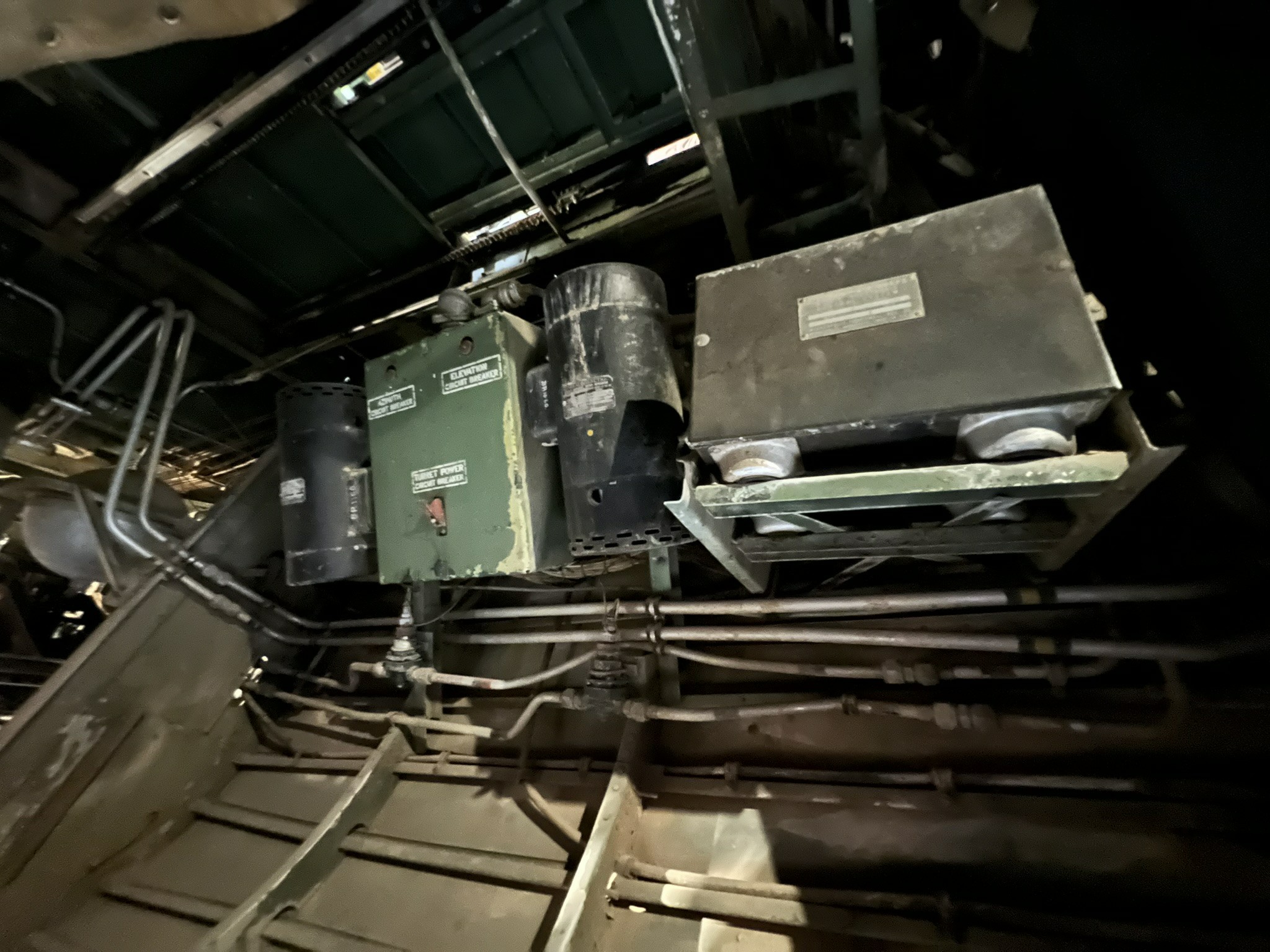
To the left of the nose wheel are the two amplidyne motors for the aircraft’s bow turret.
The box to the right is the amplifier box for the Type C-1 autopilot.
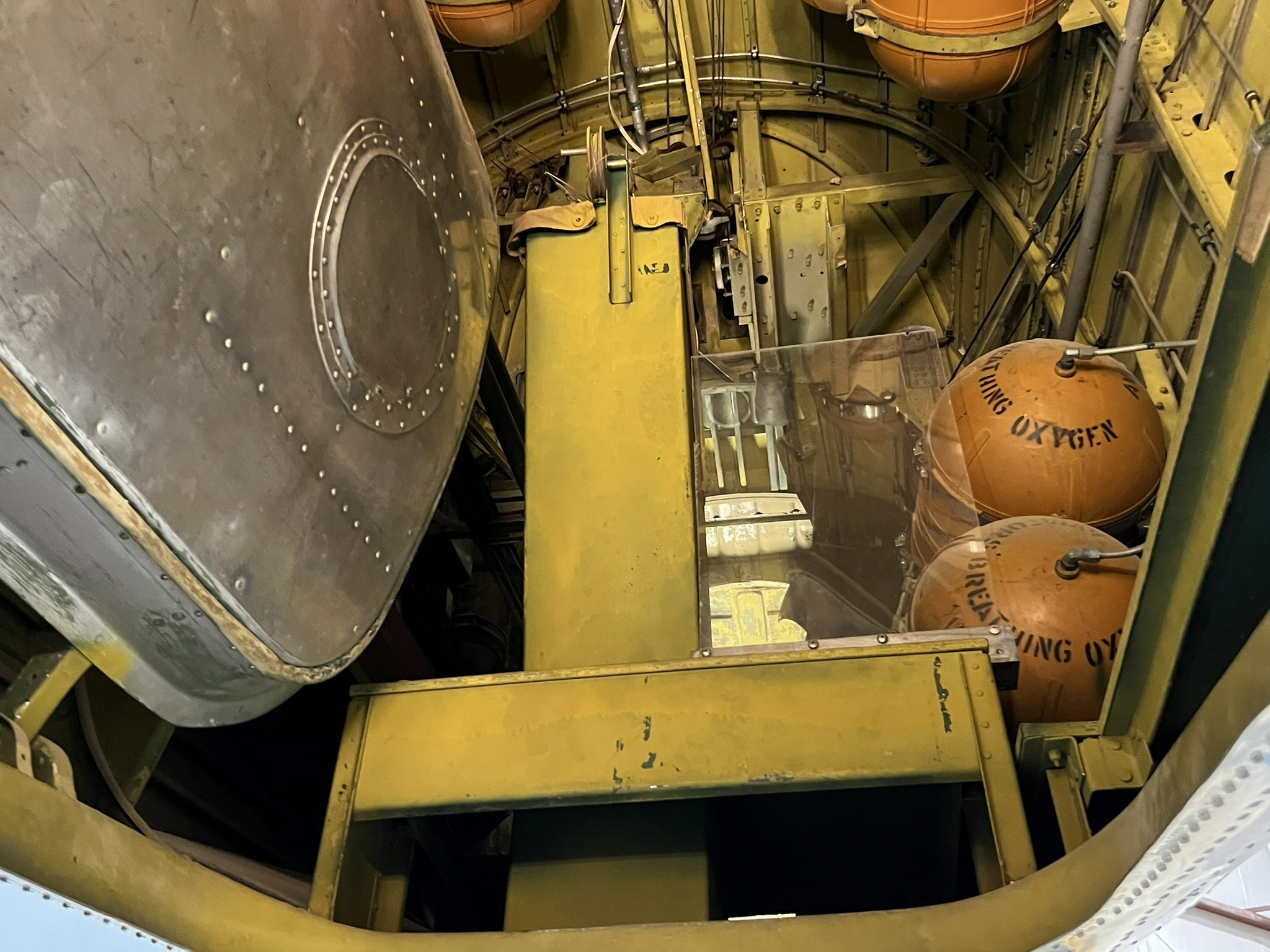
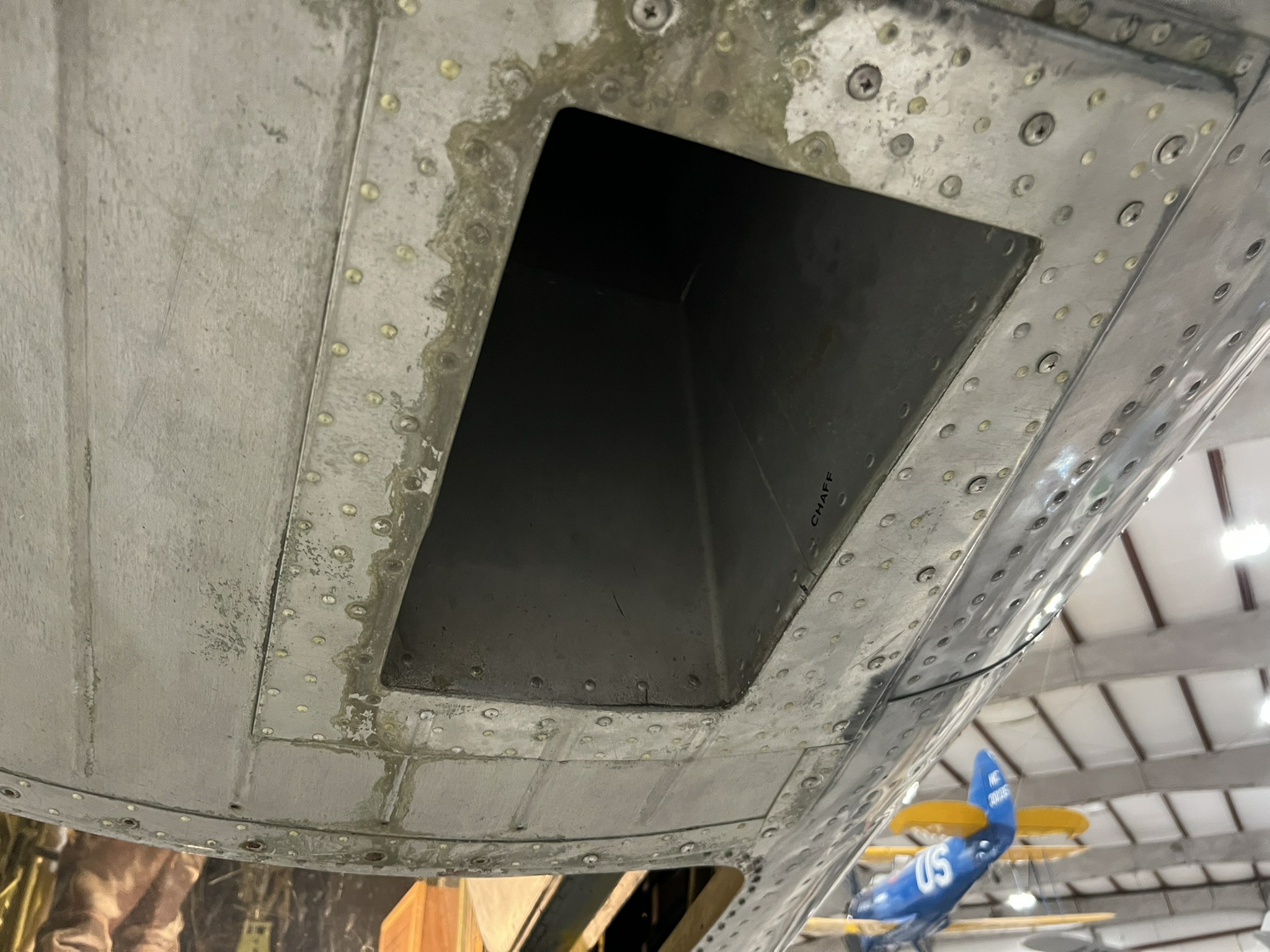
Just aft of the B-24’s main entry door is the aircraft’s flare dispenser.
Essential for night operations, the Liberator II being restored by Project Warbird used this same piece of equipment. So, if anyone can be of help with this piece, please let us know!
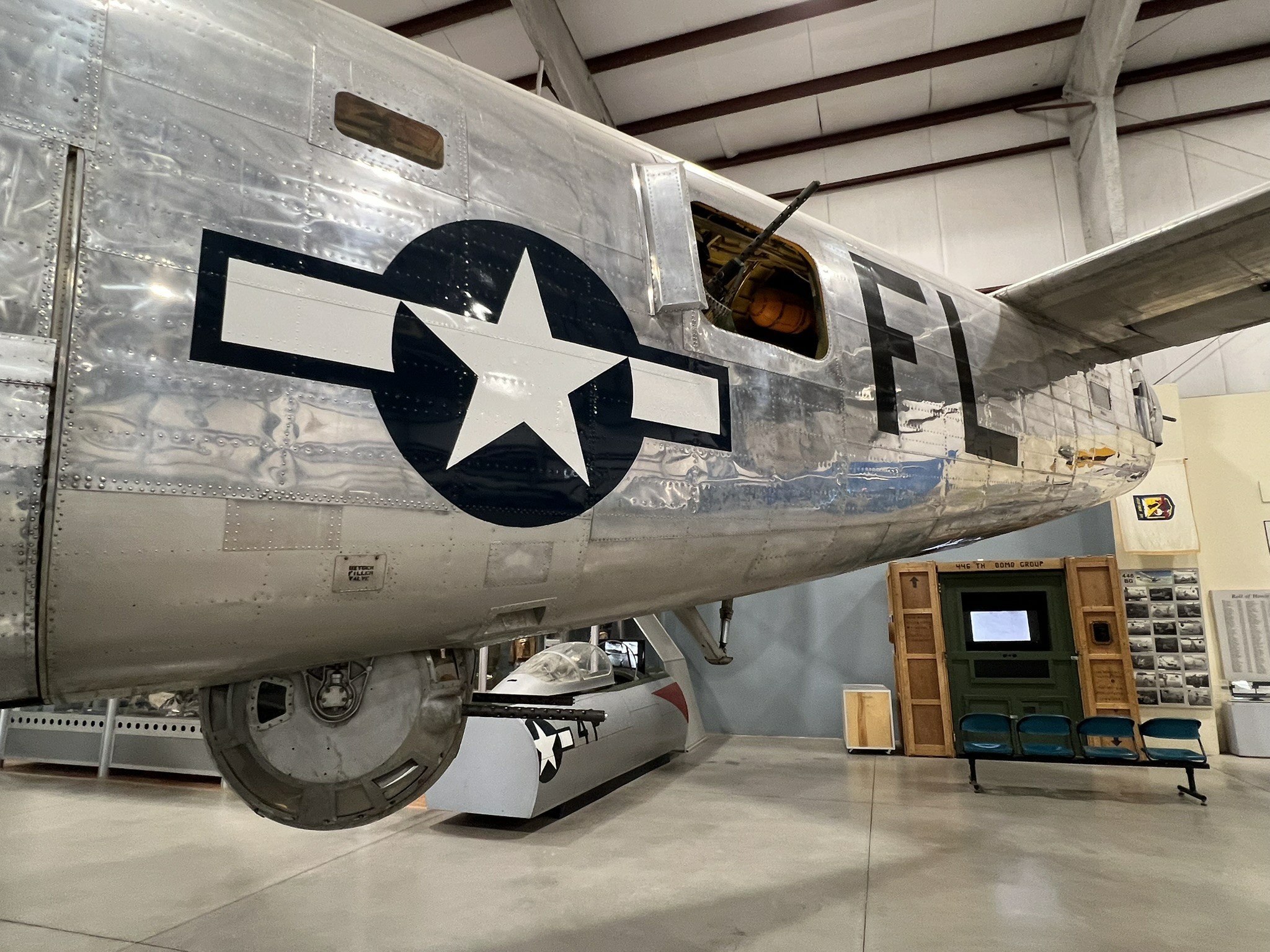
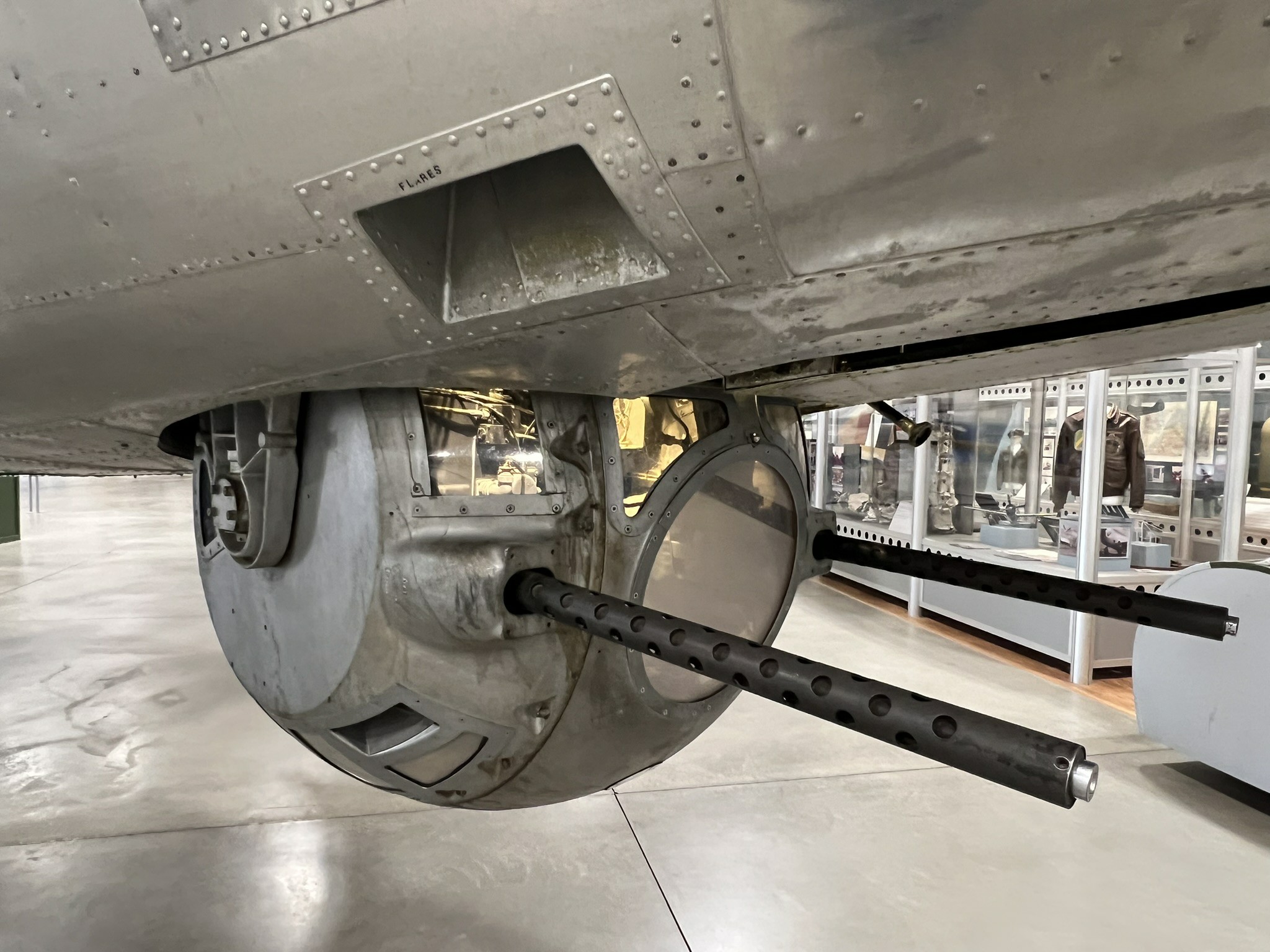
The Type A-13A Ball Turret aboard Bungay Buckaroo (44-44175).
As noted in our ball turret article, it is not uncommon today to see A-13A balls installed on Boeing B-17s. In reality, the A-13A was only used on late-B-24s (starting with block J-185-CO) and the short lived Consolidated B-32 Dominator. As such, the ball on this aircraft is real treat, being a rare occasion of an accurately displayed A-13A.
The chute above the ball is mislabeled, being in actuality a chaff dispenser. That said, on older B-24s, prior to the introduction of the ball turret, the flare chute was indeed located in this area.
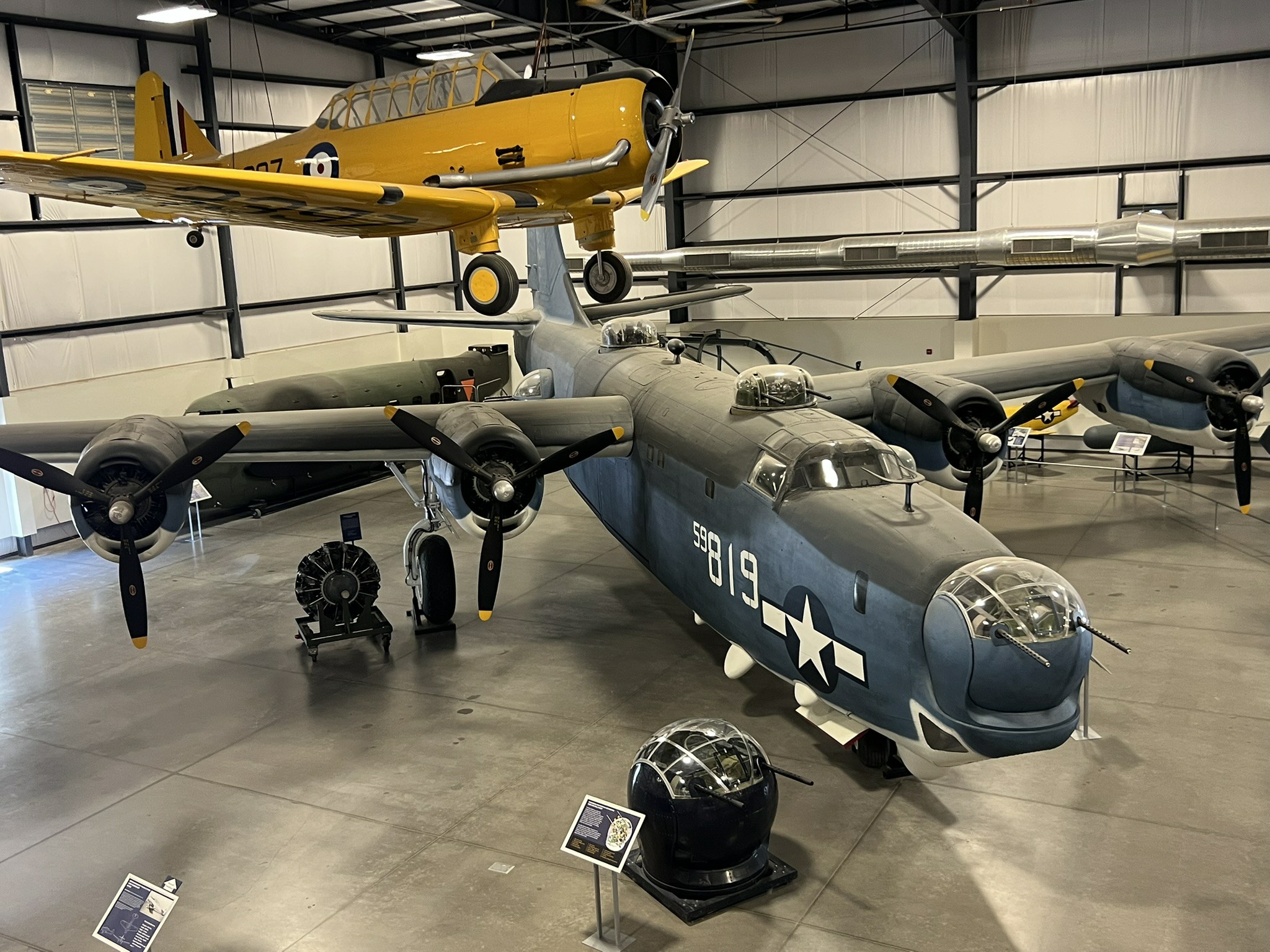
Another aircraft on my bucket list – PB4Y-2 Privateer BuNo 59819.
As noted in our previous update, the Privateer was the US Navy variant of the Army’s B-24 Liberator. Optimized for maritime patrol, the Privateer lacked turbochargers and a ball turret, but was several feet longer, carrying a massive array of early-warning equipment and powered gun turrets.
This particular example was the subject of an extensive restoration by the Lone Star Flight Museum of Galveston, Texas, who began work to restore the former firefighting tanker back to her Navy configuration in 1991. No small task, hopes of returning her to the air was dashed by Hurricane Ike in 2008, and she was transferred to Pima for static display in 2015. Even so, she is the most complete example of a wartime Privateer in existence.
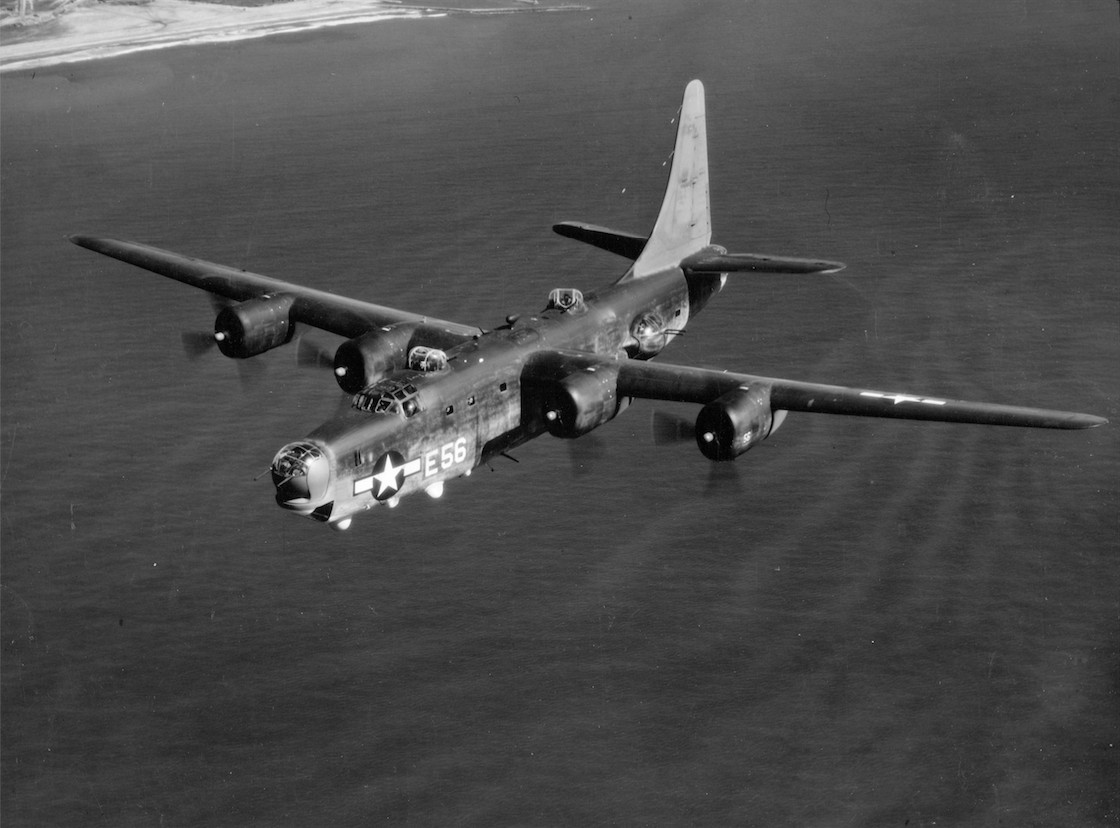
Privateer BuNo 59602, a similarly marked aircraft, circa 1944.
The aft upper turret is pointed directly at the camera.
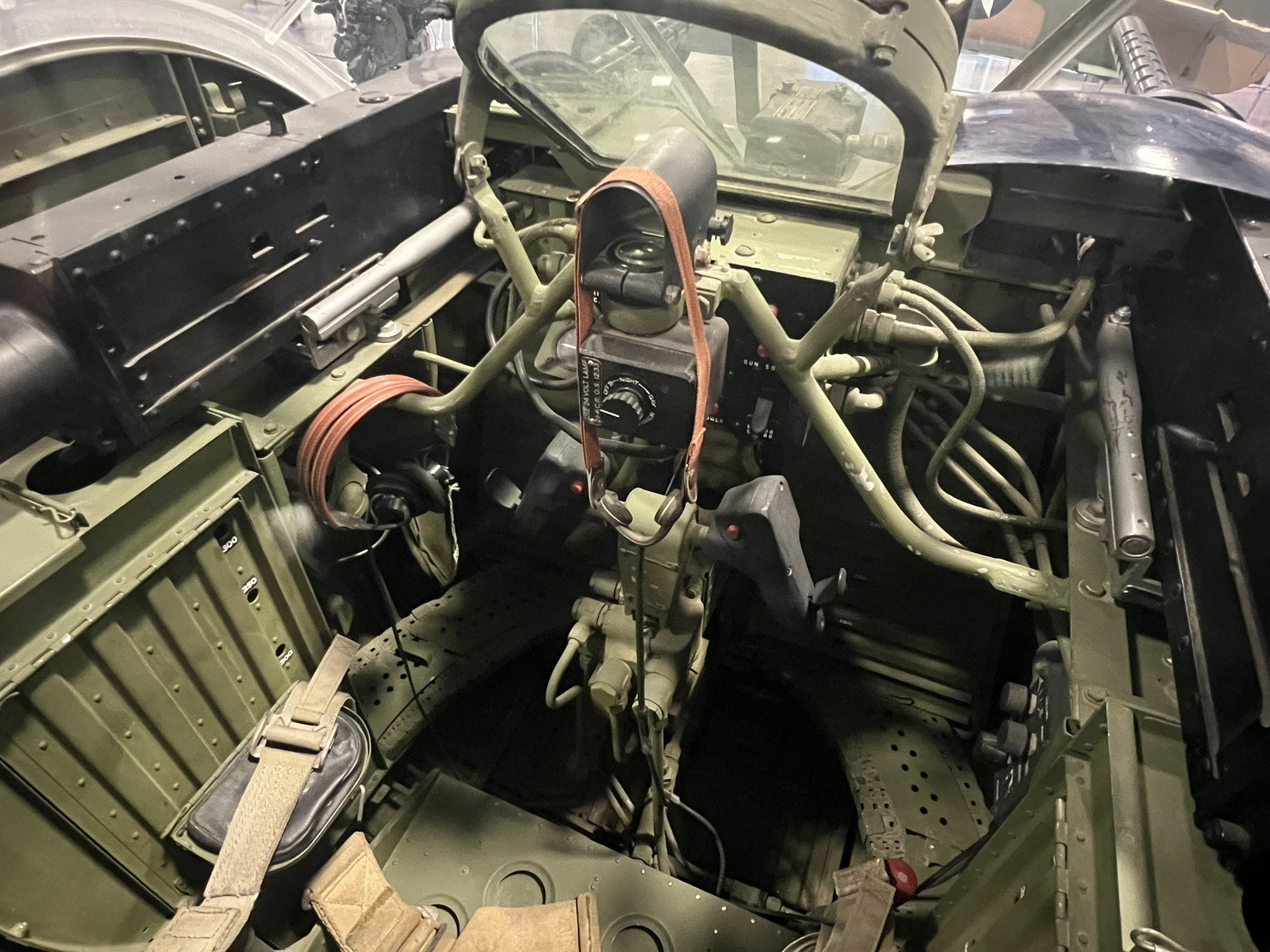
The interior of the immaculately restored bow turret displayed in front of the Privateer.
Made by the Engineering and Research Corporation of Riverdale, Maryland, the ERCO 250SH was unique to Privateers.
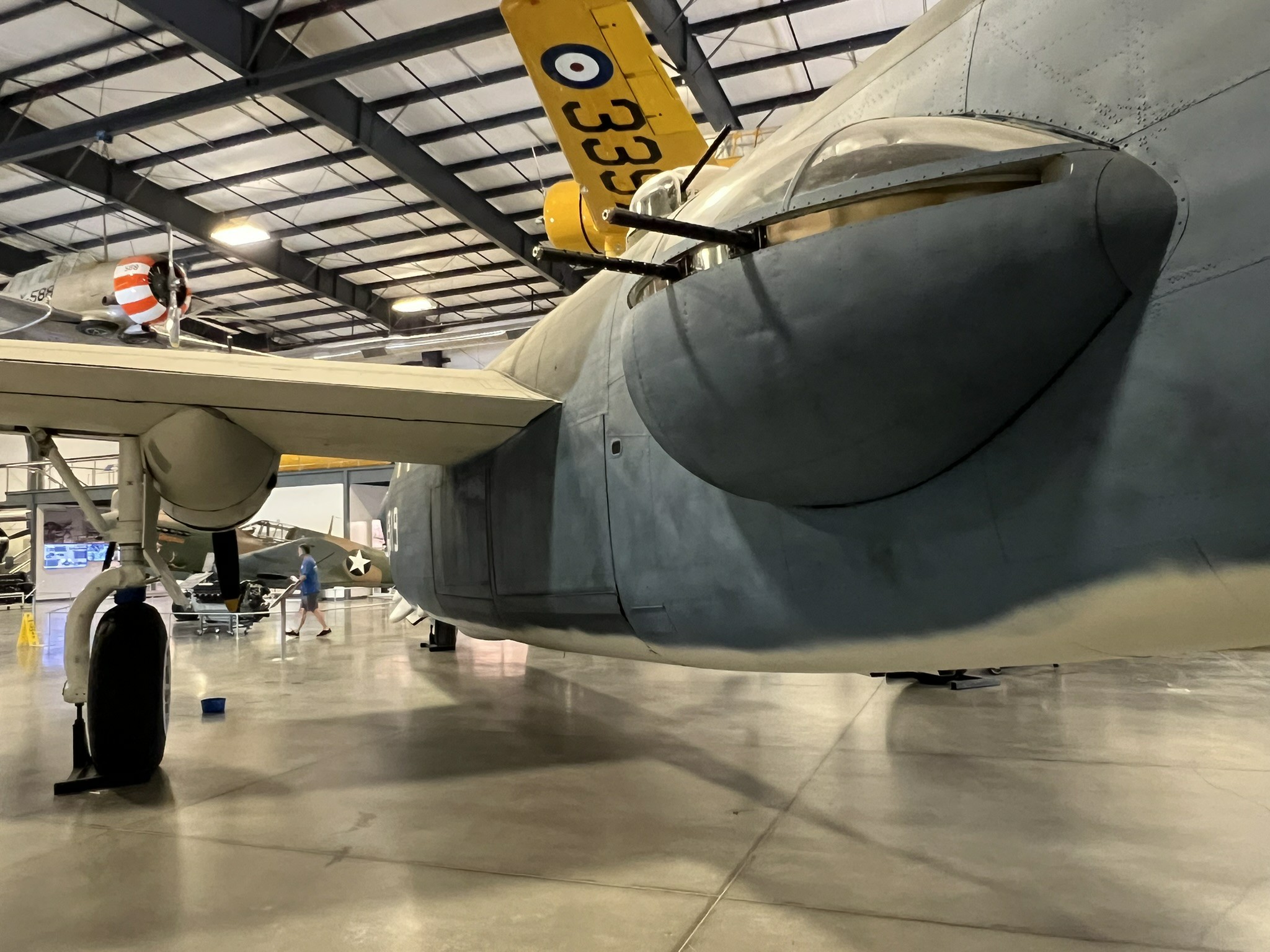
Another turret unique to the Privateer, the Erco 250TH waist turret.
With its heavy gun complement and dual bomb bays, the Privateer was a shockingly lethal patrol bomber.
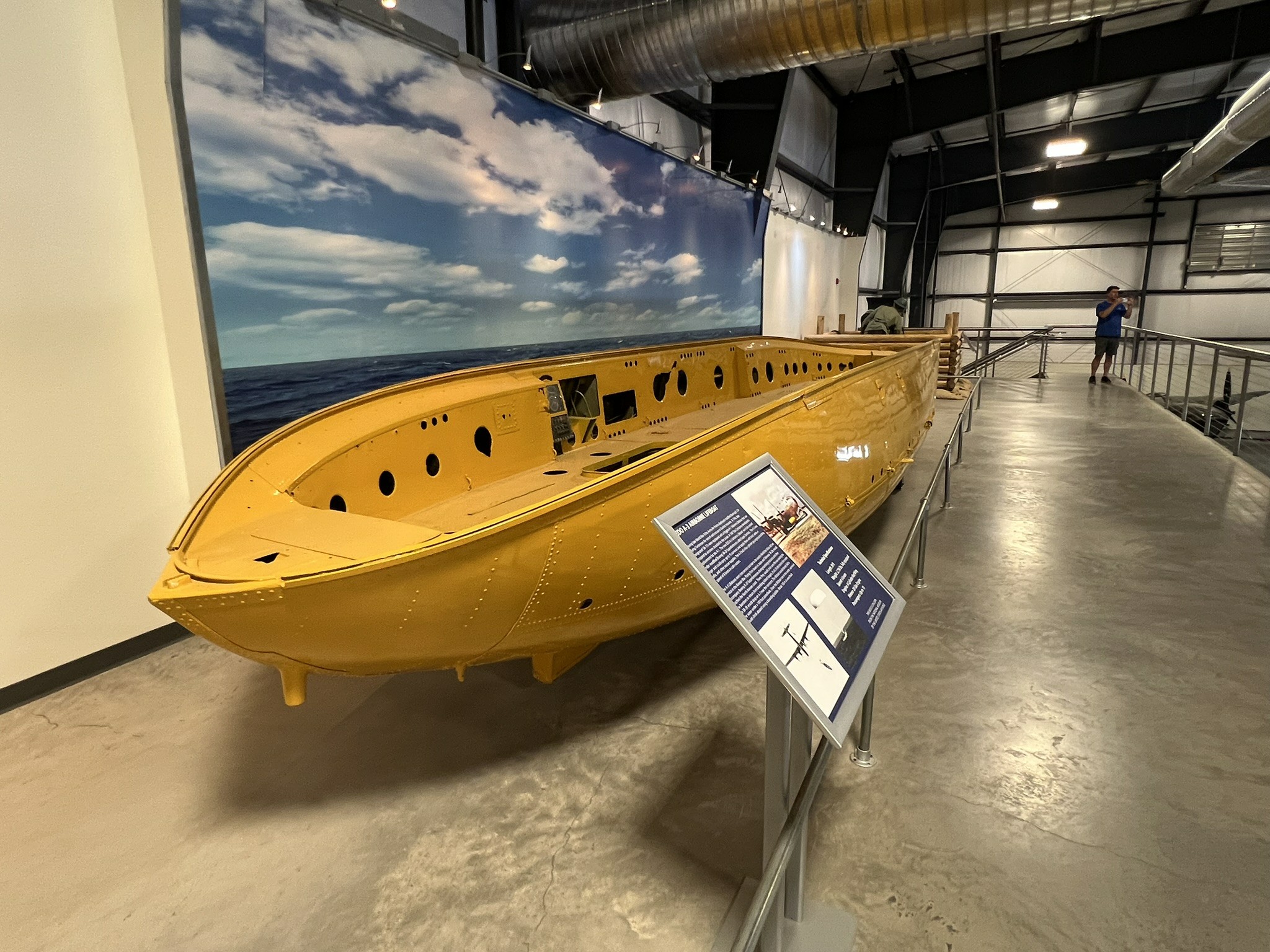
Another subject discussed in our Oddballs article was SB-17Gs, also known as “Dumbos.” These were heavy bombers converted to carry a Higgins Type A-1 life boat under the fuselage for rescuing Boeing B-29 crews. During the war’s final airstrike on 14 August 1945 for example, the bombers’ route was patrolled by nine land-based Dumbos, 21 flying boats, five rescue ships, and 14 submarines.
No A-1s survive today but there are two examples of the EDO Type A-3 life boat, carried by the SB-29 “Super Dumbo.” Sixteen B-29s were converted to carry these boats after the Second World War and saw use in the Korean War before being retired in favor of dedicated rescue helicopters. The other surviving A-3 is on display at the National Museum of the US Air Force in Dayton, Ohio.
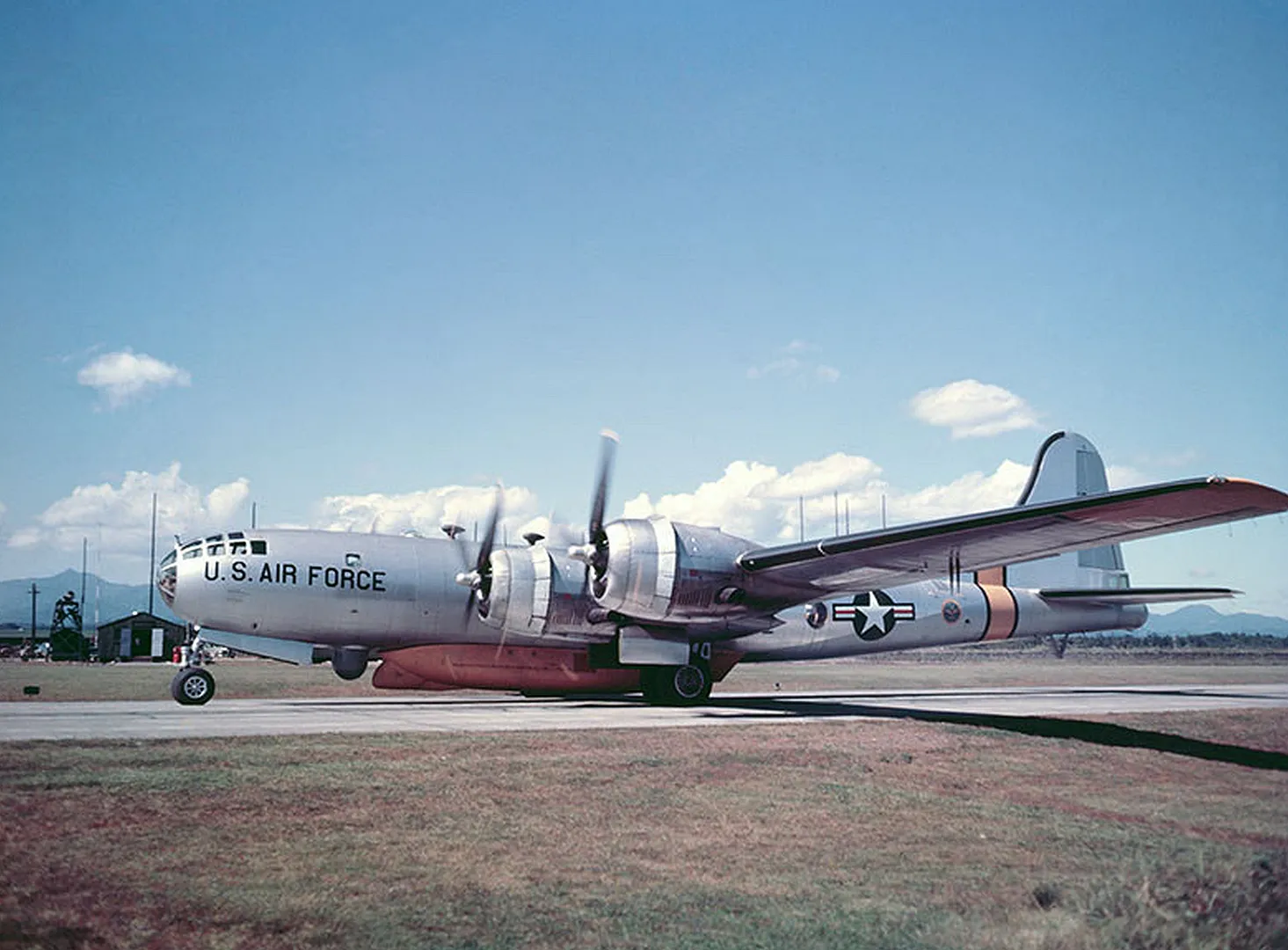
While no SB-29s remain, there are two SB-17Gs still in existence, both of which are currently in Brazil: 44-83718, on display at the Museu Aeroespacial in Rio de Janeiro, and 44-85583, on outdoor display at the Aeroporto Internacional in Recife.
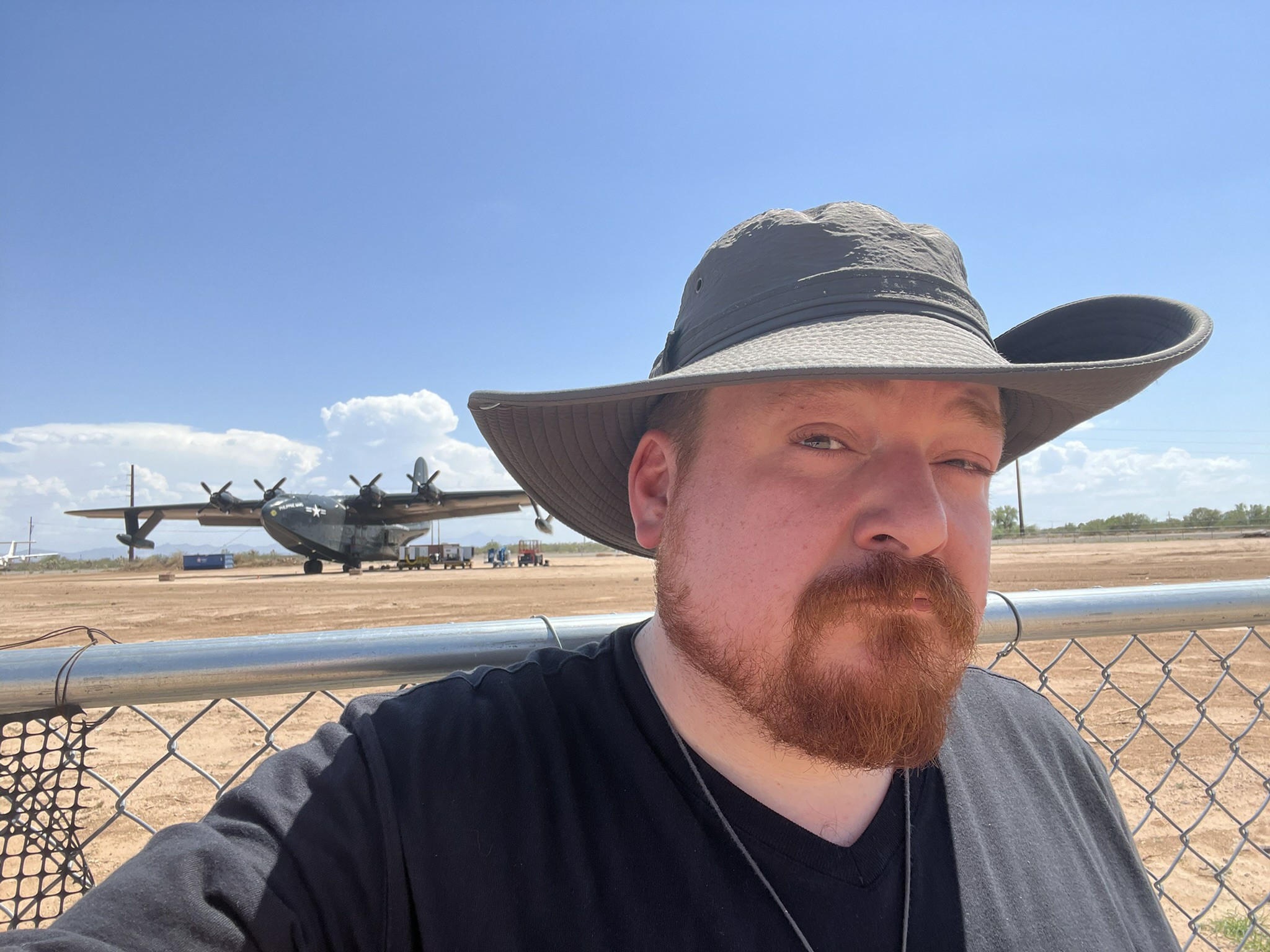
Yours truly with the Philippine Mars.
Despite my desperate wishes to see her fly, I was not able to make it happen before her retirement (though I followed her closely for years after the announcement was made). Still, I am glad to see her come to Pima and hope that they will be able to get a structure up to display her indoors. It would certainly be amazing to have the JRM Mars and PBM Mariner beside one another!
The restoration team were still in the process of prepping the Mars for display, and we were too late to get a chance to talk to them and maybe see her up close. There was just too much to see! If you have never been to the Pima Air & Space Museum and are an aviation lover, I might suggest you set aside an extra day.
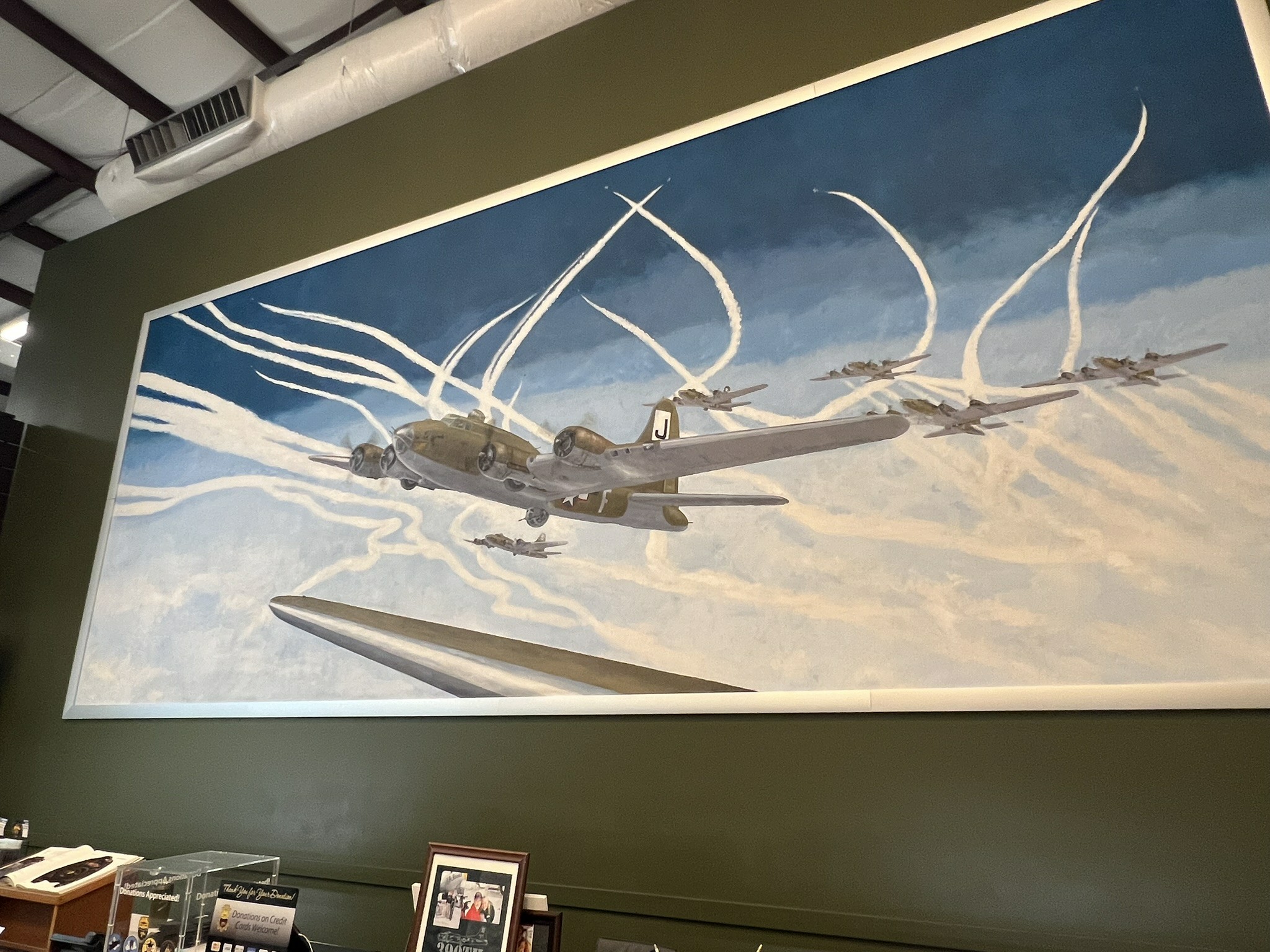
Located on the museum grounds but a separate and distinct entity is the 390th Bomb Group Memorial Museum.
This painting, displayed in the lobby, was painted by our good friend Frank Drain and is a recreation of one of the war’s most iconic photos.
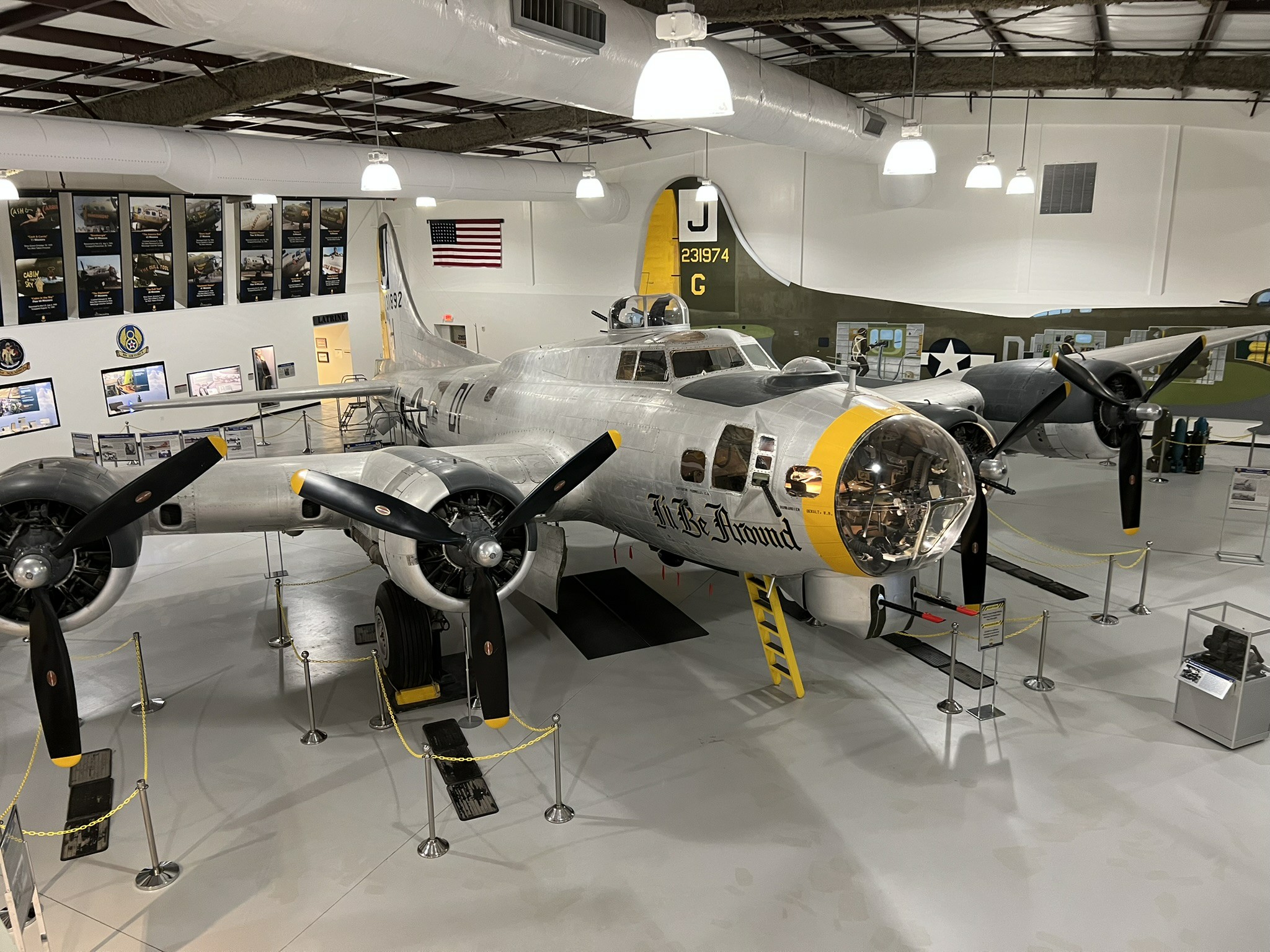
The museum’s Boeing B-17G, I’ll Be Around (44-85828), is in actuality a Coast Guard PB-1. Delivered on 14 August 1945 as BuNo 77254, the aircraft was assigned to the US Coast and Geodetic Survey program for surveying and photography from 1946 to 1959.
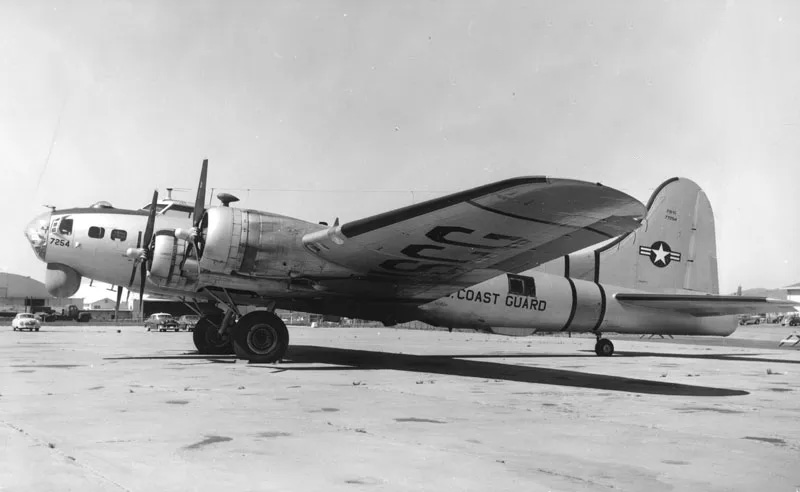
77254 back in her Coast Guard days.
Note the H2X radar, moved from the ball turret position to the chin turret one. This was common.
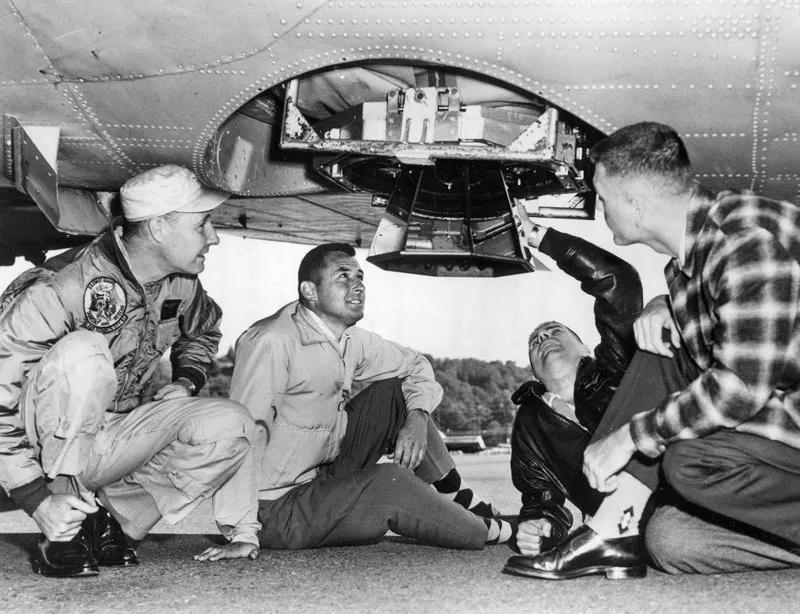
Purpose-built for the task by Fairchild Aviation and introduced in 1935, the C&GS nine-lens camera was absolutely massive. As the name suggests, nine lenses combined to create an 34 inch square composite photo, combined using a series of mirrors onto 23-inch wide film stock.
The camera weight nearly 750 lbs and was mounted in the ball turret position, where it could be raised and lowered as needed.
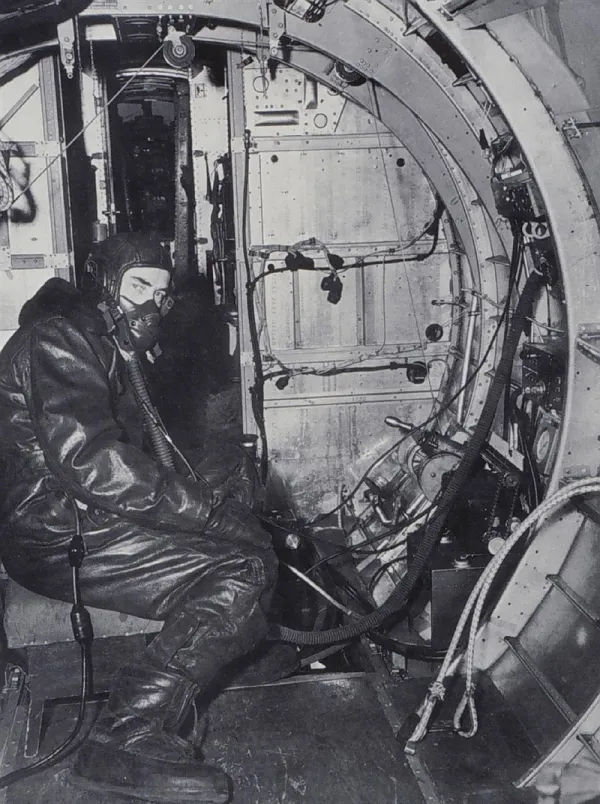
77254 typically operated between 22,000 to 30,000 ft, using its Norden bombsight and Honeywell autopilot to assist in setting up photo lines. The camera was retired in 1963 and is currently held by the Smithsonian Institution.
77254 left the military in 1959 and was converted into a firefighting tanker in 1962. She served in this capacity until 1980, after which she was restored for museum display.
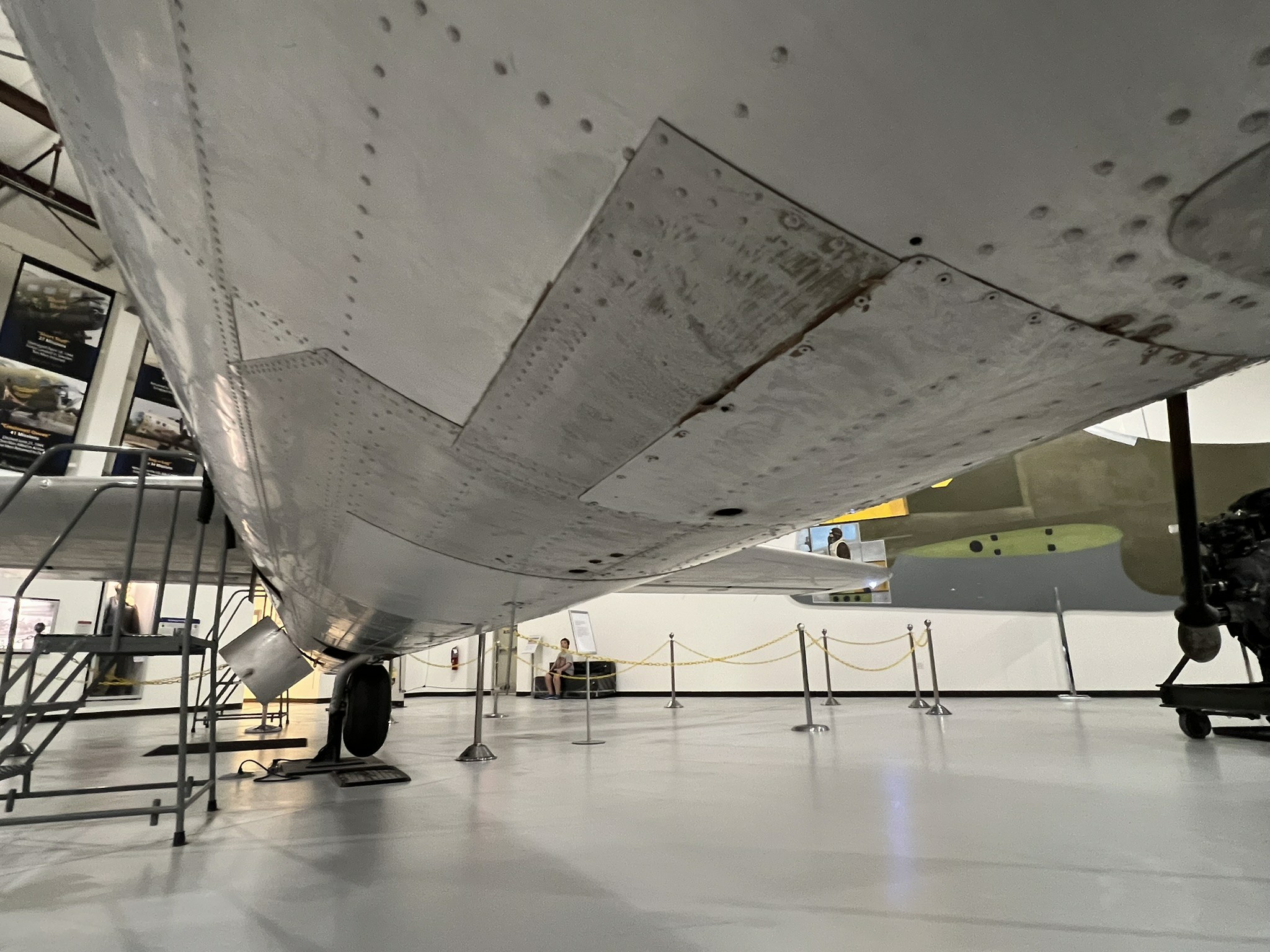
Looking under the aft fuselage of I’ll Be Around at the extensive metal work left over from her camera mapping days.
Normally, this area carried the Boeing B-17’s red, green, and amber identification lights, as well as the marker beacon antenna and ball turret window cleaning hatch.
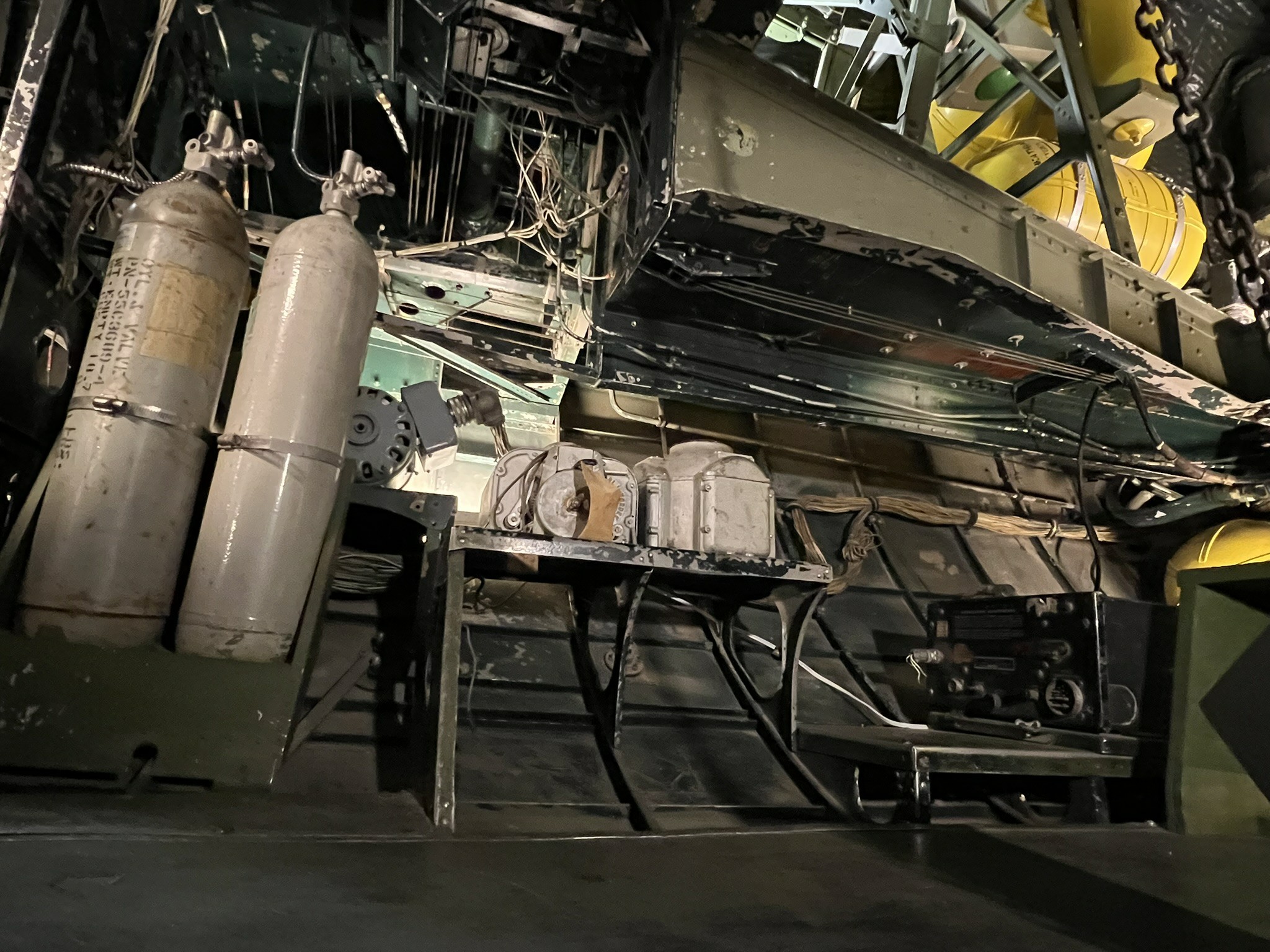
Looking up into the I’ll Be Around‘s forward entry hatch, showing the crawlway between the nose and cockpit compartments.
The light gray cylinders to the left are the engine fire extinguishers. The gray object behind them is one of the aircraft’s inverters, normally mounted in the cockpit beneath the pilot seats. To the right is the autopilot’s aileron servo and vertical flight gyro.
To the far right is the R-5 main unit to the aircraft’s ARN-7 radio compass. Older B-17s carried the SCR-269 system, which was almost identical but with a different directional antenna and one less frequency band. Mixing components of these two systems is a common mistake on restorations.
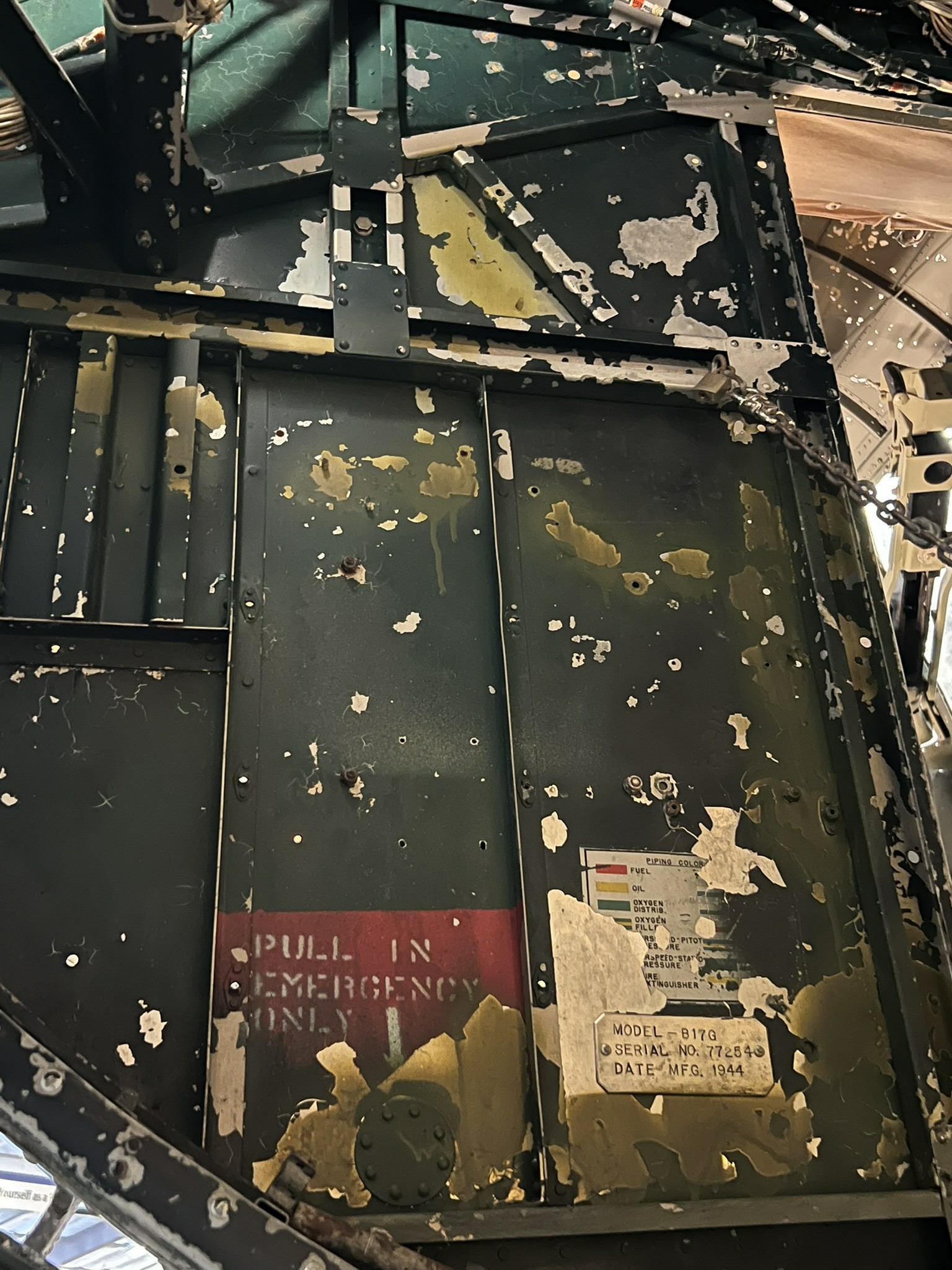
Looking forward from the nose hatch at Station 3 of I’ll Be Around.
The worn gray decal to the right indicates color codes for tubing throughout the fuselage. The metal plate below it is the aircraft’s Coast Guard dataplate. On Army aircraft, the dataplate was located in the back near the main entry hatch.
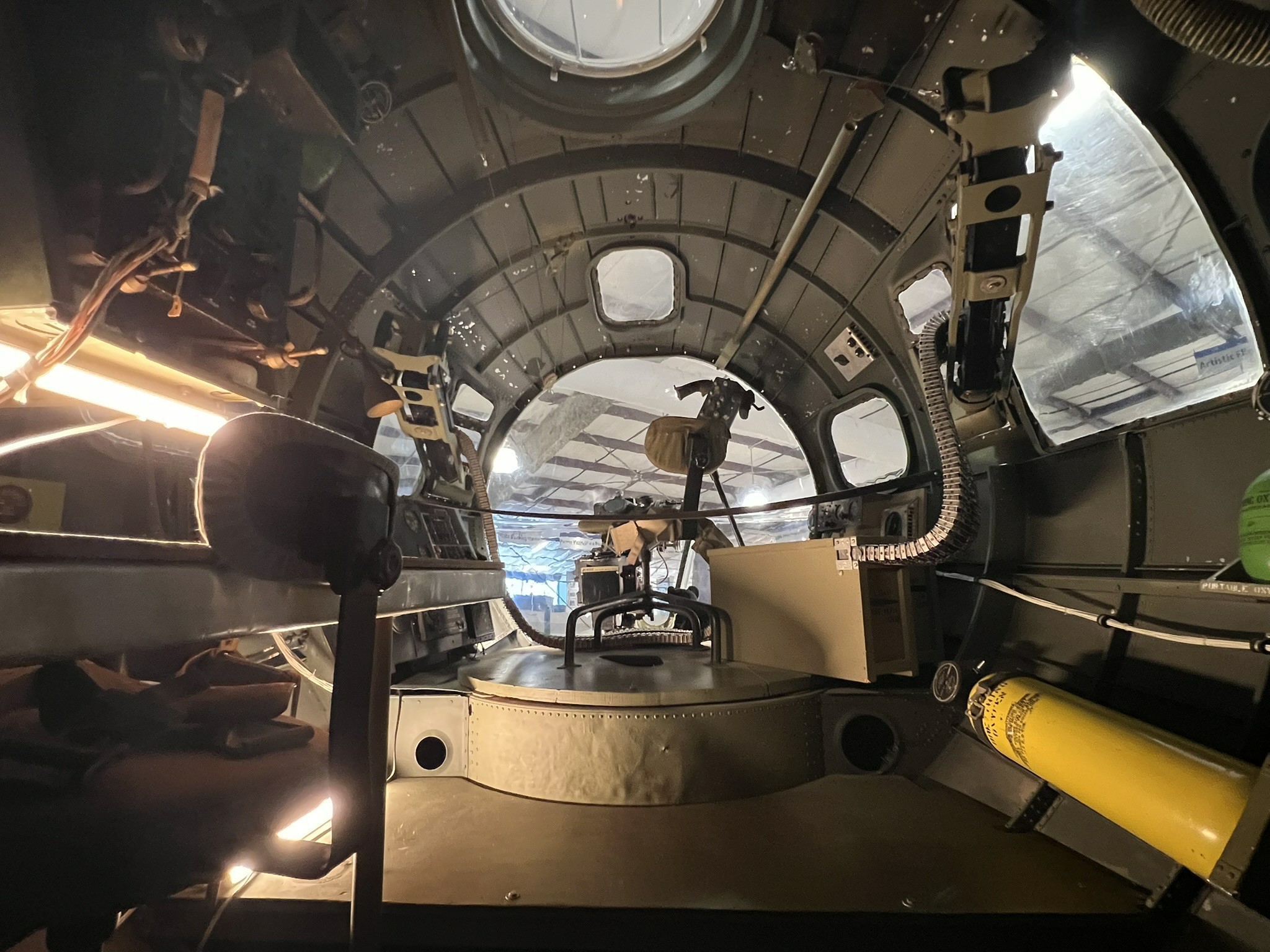
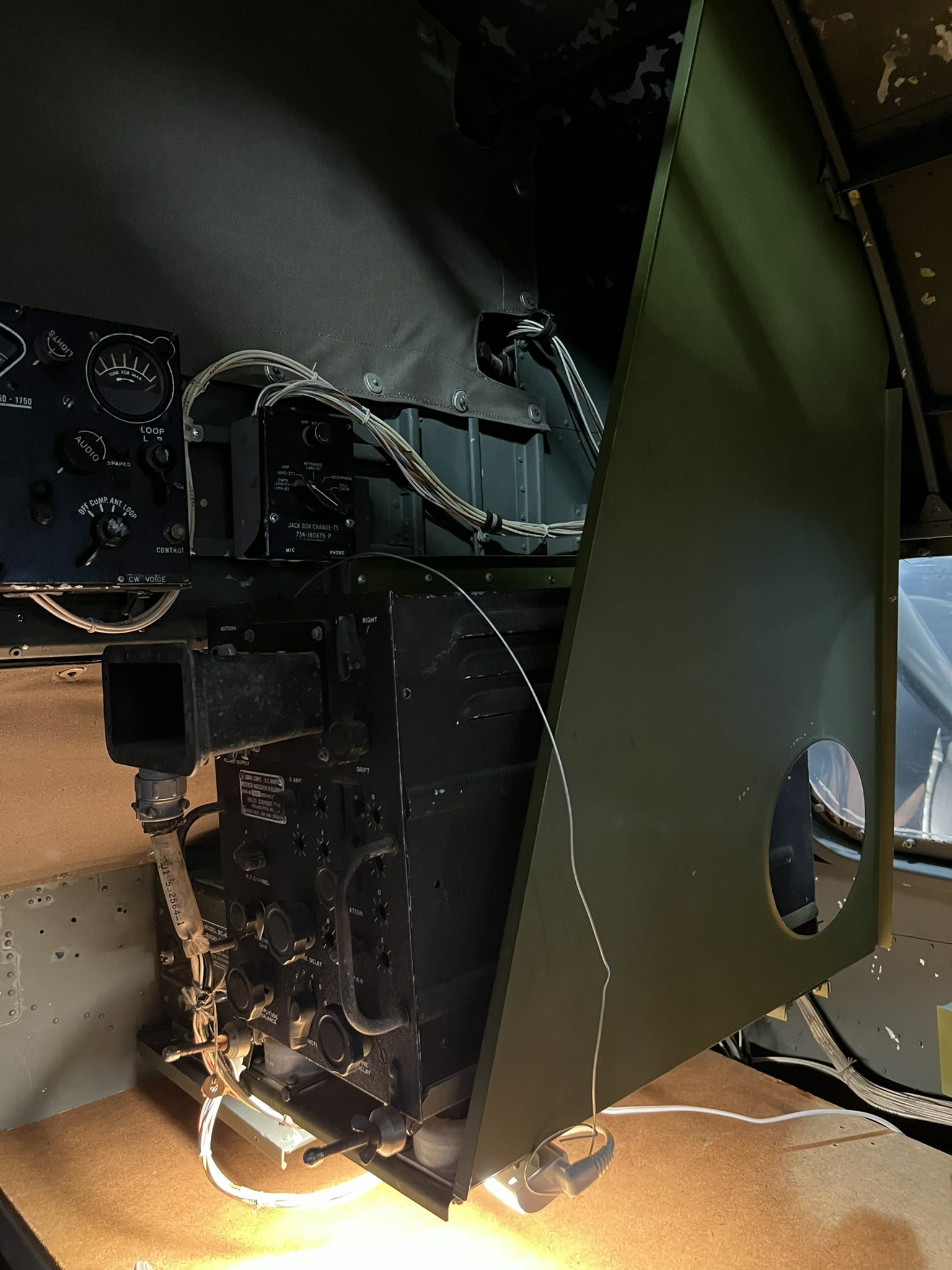
The nose compartment to I’ll Be Around.
Note the Type D-2 Walkaround Bottle just behind the navigator’s desk. This is actually the correct walkaround bottle all surviving B-17Gs except Shoo Shoo Baby (42-32076, 91BG) at the Smithsonian Steven F. Udvar-Hazy Center in Chantilly, Virginia.
The large black object above the navigator’s desk is the APN-9 LORAN indicator, a rarely seen piece.
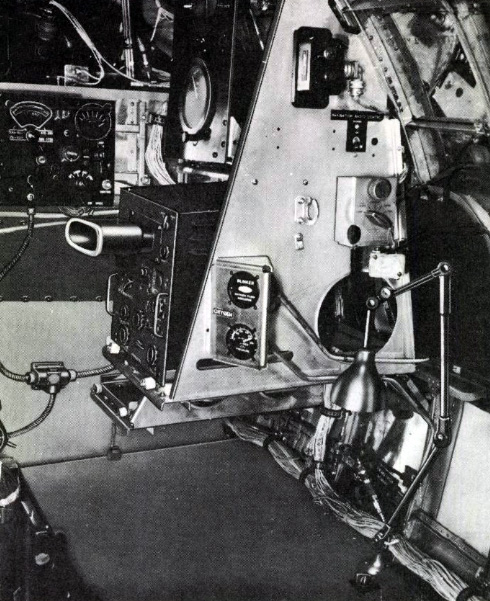
Manual illustration showing the LORAN receiver aboard a late B-17G.
An improvement of the GEE hyperbolic navigation developed by the British, LORAN’s greater accuracy proved essential over the vast Pacific in the latter months of the war and immediate postwar years. The last US LORAN stations went inactive on 31 December 1980.
Many B-17Gs which saw combat over Europe were equipped with British-made GEE receivers, though no examples today have been preserved with this equipment. The presence of the LORAN receiver aboard I’ll Be Around is a nice homage to her original history.
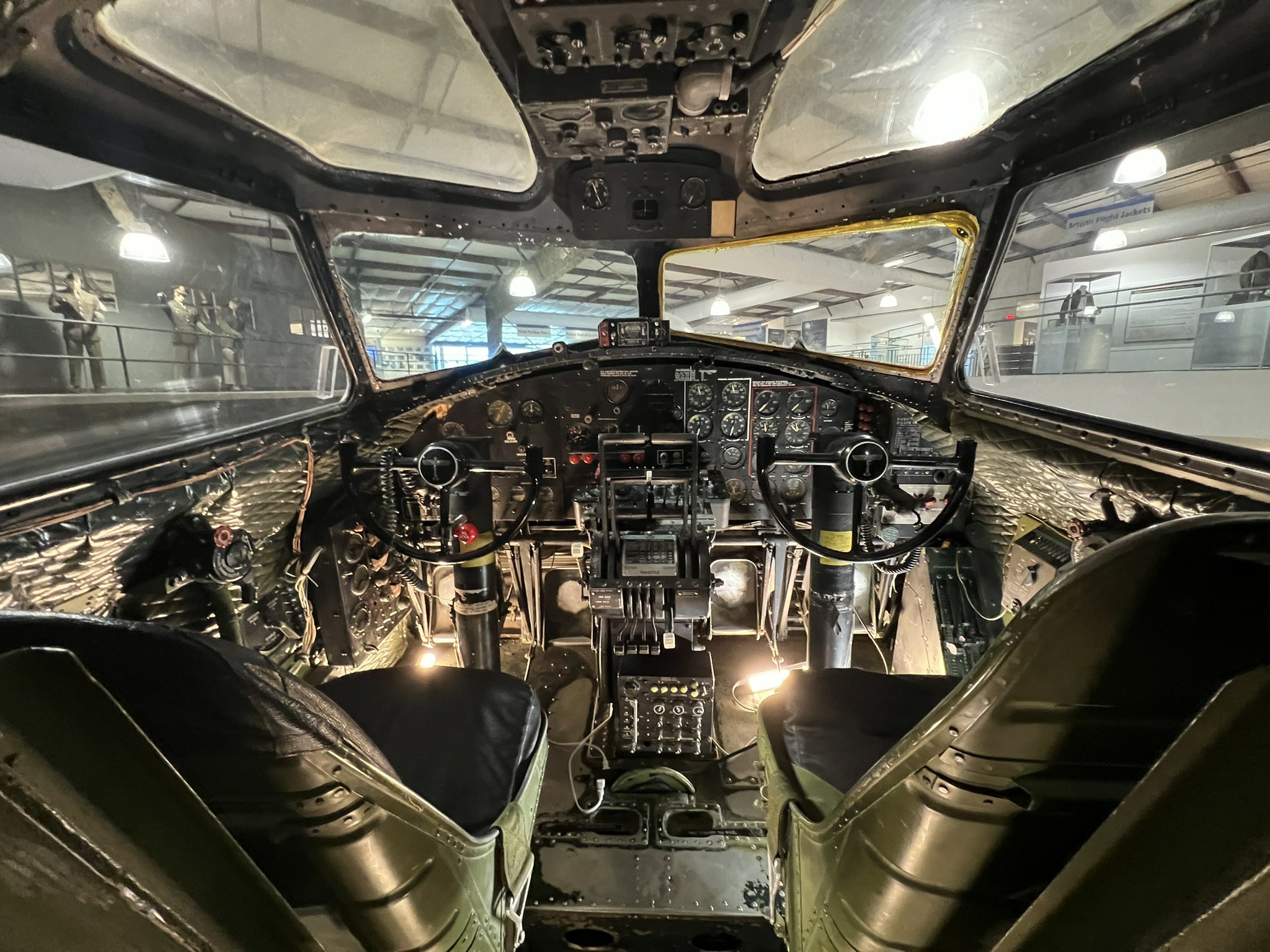
The cockpit to I’ll Be Around.
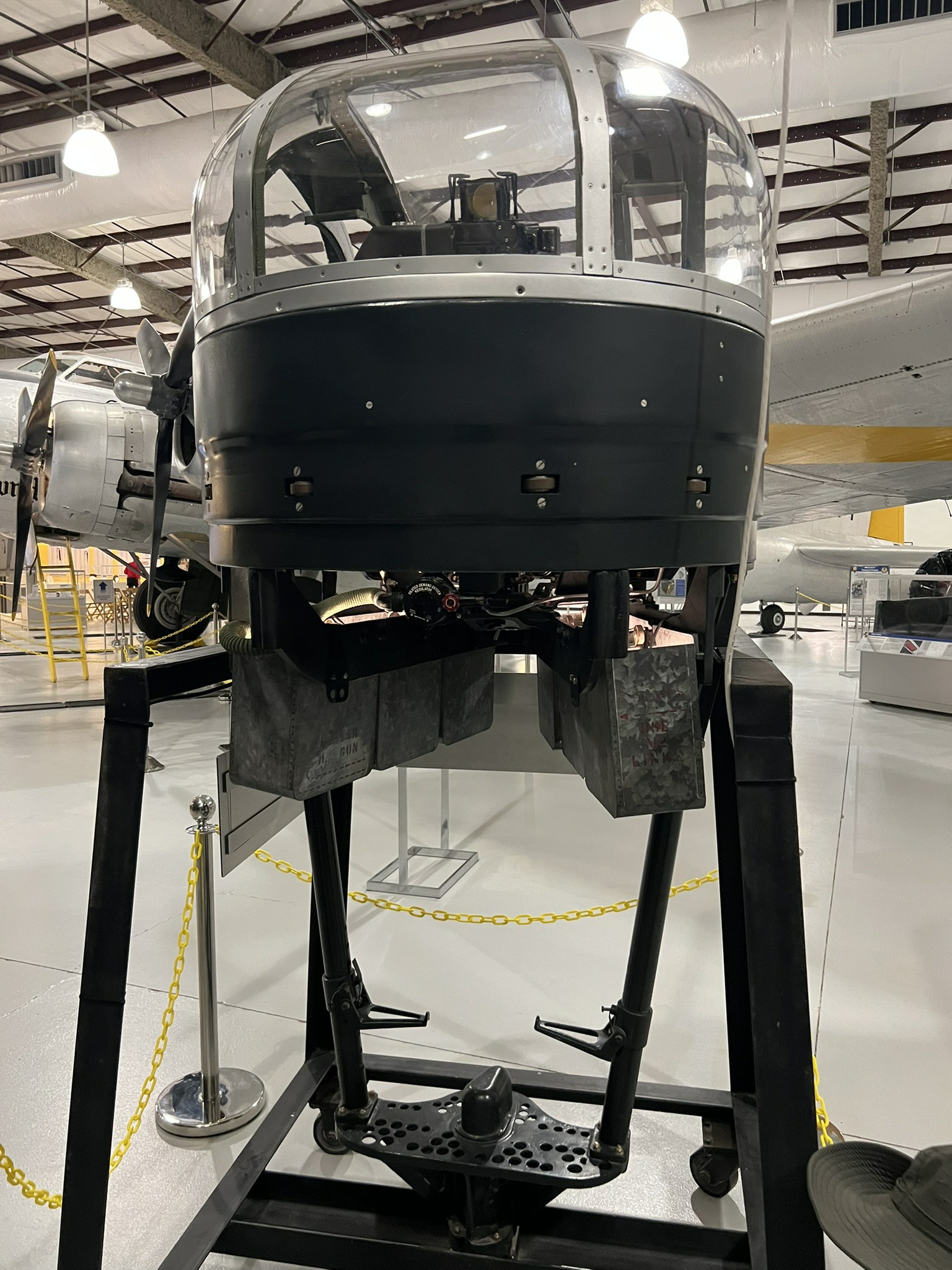
The top turret dome on I’ll Be Around is a falsie, though a Type A-1A upper turret is displayed in front of the aircraft. This particular A-1A is a later variant made by SPECO (Steel Products & Engineering of Ohio).
While Sperry Gyroscope designed the turrets for the Boeing B-17, they did not actually manufacture them. The A-1 Upper was license built by SPECO and the A-2 Lower by Briggs Manufacturing. Neither company was able to meet production quotas and were eventually supplemented by Emerson Electric. This led to an interesting dichotomy in upper turrets as Emerson models varied little, as they were built on an assembly line, while SPECO turrets varied a great deal. Later SPECO A-1As, like this one, featured a redesigned base and support brackets, altered to save weight.
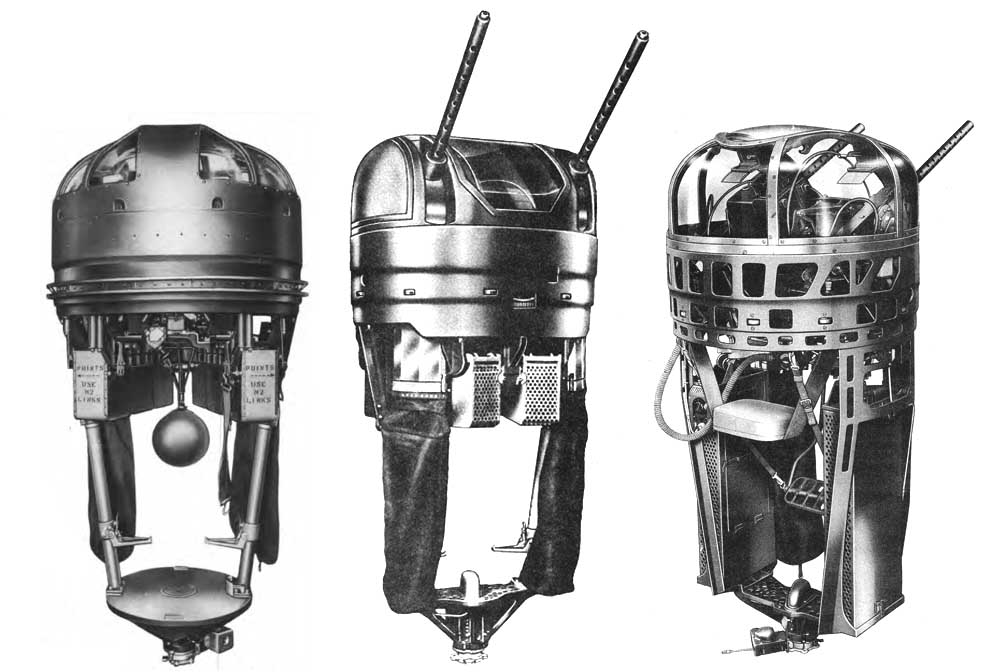
Manual illustrations of a Type A-1, Type A-1A, and Type A-1B turrets. The turret in the middle is identical to the one displayed alongside I’ll Be Around.
Emerson A-1s and A-1As differed little, primarily changing out the oxygen tank to a direct feed into the airplane. Emerson never produced the A-1B, but you can see how SPECO’s continuing alterations bled over from their A-1As to the A-1B.
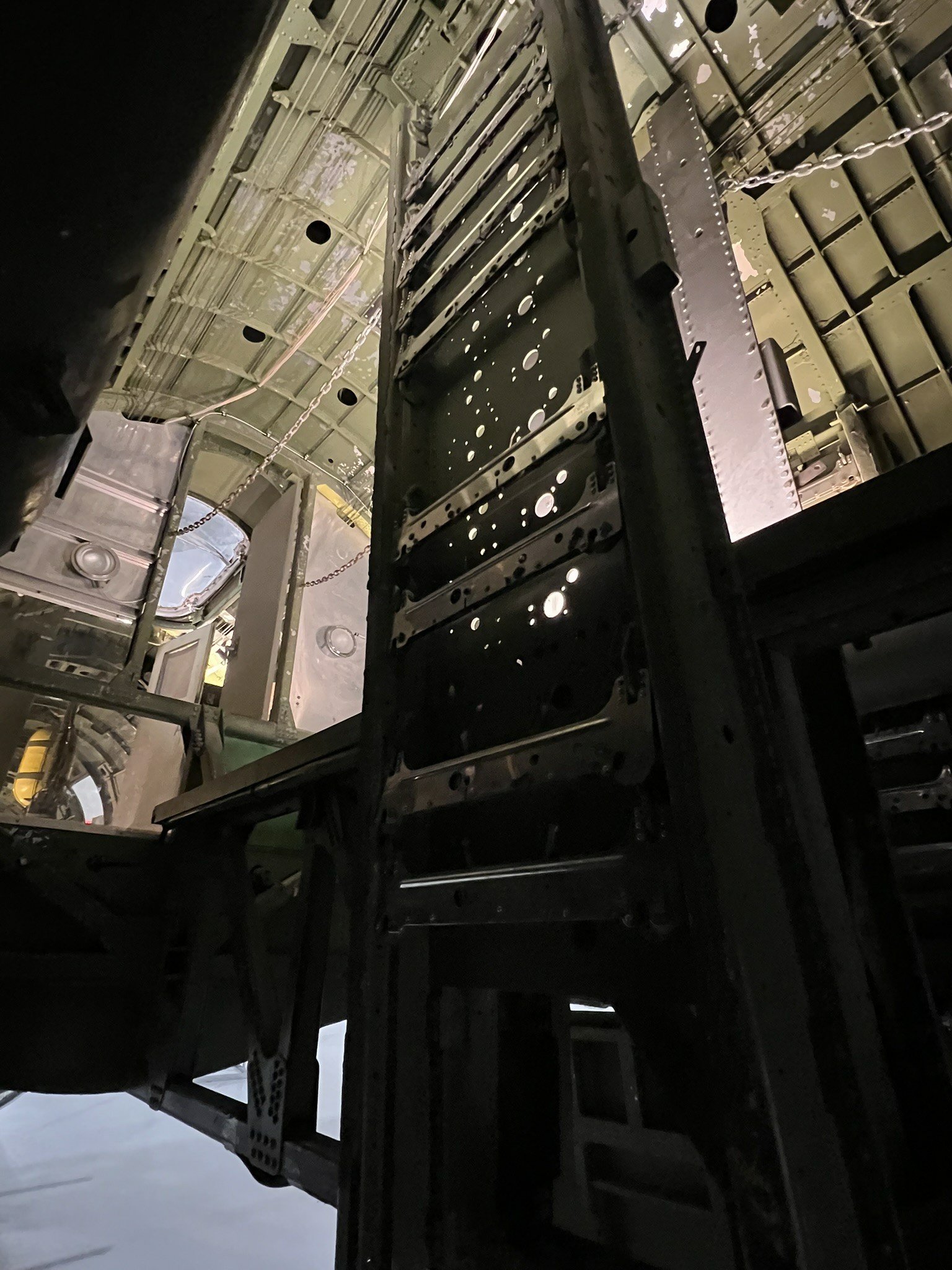
The bomb bay of I’ll Be Around. Note the unpainted Station 5.
At some point in her career, this bulkhead was removed entirely, necessitating it be replaced during restoration. This was surprisingly common, as several B-17 survivors today had to go through the same trouble.
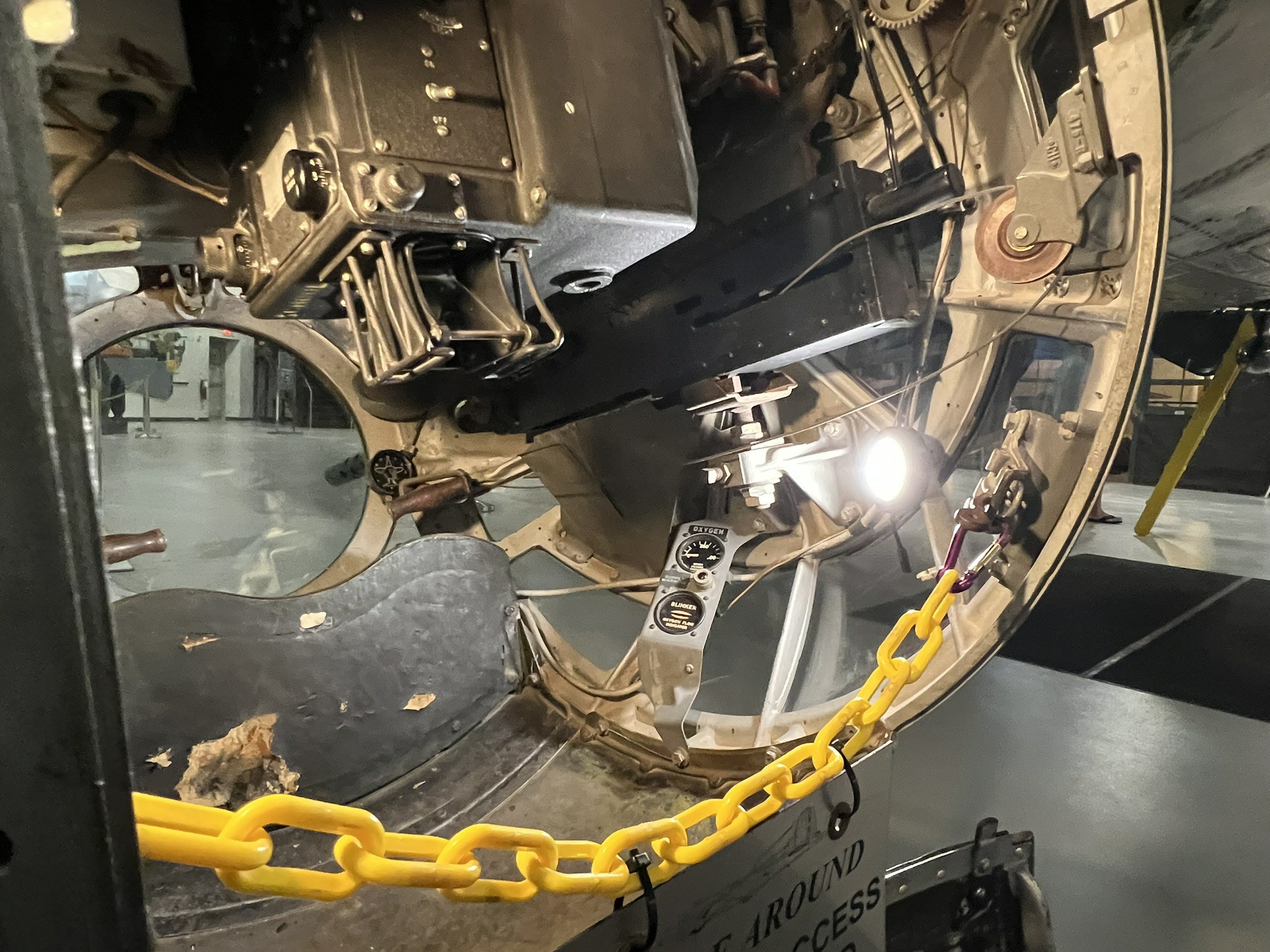
The Type A-2A Ball Turret aboard I’ll Be Around.
This turret is very well preserved, being a Briggs-made example. The black on the lower portion is the residue left from the adhesive that held the vinyl padding. A small piece of this padding is still visible on the seat plate.
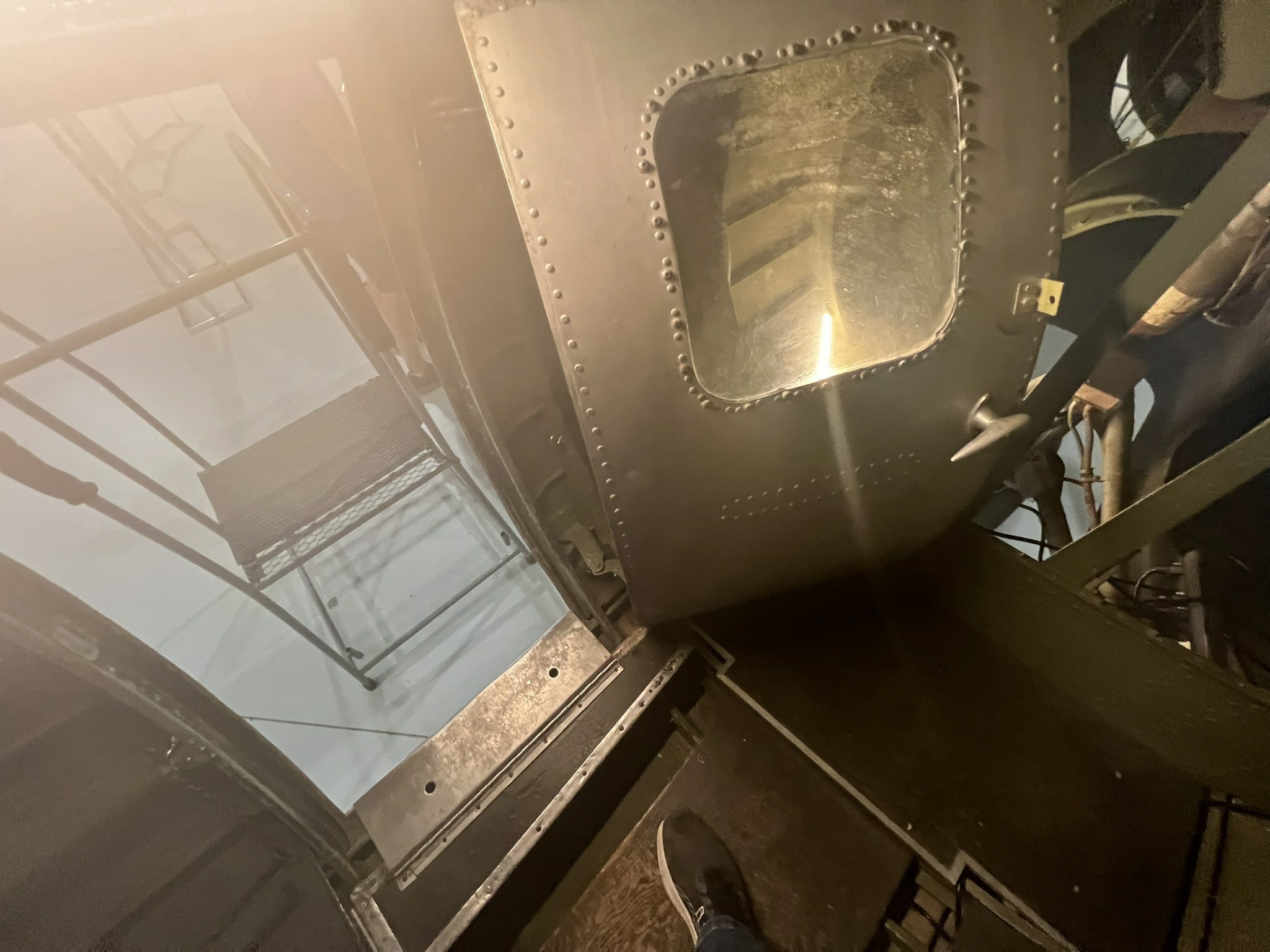
Another relic from I’ll Be Around‘s history with the US Coast Guard – her waist hatch opens inward instead of outward.
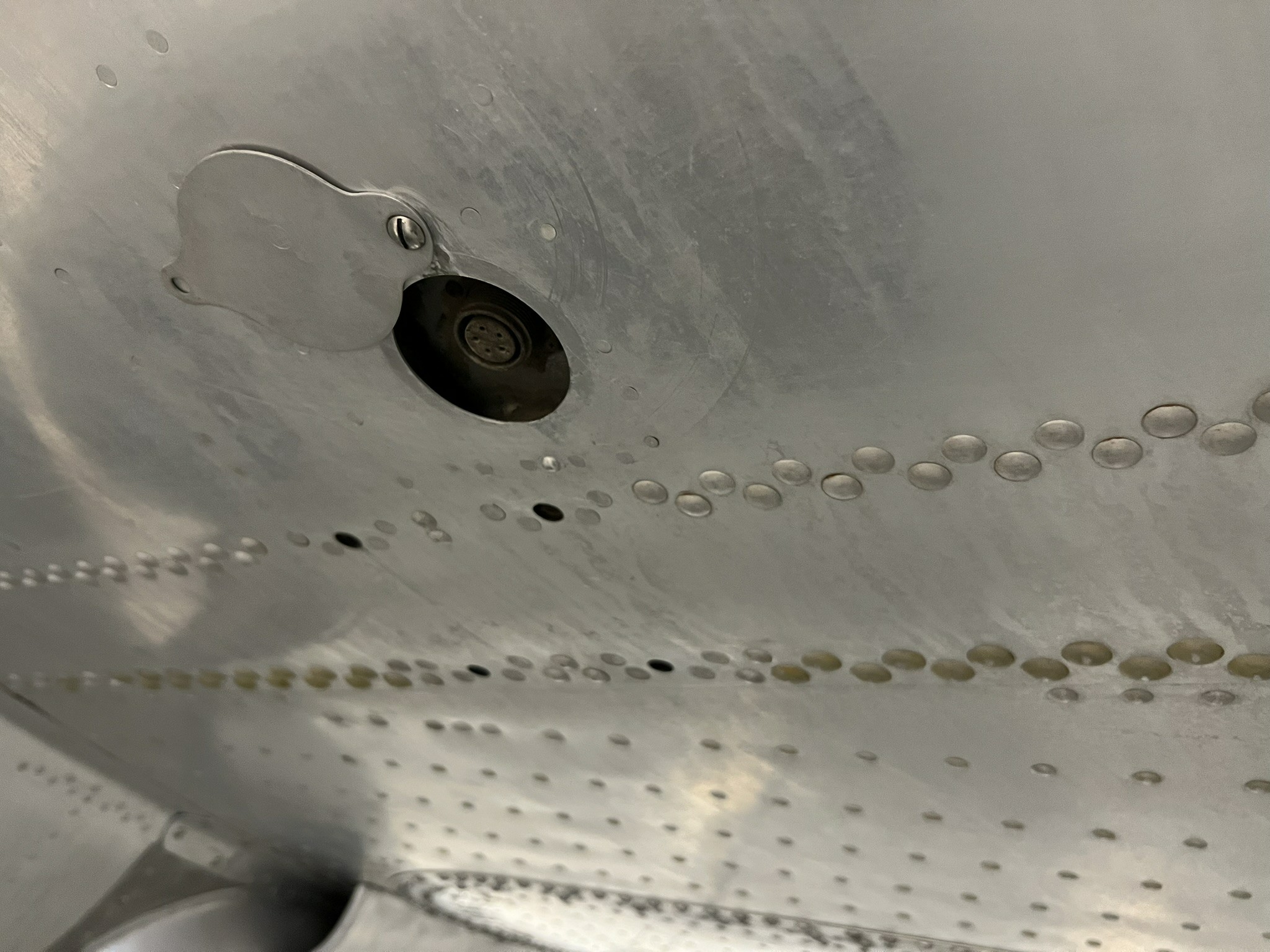
A rarely noticed piece on Boeing B-17s, this the electrical release socket for the aircraft’s external bombracks.
Today many dismiss the B-17’s payload as small compared to its contemporaries. These arguments are based on the B-17’s maximum internal payload of 6,000 lbs. However, the B-17 was perfectly capable of carrying an additional 8,000 lbs externally. In practice this was rarely done to maximize the altitude performance.
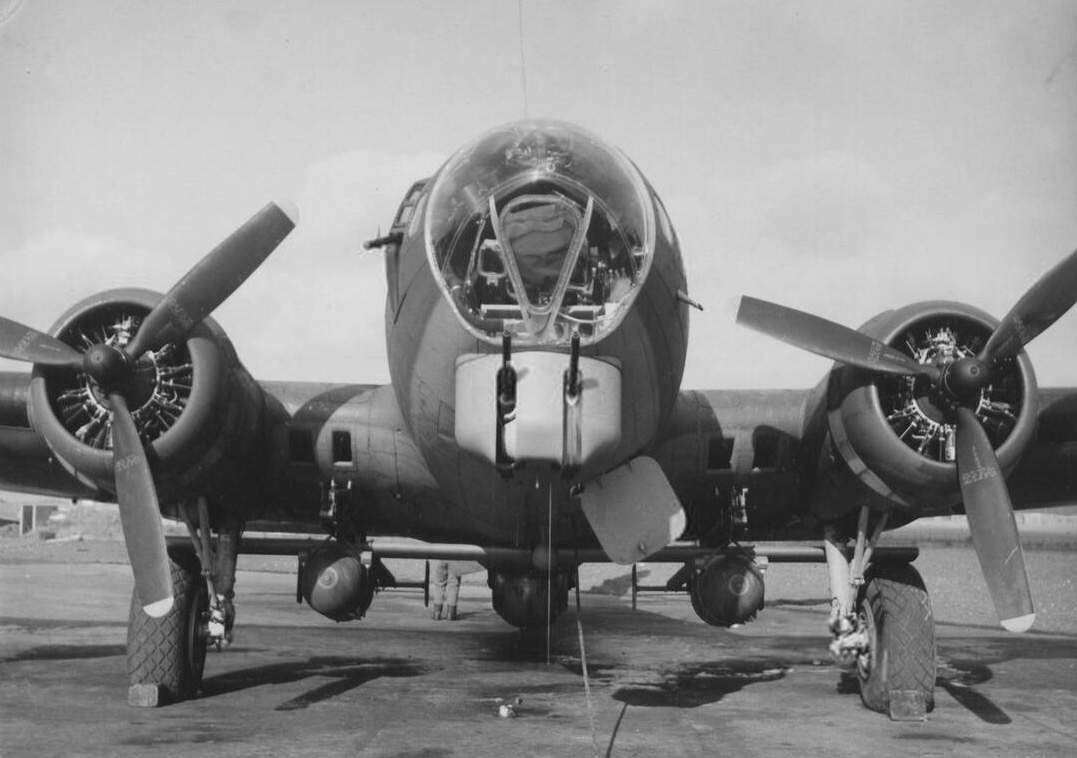
A pair of GB-1 glide bombs are fitted to the external racks of a Boeing B-17G of the 303BG.
The GB-1 was first used in combat on 28 May 1944. Mounting a 12 ft wing and tail assembly to a standard AN-M66 2,000 lb bomb, the GB-1 used a gyroscoped autopilot to hold its course once dropped some 20 mi from target. The GB-1 proved to be a failure, with only 42 of the 113 launched against Cologne hitting due to high winds and battery failures. While the 8AF never again used the GB-1 operationally, other air forces continued experimenting with the bomb until the project’s termination in January 1945.
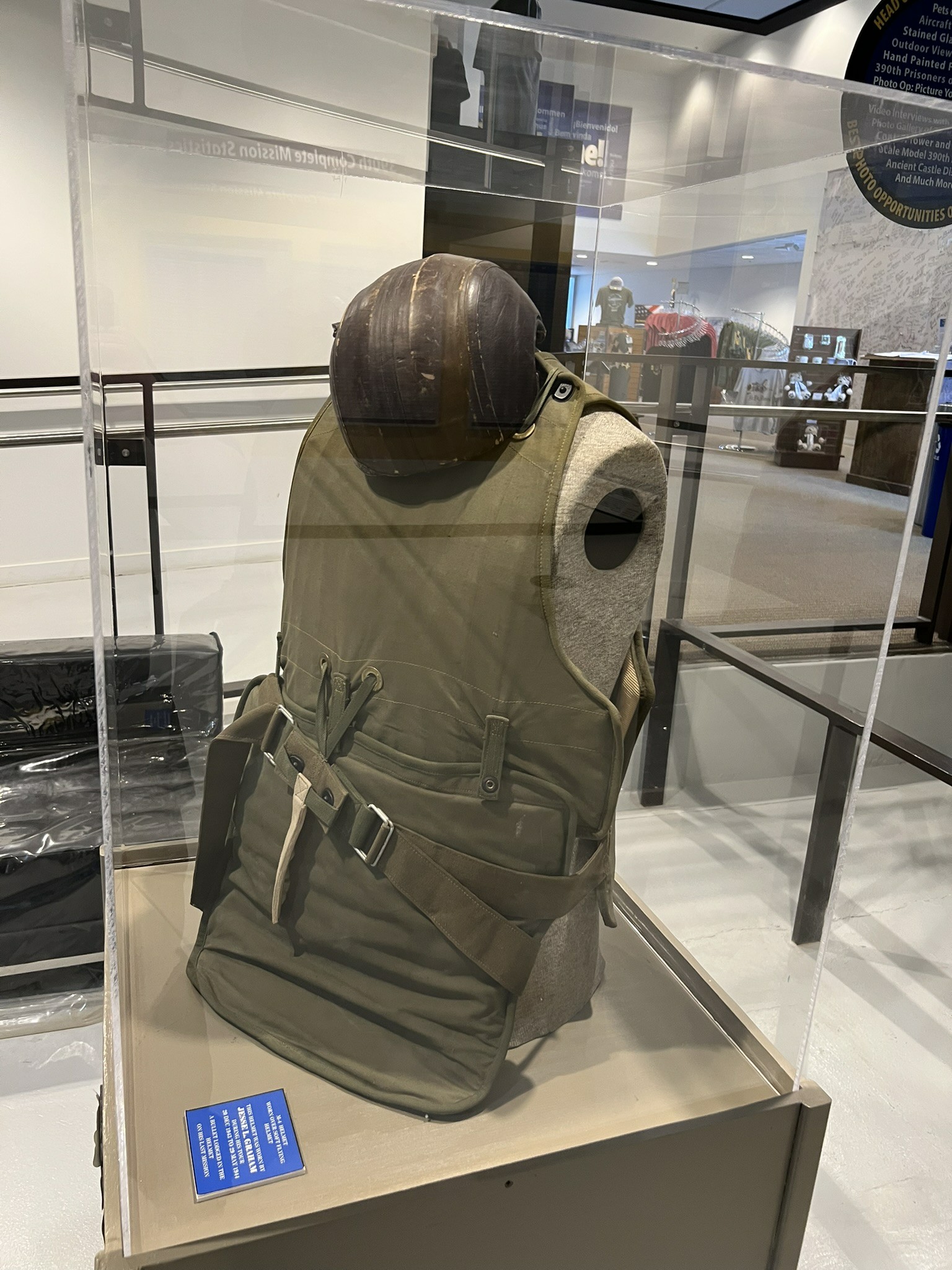
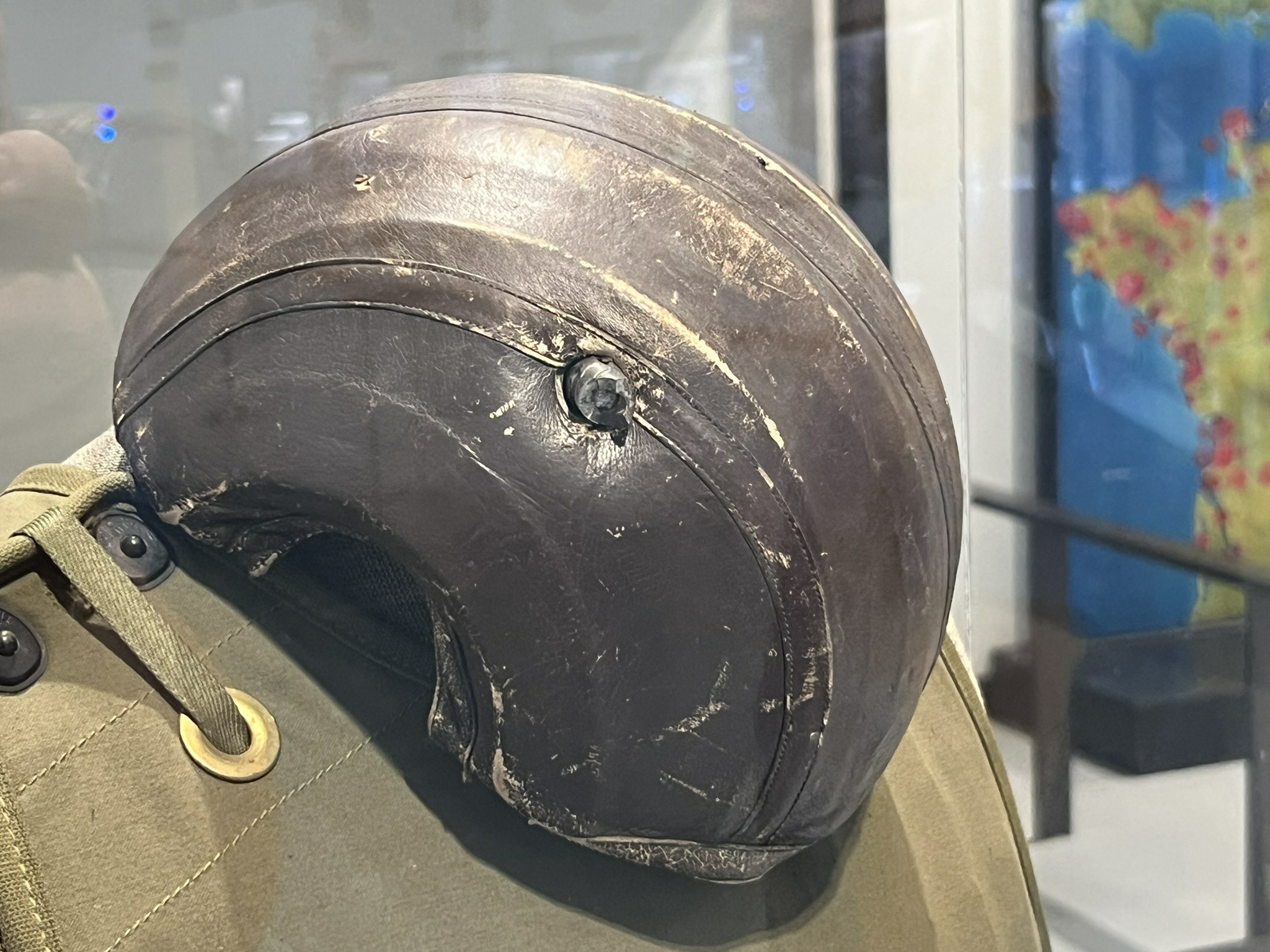
The flak helmet on this display belonged to SSGT Jesse L. Graham, a ball turret gunner with the 390BG.
The bullet lodged in Graham’s helmet on his final combat mission, flying aboard Gloria Ann II (42-107010) on 29 May 1944.
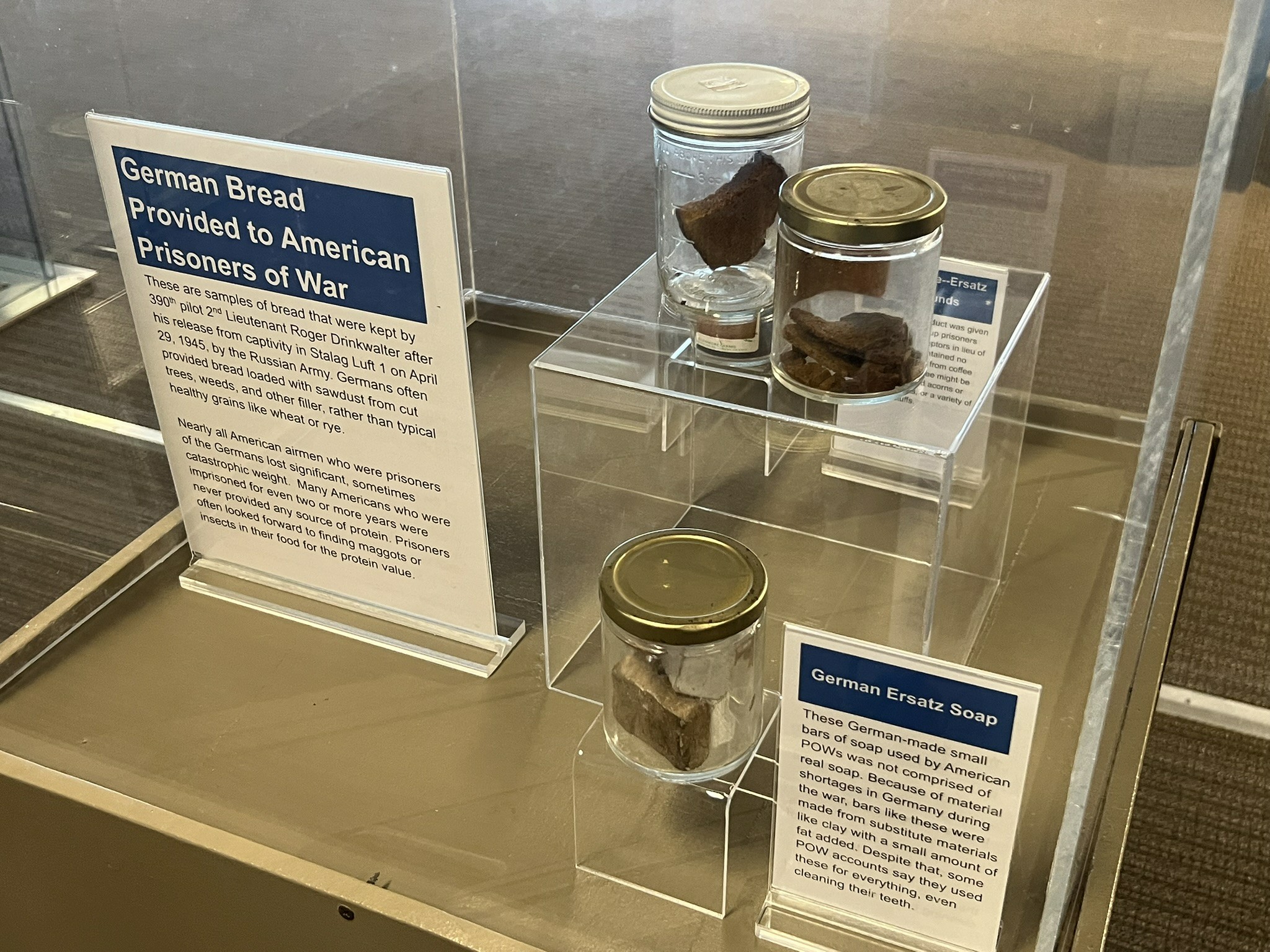
2LT Roger W. Drinkwalter was shot down on 2 January 1945 aboard Belle of the Brawl (42-97846) over Bad Kreuznach, Germany. Taken prisoner, Drinkwalter was liberated by Soviet forces on 29 April 1945.
Unsure of how the POWs would be treated by the Soviets, Drinkwalter held onto his German food and soap rations. These rare pieces are now on display at the 390BG Memorial Museum.
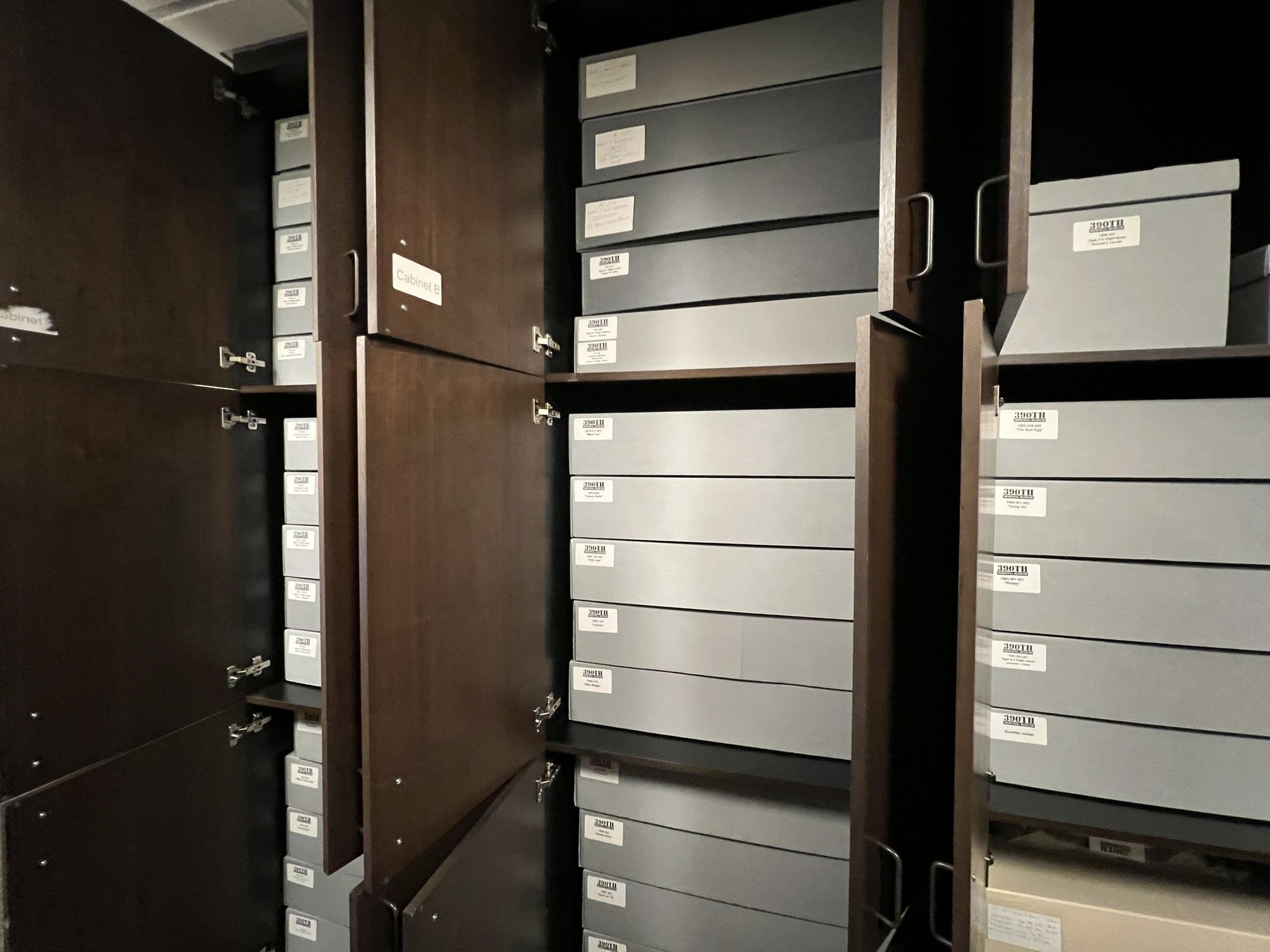
The level of professionalism displayed by the 390BG’s museum staff is exceptional.
Here, in the museum’s archives, each box holds a carefully preserved flight jacket in the museum’s collection. Displays in the main gallery are regularly switched out with jackets in the archives.
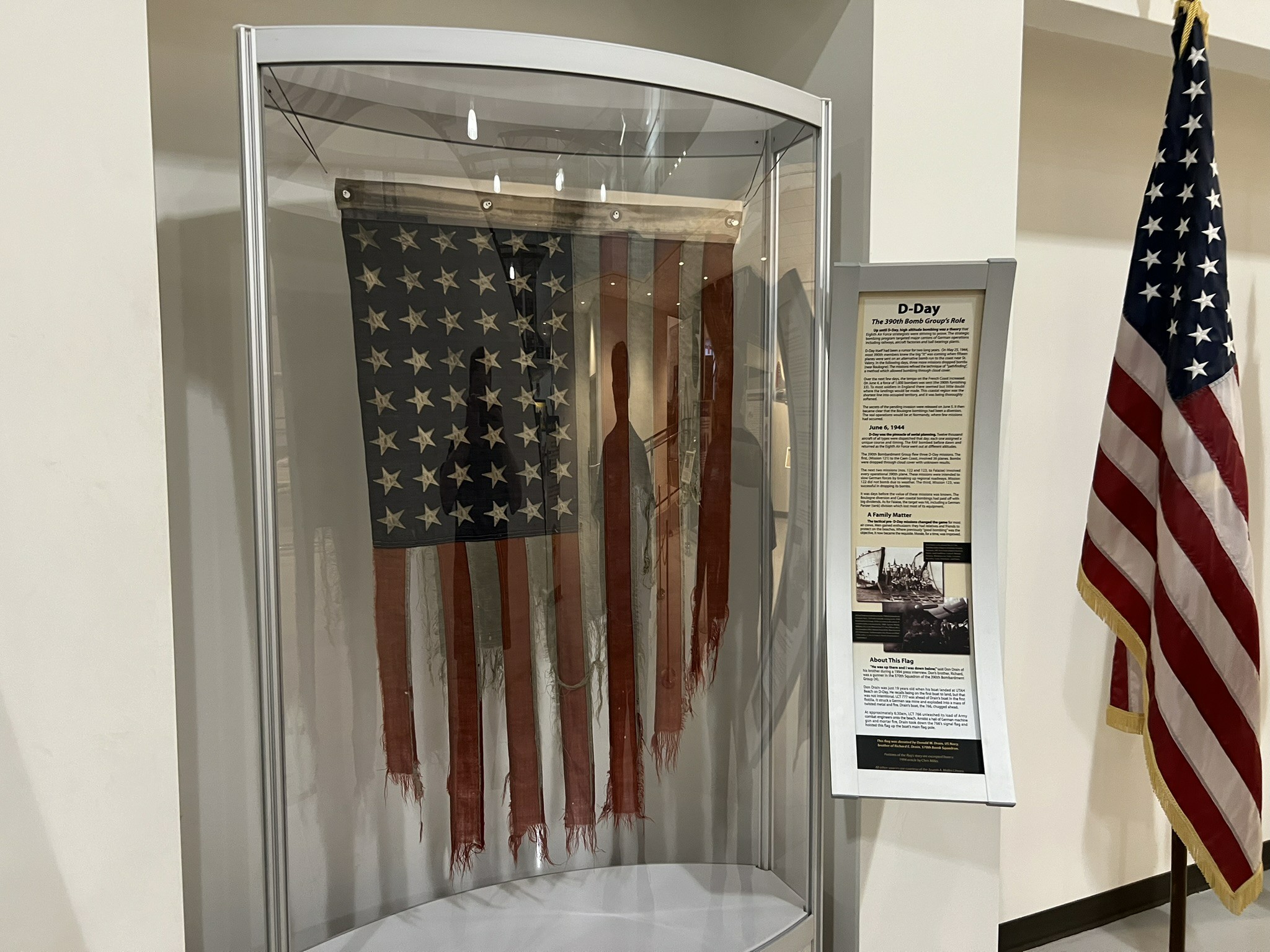
Perhaps the most incredible piece in the museum’s collection: the first US flag raised over Utah Beach during the D-Day invasion.
The flag was raised by Don W. Drain, a sailor aboard LCT 766, the first vessel to successfully land on the beach. His brother, Richard, was a radio operator with the 390BG.
Photos taken 11 August 2025.
Special thanks is due to Alex Chambers, the operations manager of the 390th Memorial Museum for being so welcoming and showing us around the museum. These guys really do amazing work and we highly recommend our supporters check out their facility.
With this post running long, I think I will stop here for now. To see more from our recent adventure, look out for our Roadtrip 2025 Pt. 2 post!
The Hangar Thirteen Foundation is a 501c3 nonprofit charity dedicated to bringing back a B-17F representative of the bloody counter-air campaign of June 1943 through March 1944. Donations to this project are tax deductible. If you can spare a little to help this project, you can guarantee that you will see the results on Facebook and here on our website.
You can contribute through the Donate page or, to avoid a PayPal fee, you can send something via the mail to:
Gerad Allen Blume
Hangar Thirteen Foundation
442 Old Chalk Bed Road
Batesburg, SC 29006
Volunteers are also always welcome. In fact, you need not be an Asheville resident – you can work from home! Persons skilled with metal fabrication, machining, CAD modeling, metal casting, 3D scanning, and laser/waterjet cutting, are particularly helpful. Just reach out to us to get started.
Keep the show on the road!