
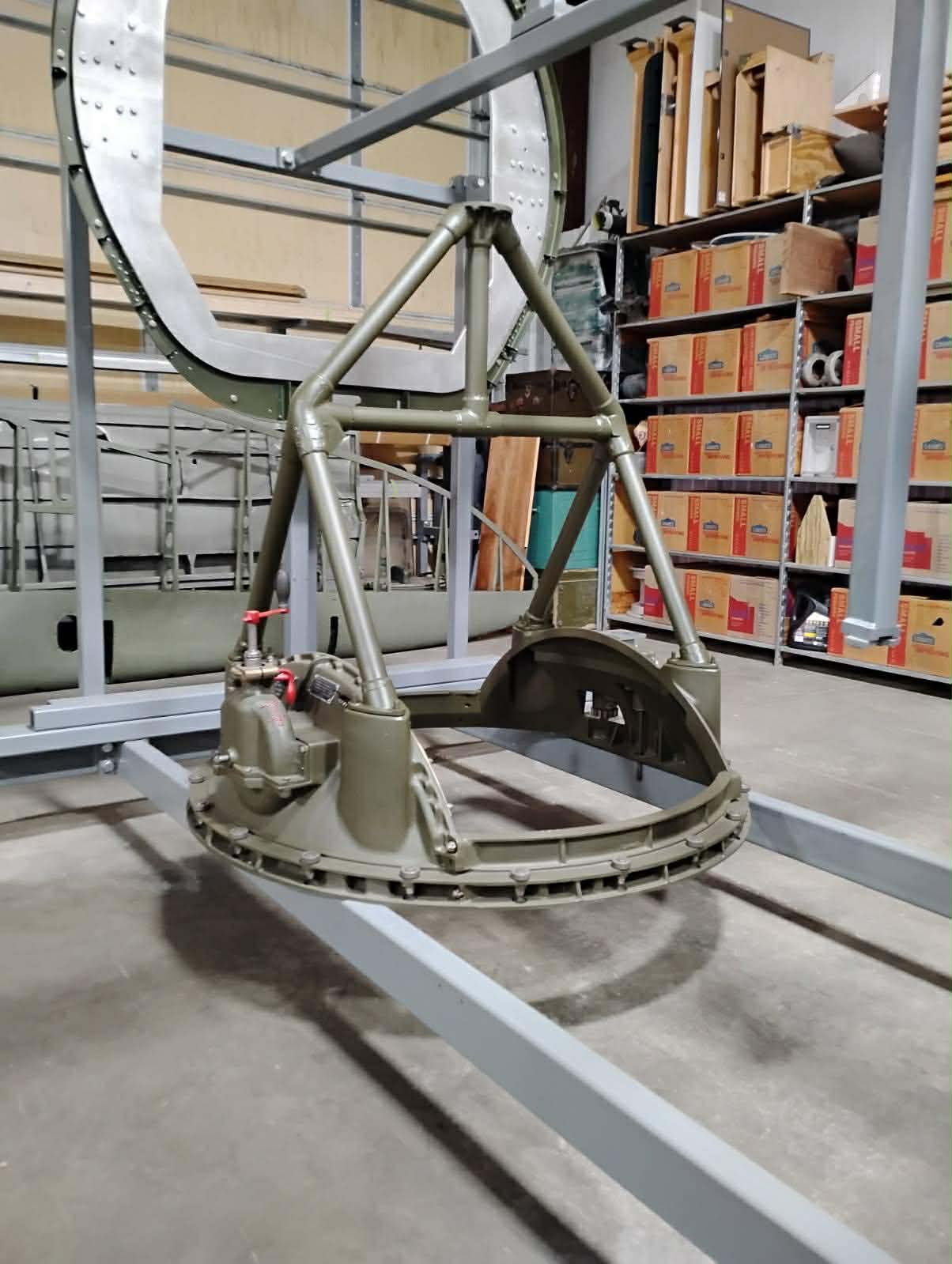
To start 2026 with some happy news, the hanger assembly for Lucky Thirteen‘s ball turret is now restored.
The bolts to secure it to the trunnion, as well as the electrical plug for the main power conduit, are currently on the way. (The plug had to be special ordered so, despite being purchased on 15 December, the estimated delivery date is 20 March.) Two longtime supporters are also hard at work on the spare parts box and oxygen bottle bracket which attach to this assembly. Whenever the timing is right, the hanger and trunnion will be returned to my woodshop, where I can attach the brush housing and begin wiring everything.
Words can hardly express how ecstatic we are seeing this come together.
Photo taken 16 January 2026.
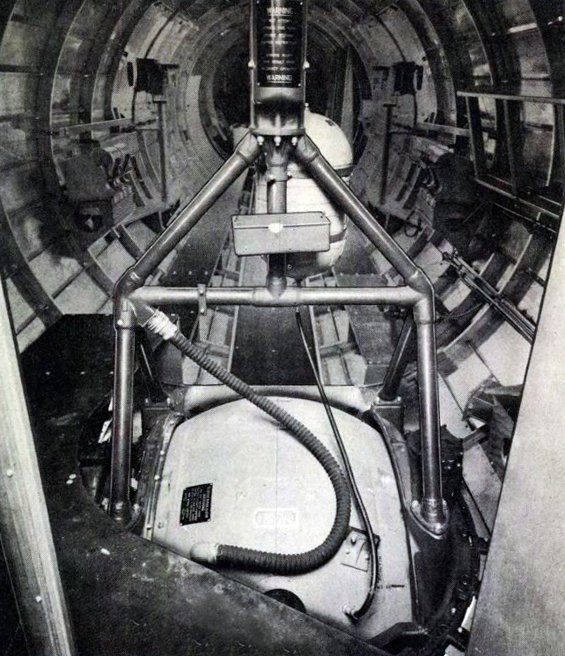
Manual photo of a Type A-2 Ball Turret aboard a late-B-17E or early-B-17F, based on the waist gun ammo cans.
The aforementioned oxygen tank, spare parts box, and main power conduit are all visible here.

The ball turret’s Type F-1 Oxygen Tank, restored and ready for installation.
Despite being a common sight on modern restorations, only the Type A-2 Ball Turret – the type on B-17E 42-2505 through block G-20-BO – carried its own tank. The other variants, characteristic to most surviving bombers, had their oxygen fed directly in from the aircraft’s supply. The silver nipple on this assembly (painstakingly recreated after extensive research) was for recharging the tank whenever its supply was low. It was the ball turret gunner’s responsibility to notify the waist gunners when the tank needed to be recharged.
Photo taken 14 June 2025.
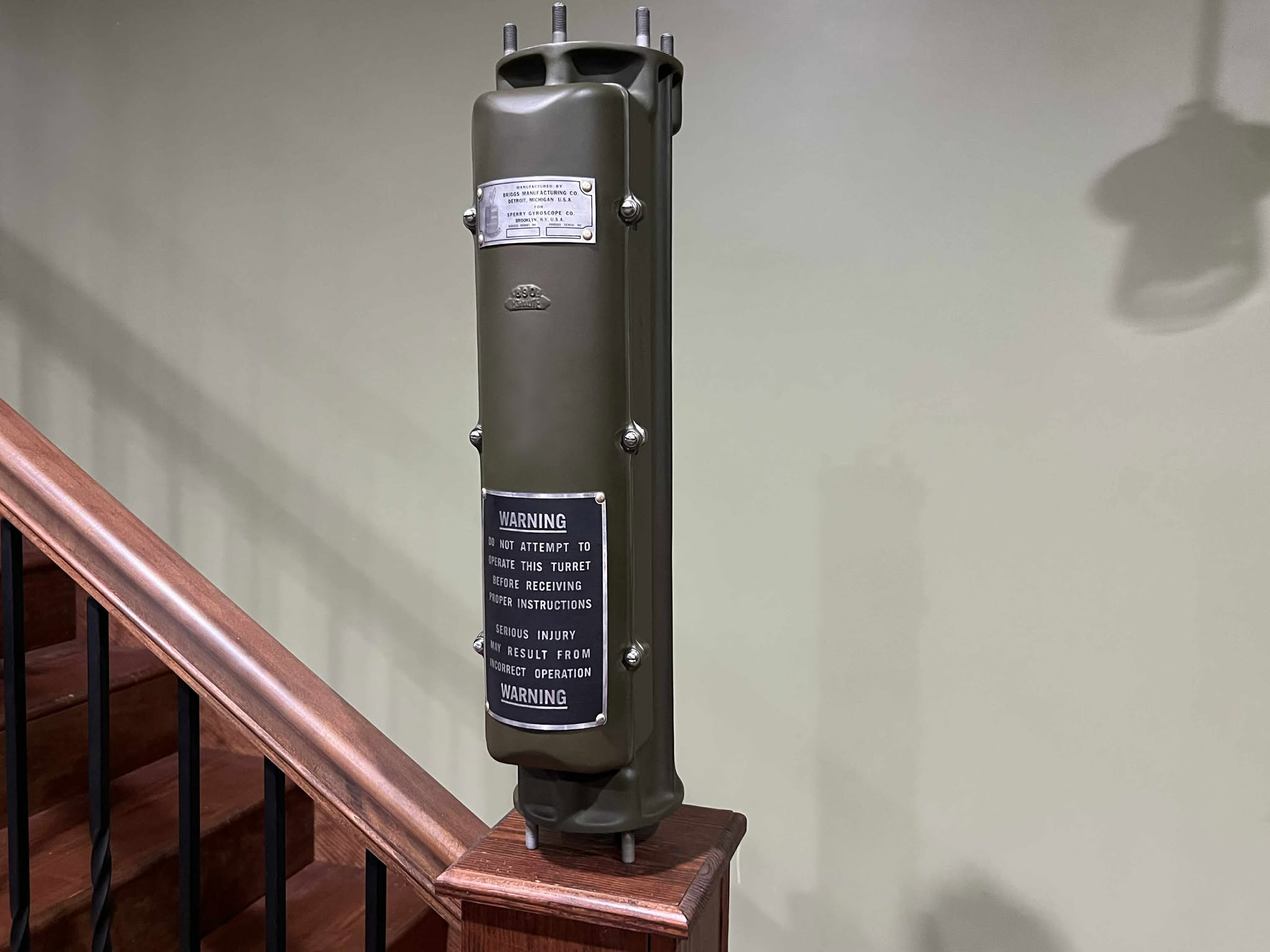
The restored brush housing, ready for installation to the ball turret hanger and trunnion assembly.
Photo taken 29 October 2025.
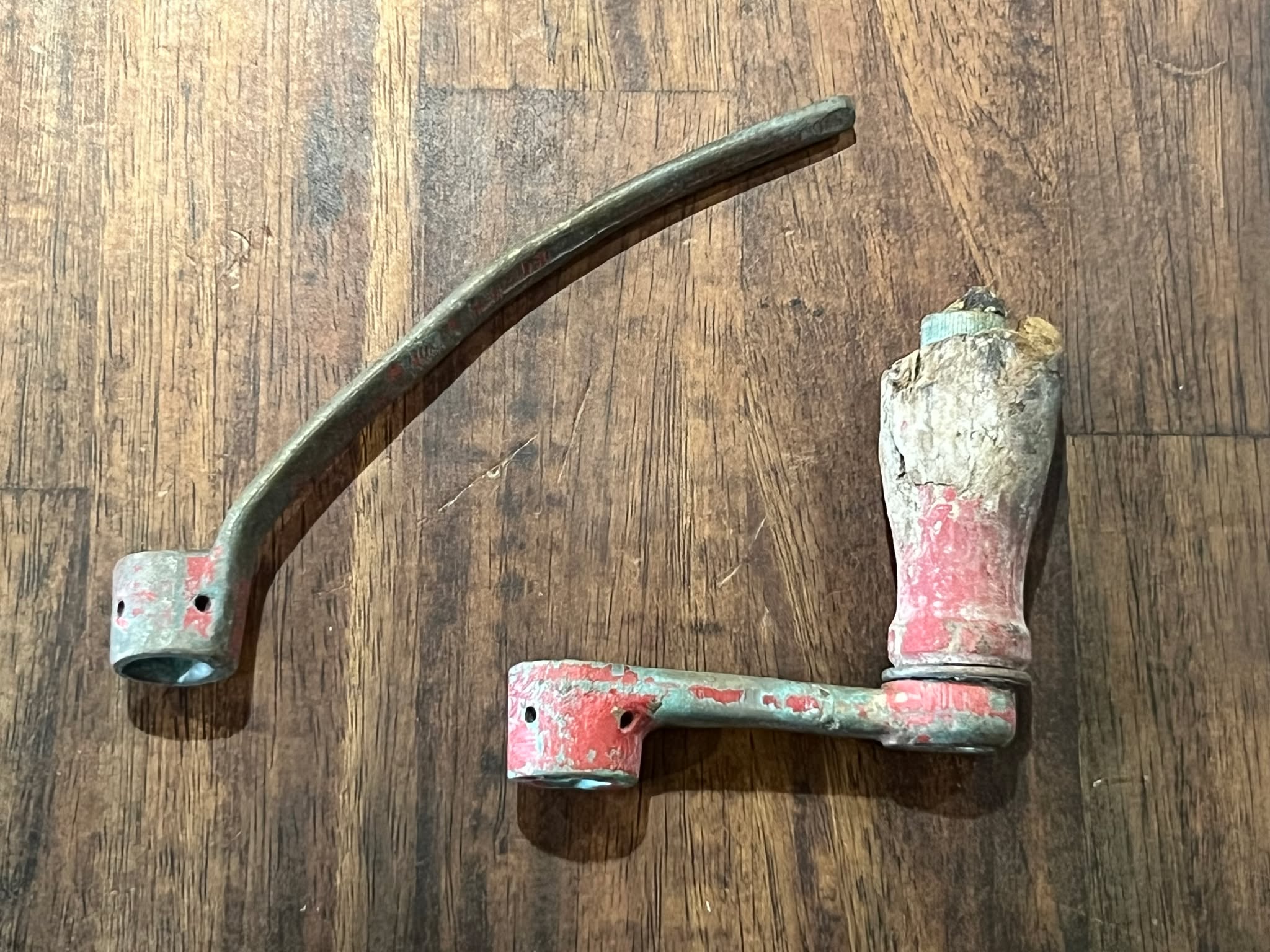
These pieces come to us from Andrew Cox in the UK. Dug up at old US airbases, these are the last handcranks needed for restoring Lucky Thirteen‘s Type A-2 Ball Turret.
The piece on the left is particularly rare, as it is the clutch release for the turret’s elevation gear. It is one of two handles stowed on the trunnion’s exterior.
Photo taken 8 January 2025.
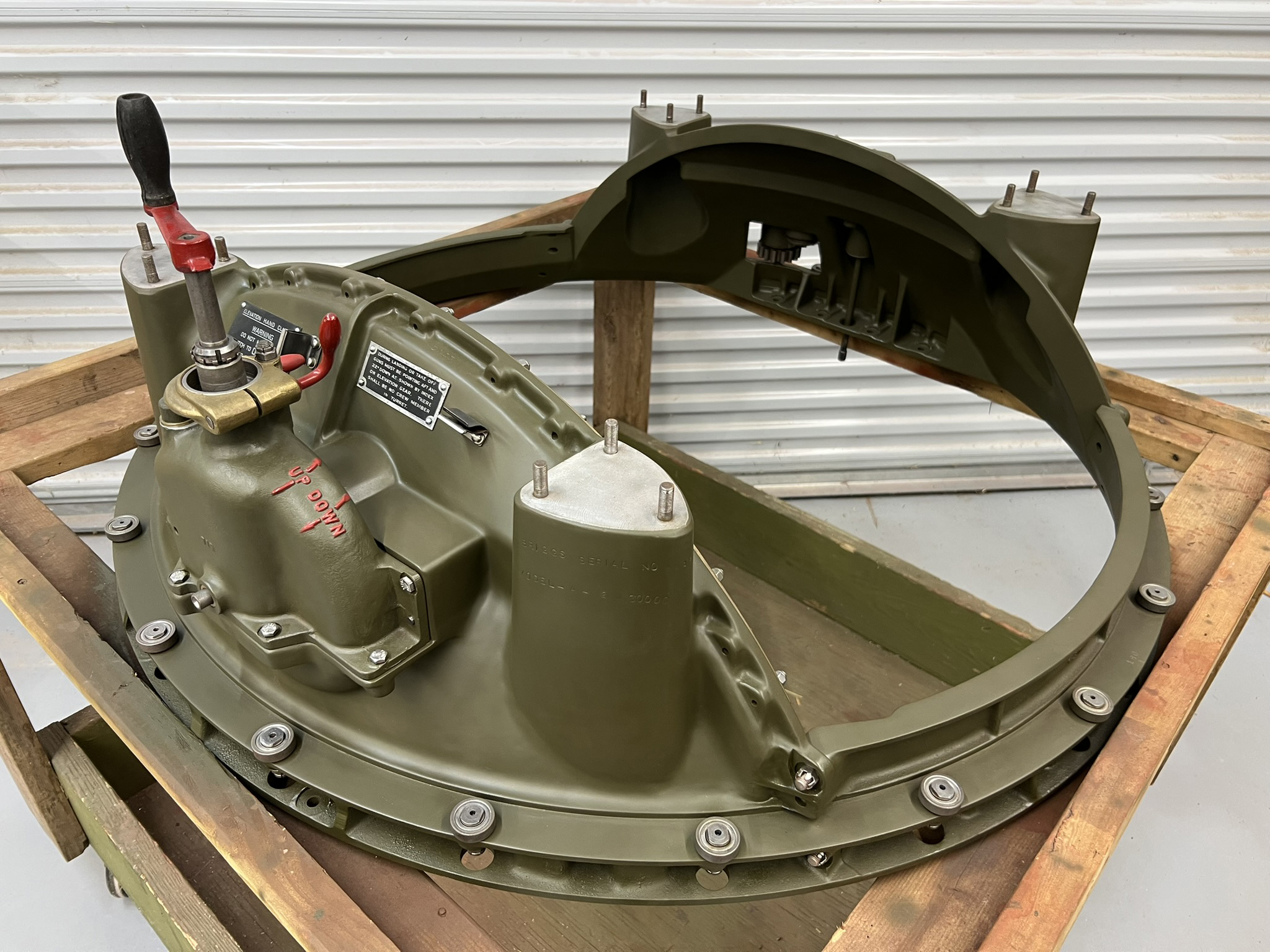
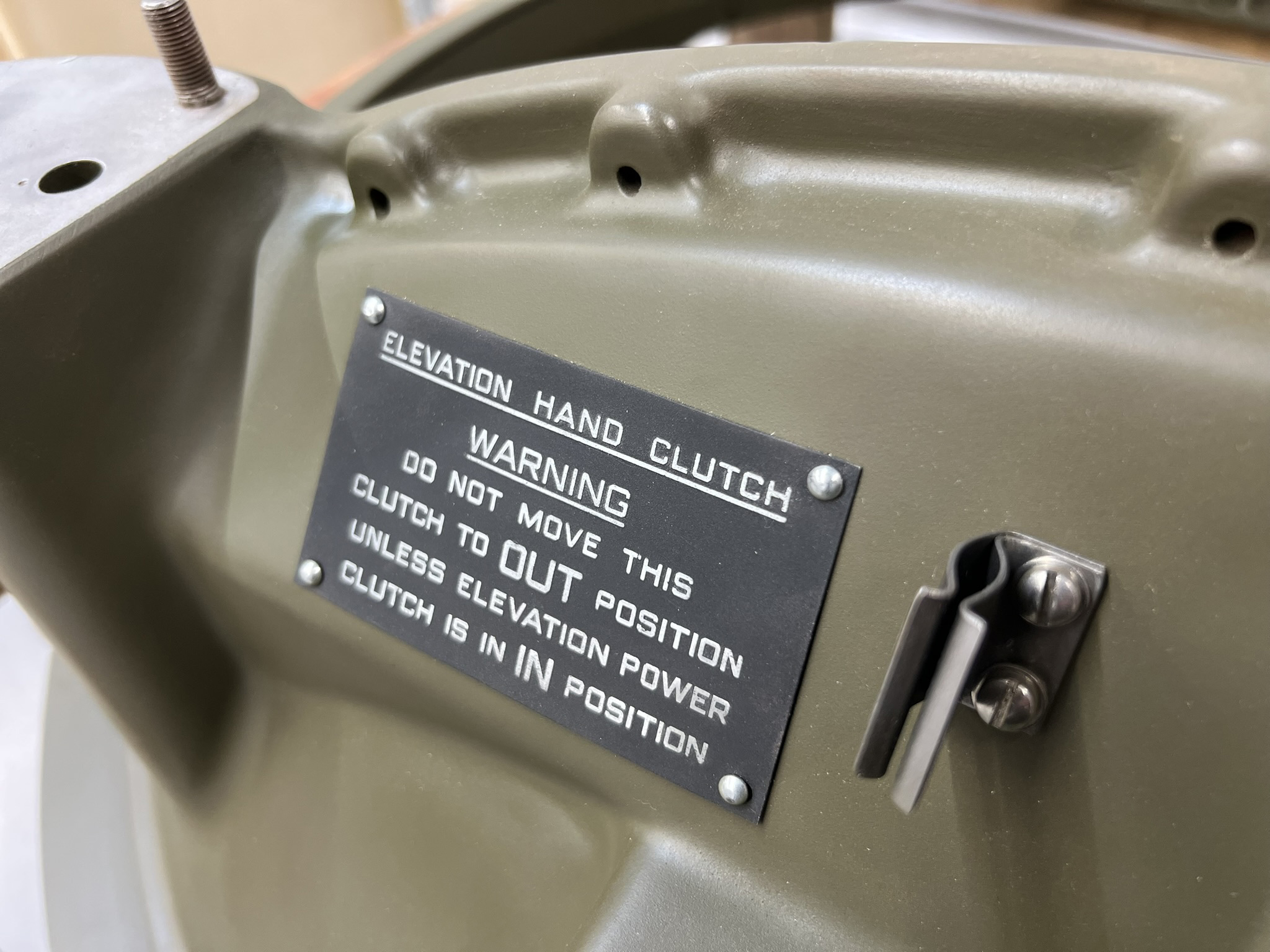
The elevation side of the trunnion held handles for the manual operating the elevation drive and the clutch connecting the external hand crank and internal gear. The close-up photo here shows where the clutch handle is stowed. All pieces here, including the placard, are original and were carefully restored.
The placard instructs the gunner to not pull out the clutch on the hand crank unless the clutch on the elevation gear is pushed in. On the Type A-2A, the clutch on the elevation hand crank was removed altogether. A report, recently provided to us by the Smithsonian, shows that these turrets vibrated terribly above 15,000 ft, recommending said external clutch be reinstalled.
Photos taken 6 August 2025.
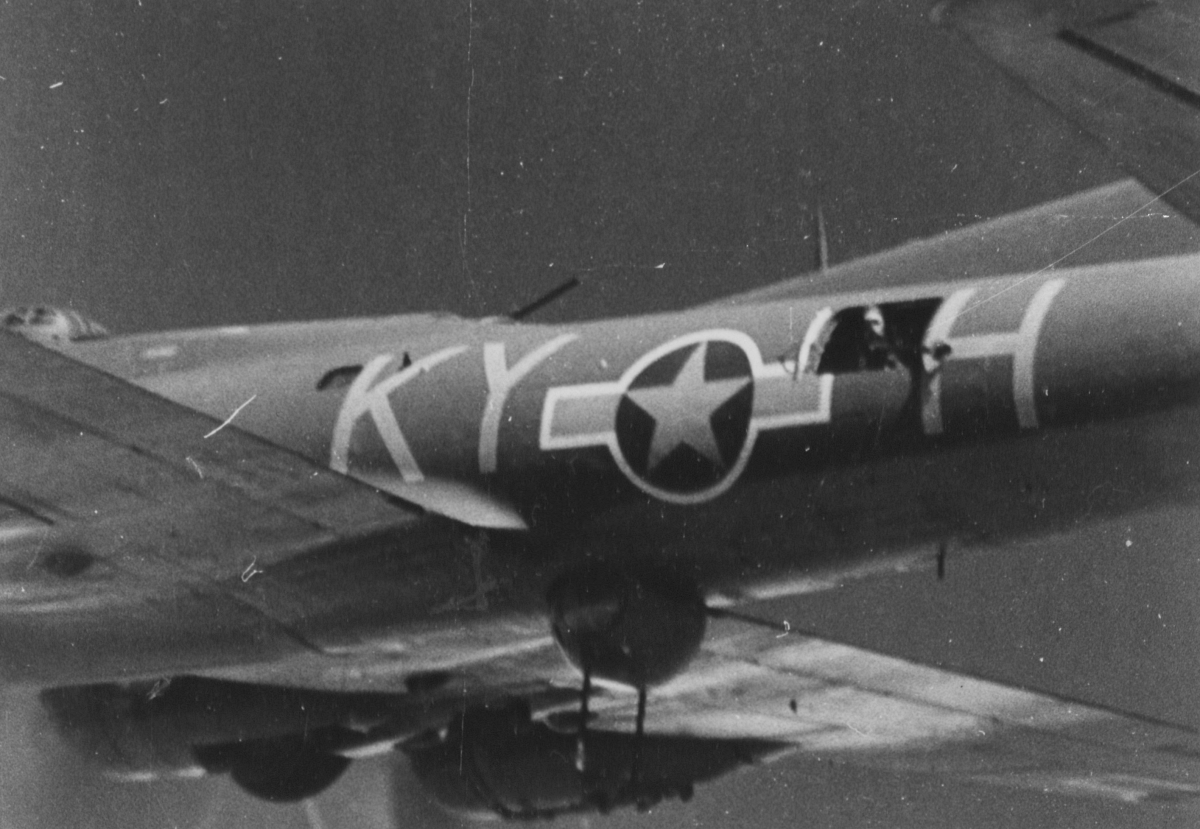
The external hand crank for elevation was necessary as the turret had to face down in order to enter or exit. This photo of Polly Ann (42-30647, 305BG) shows this exact scenario.
Polly Ann, a late-F like Lucky Thirteen, was lost on 23 September 1943 upon returning from a strike on the port of Nantes, France. She suffered a midair collision with “G-George” (42-30809) while in orbit to land, and while “G-George” escaped unharmed, all aboard Polly Ann were killed.
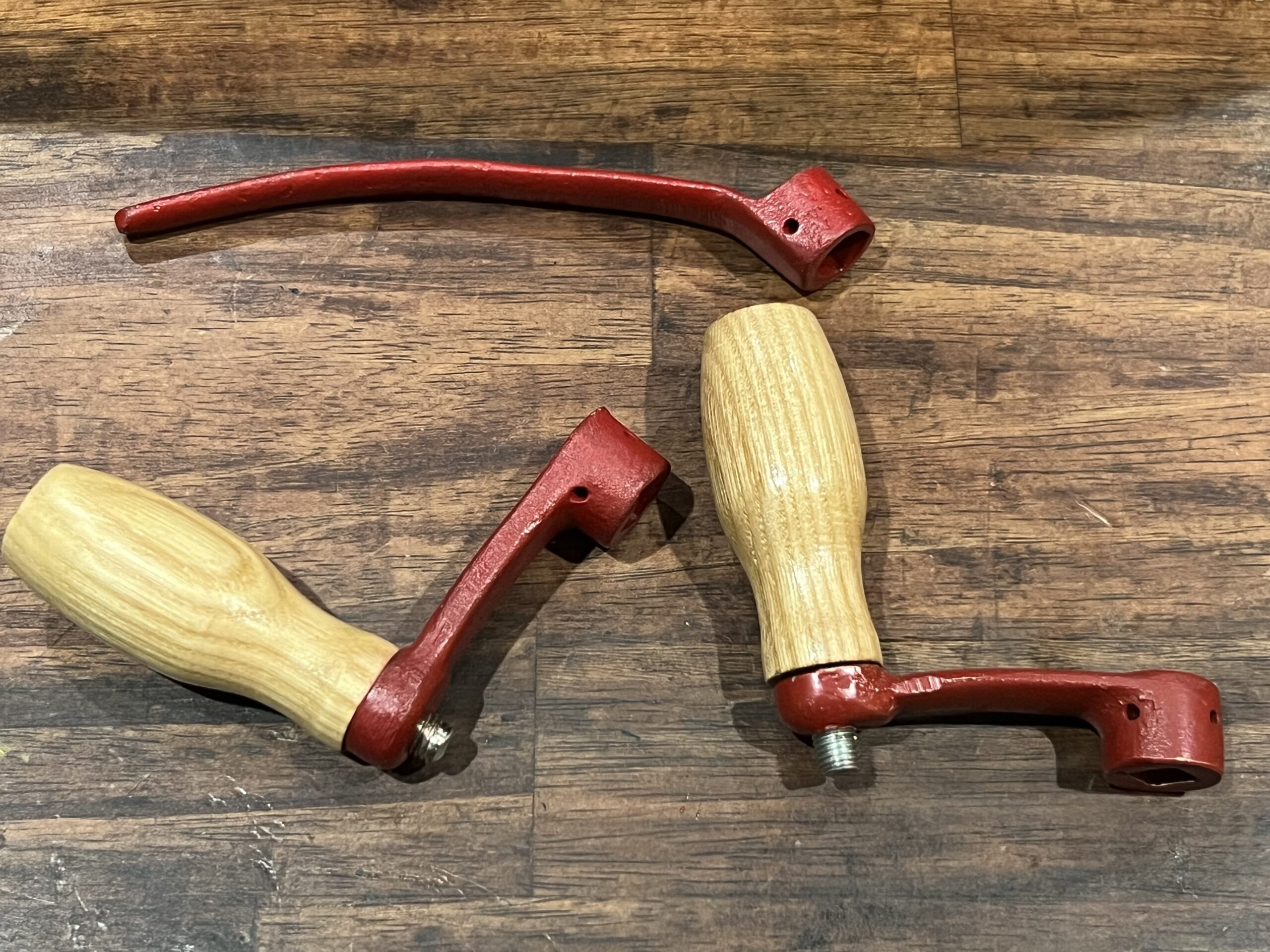
The fully restored handcranks. It took some time to get an exact match for the original red.
One of the two lower handles still wears its original paint…
Photo taken 15 January 2026.
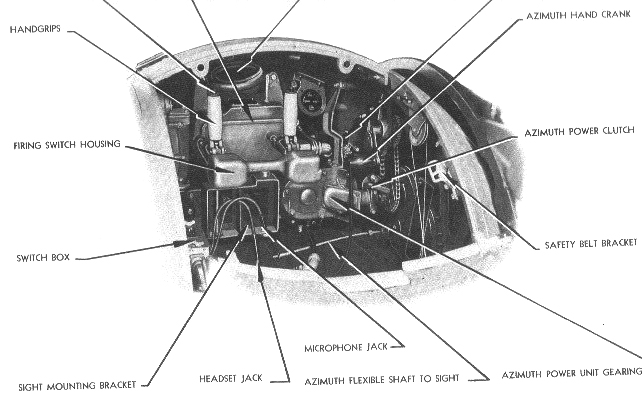
Despite the myth of the trapped ball turret gunner, the turret was fully able to move should it lose electrical power.
A pair of handcranks were stowed in clips above the gunner’s head, and could be attached to operate the elevation and azimuth gears. The crank for the elevation gear attached directly to the gear’s housing. The crank for the azimuth gear attached to a piece connected to the azimuth gears via a length of chain. This piece is visible in the manual illustration above.
Note the pressure gauge just to the right of the hand control. This is characteristic of Type A-2 Ball Turrets – in this case, a later one, like what was installed on Lucky Thirteen. This gauge simply told the gunner how much oxygen was in the tank attached to his turret. Later variants gave the gunner a proper oxygen panel by his right leg, adding a flow indicator and a low-pressure warning light.
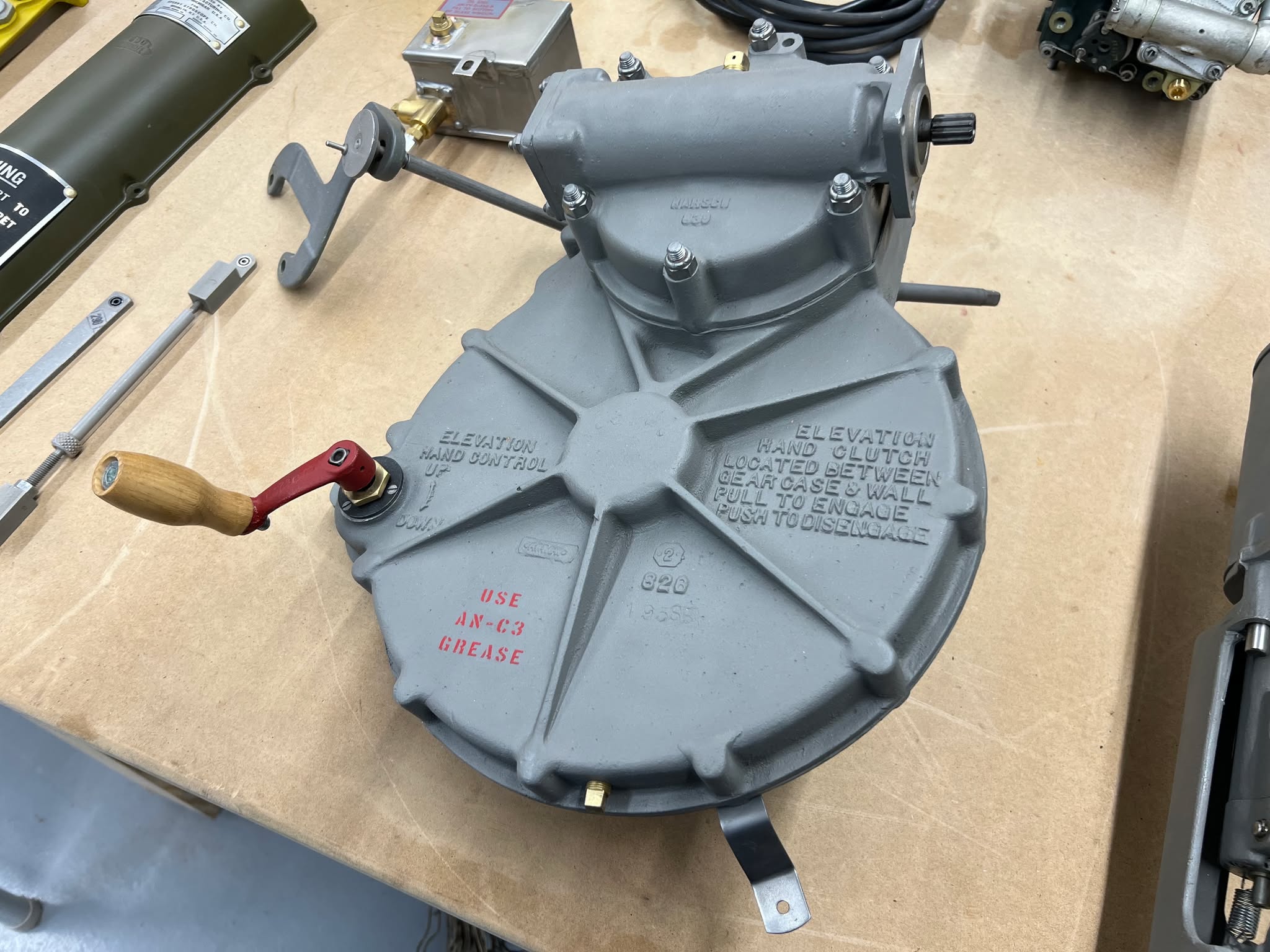
The elevation gear for Lucky Thirteen‘s ball turret, with its hand crank attached.
Photo taken 25 October 2025.
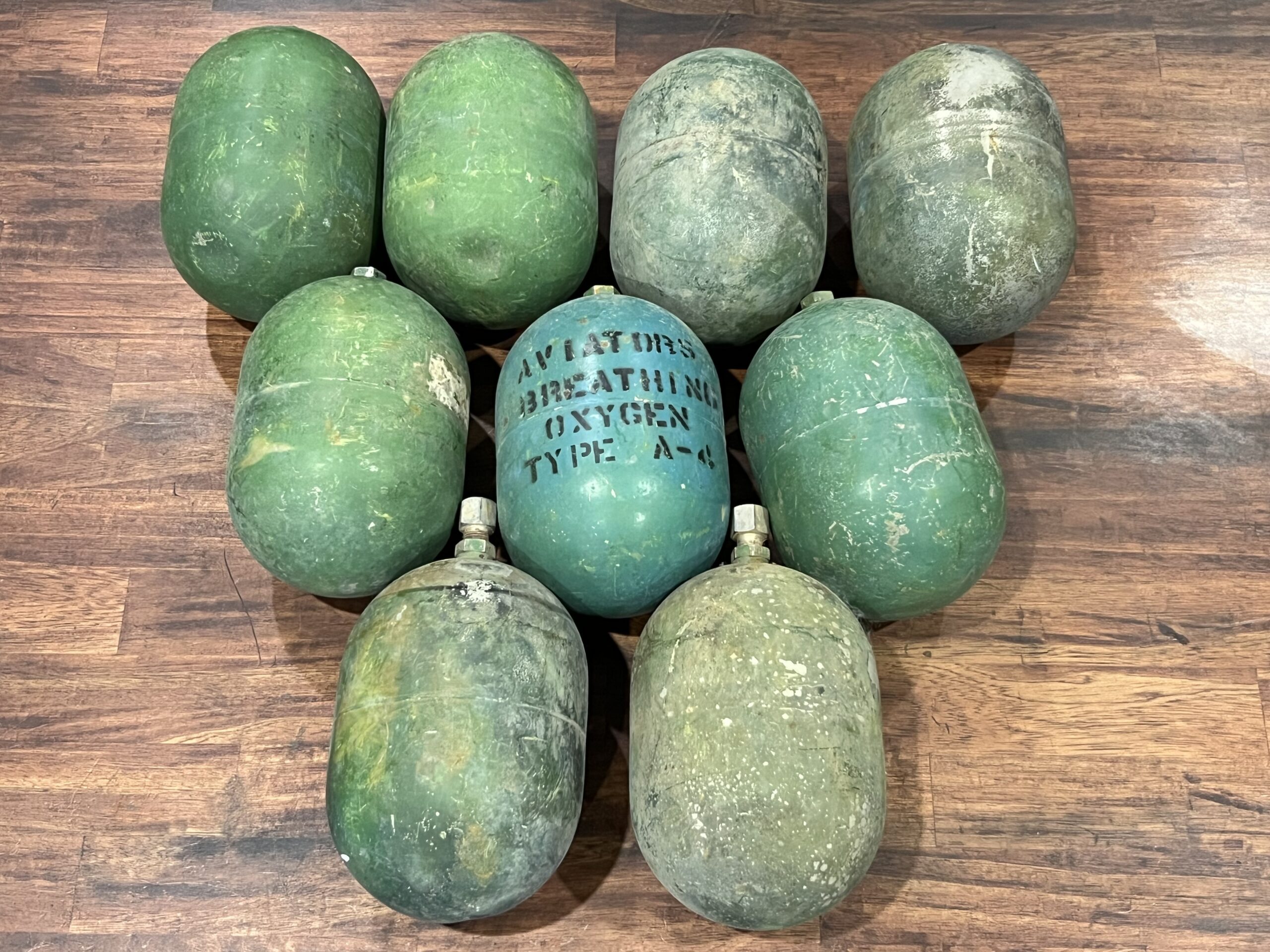
These Type A-4 Oxygen Walkaround Bottles come to us from Craig Cantwell of Justin, Texas. Craig is overseeing the restoration of an incredibly rare Fairchild AT-21 Gunner and we have corresponded back and forth since 2023. Because A-4s are popular on the collector’s market, gathering bottles for Lucky Thirteen has not been easy. So, we can hardly thank Craig enough for these awesome pieces.
Craig says he is eager to see me restore them. They still do not have their Type A-13 regulators but I can always fix up the bottles themselves. What do you think gang – should I go ahead and get started?
Photo taken 5 January 2026.
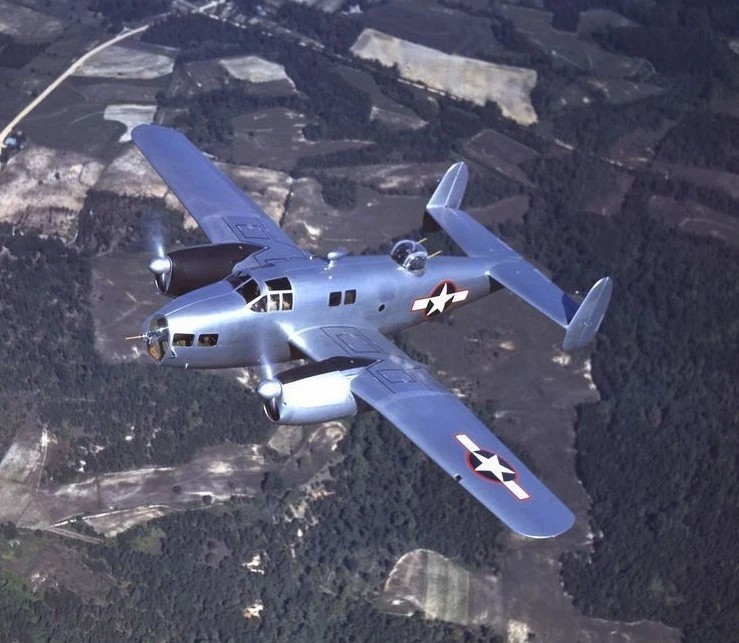
The Fairchild AT-21 was a rather unique aircraft amongst wartime US designs. Its tricycle landing gear was already unusual but what really set it apart was that AT-21 was the first US aircraft mass-produced with inverted V-12 engines and mass-produced using the Duramold process. The latter is particularly noteworthy. Fairchild found a niche in the war not just with their training designs but in the production of aircraft components. This was largely thanks to their patent for Duramold, an aircraft construction method which used compressed plywood veneers in place of valuable aluminum (as aluminum was rationed). Duramold was regularly used in the production of pieces like ferry tanks and is today most associated with the Hughes H-4 Hercules flying boat (who optioned its usage).
Designed as a purpose-built bombardment trainer – as opposed to the Beechcraft AT-11, which was a conversion of the civilian Model 18 – the AT-21 unfortunately did not perform well in its intended role. The aircraft’s short stature resulted in aerodynamic instability which, combined with other minor factors, made it too advanced for its intended role. Some 175 were built and the type was retired in 1944. Because of the rarity of this aircraft, Craig’s work in restoring her is truly something special.
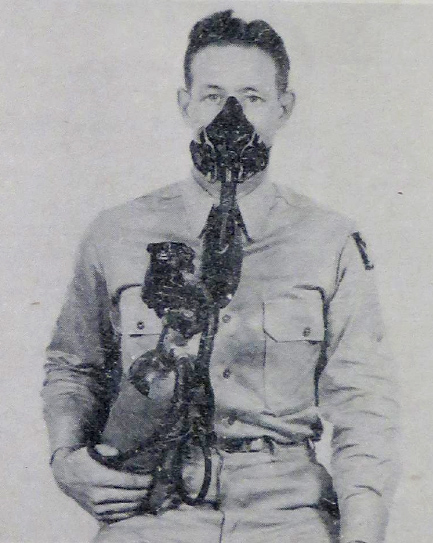
There were four types of walkaround bottles typically found on US heavy bombers: the A-2, A-4, D-2, and A-6 (each listed in order of service). With the exception of the A-2, all were demand-flow units, made to operate at around 400 PSI. Medium bombers, who typically operated at lower altitudes, used F-1 oxygen tanks converted into makeshift walkaround units.
The Boeing B-17 and Consolidated B-24 were equipped with constant flow oxygen systems up through blocks F-40-BO and D-40-CO respectively, with deliveries for such aircraft ending around the start of 1943. The constant flow system is generally associated with the Type A-8B Oxygen Mask, recognizable by its distinctive bladder. Such aircraft carried Type A-2 Walkaround Bottles, which carried 86 cub in of oxygen at 1800 psi. Said bottle gave the wearer some 45-60 min worth of oxygen.
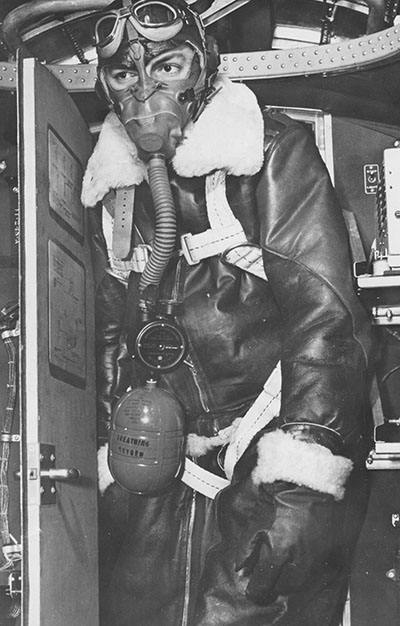
An airmen walks through the forward radio door of a late-B-17F just like Lucky Thirteen.
His Type A-10 mask is connected to a Type A-4 Walkaround Bottle. The A-4 carried 104 cub in of oxygen and was rated to last between 6-8 min, depending on the wearer’s breathing. The nipple on the side of the Type A-13 regulator was used to recharge the bottle using the aircraft’s oxygen supply. Bottles were available in both banded (stainless steel) and unbanded (low alloy) steel varieties.
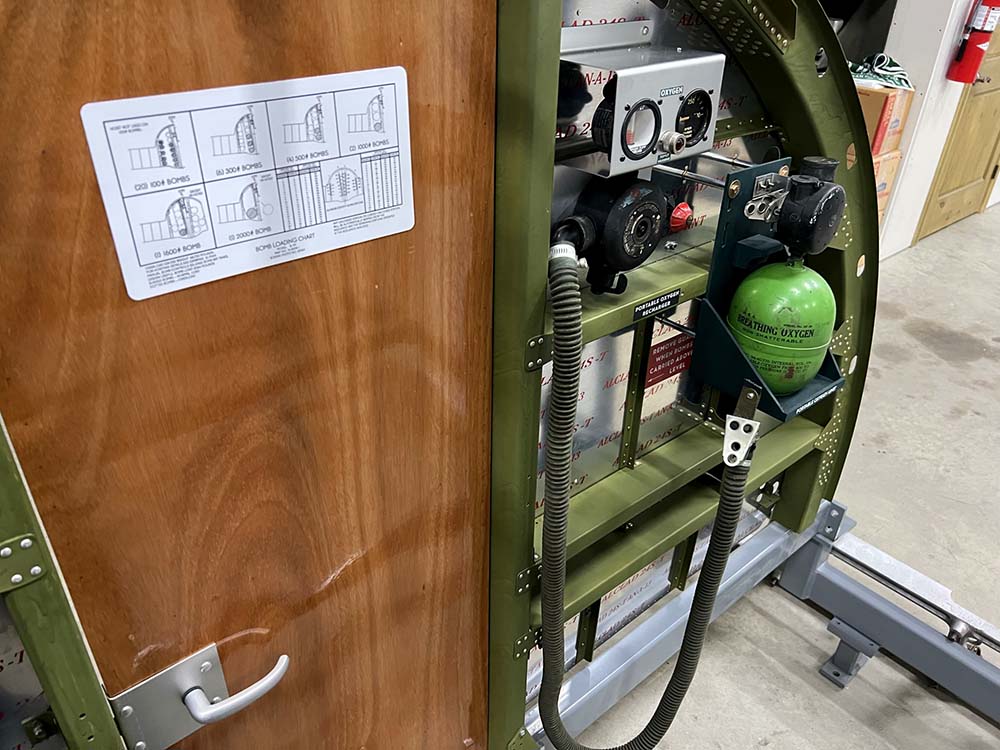
The oxygen panel on the bomb bay side of Station 5 on Lucky Thirteen. Note the A-4 Walkaround Bottle and its stowage bracket.
The standard B-17 carried thirteen walkaround bottles, and it is our intention to do just that with Lucky Thirteen. While they historically did not always match, we are hoping that all those on the aircraft will be unbanded A-4s with rounded A-13 regulators. Type A-13 Regulators were made by Peerless of Marion, IN, Lion of Chicago, IL (now Bally Entertainment), and Scott Aviation of Lancaster, NY (now 3M Scott Fire & Safety). The latter company produced the rounded face variant seen here.
Craig’s donation brings us much closer to that goal. Thanks buddy!
Photo taken 16 January 2023.
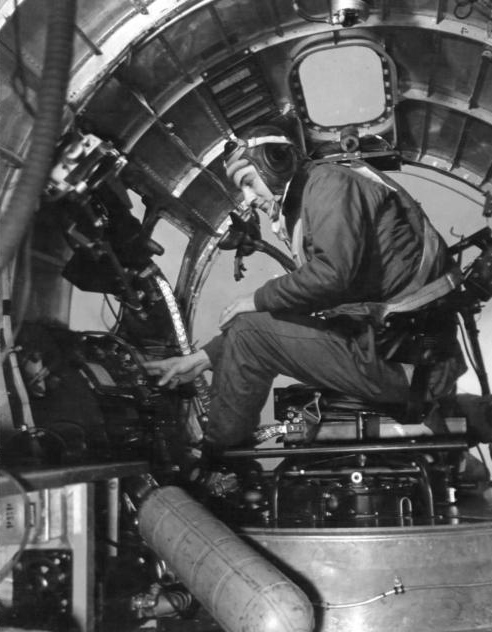
Bombardier 1LT Maurice A. Bonomo of the 91BG checks his instrument panel. Note the D-2 walkaround bottle by his left leg. The small size of the A-4 made it unpopular with crews and manuals encouraged flight engineers, in particular, to replace their A-4s with D-2s. It appears that Bonomo made a similar decision. Bonomo was shot down aboard Liberty Run (42-102509) on 20 July 1944 after AAA caused a fire over Leipzig. All of the crew survived and were taken prisoner.
The D-2 was common to Martin A-3 turrets and easy enough to acquire. The D-2 was eventually standardized as a walkaround bottle, replacing the A-4 on the B-17 in block G-100-BO, which roughly correlates toward the end of 1944. It is unclear when the B-24 made the same switch. The D-2 had a 500 cub in capacity and gave the wearer some 30 min worth of oxygen, depending on the wearer’s breathing. Bottles were available in both banded (stainless steel) and unbanded (low alloy) steel varieties.
It is worth noting that, with the exception of Shoo Shoo Baby at the Smithsonian Udvar-Hazy Center, and Virgin’s Delight at Castle Air Museum, the D-2 is the correct walkaround bottle for all surviving B-17Gs today.
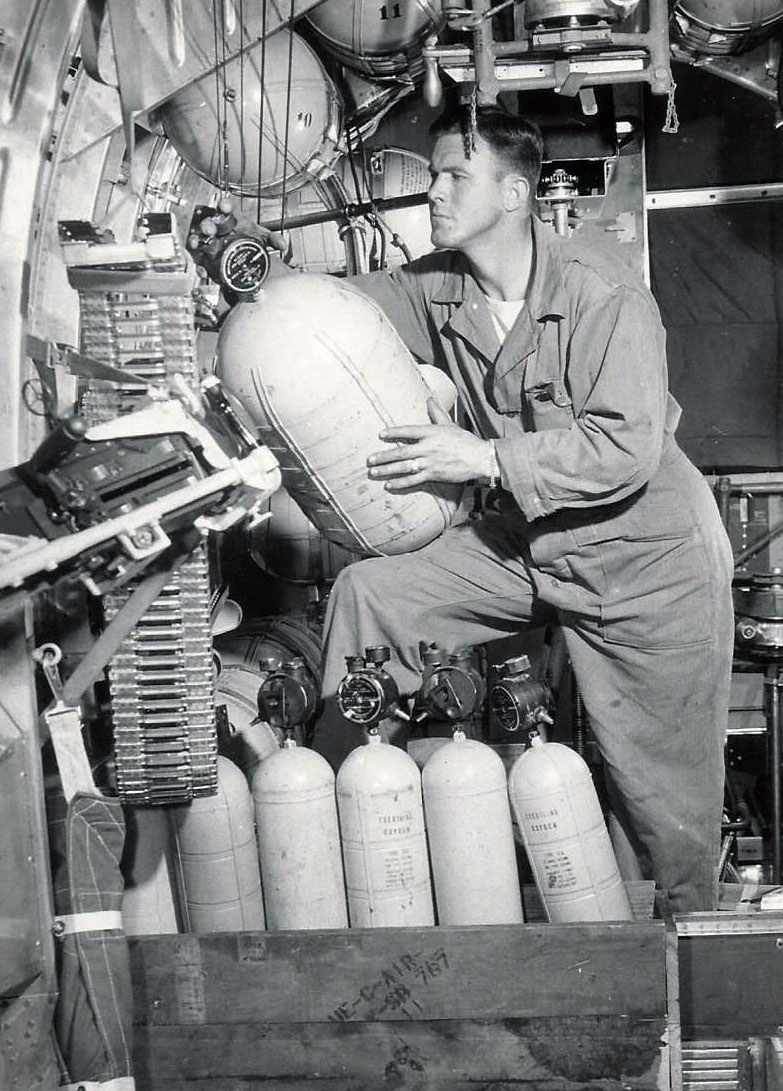
T/4 Clifford Coates recharges the oxygen system of a 466BG B-24.
Note the box of D-2 walkaround bottles.
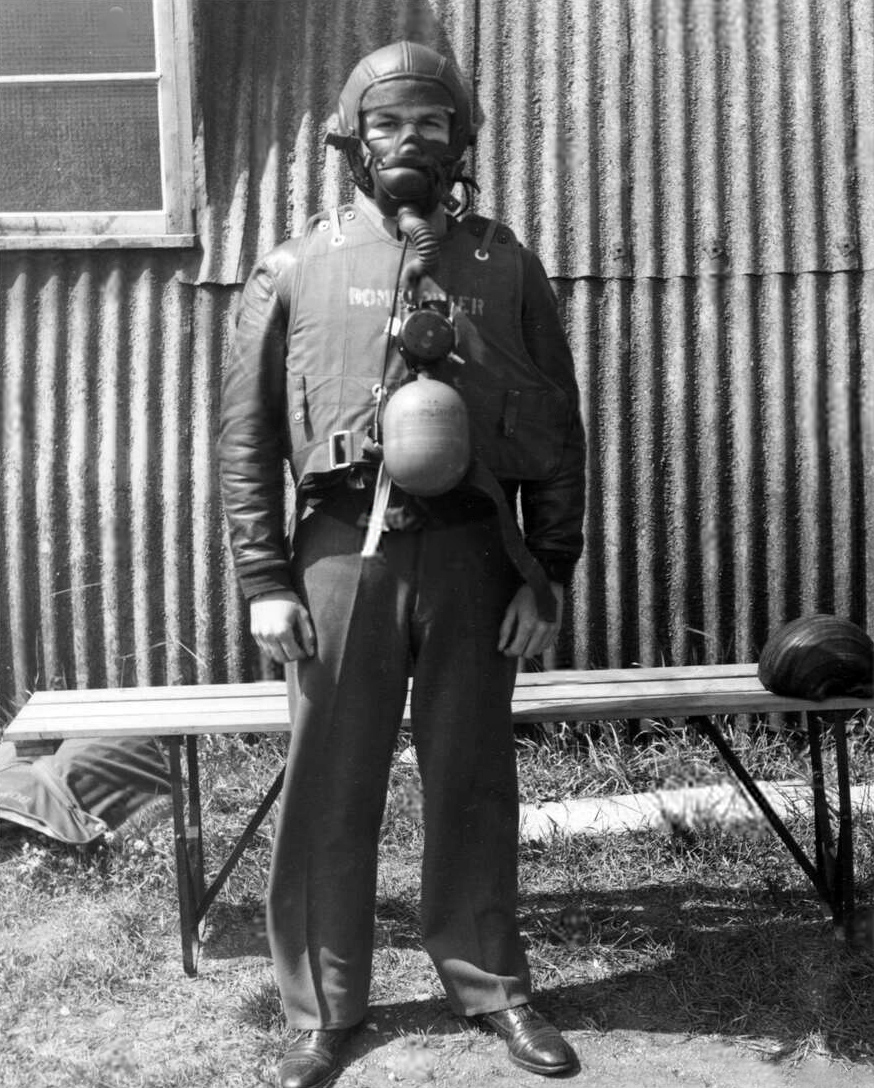
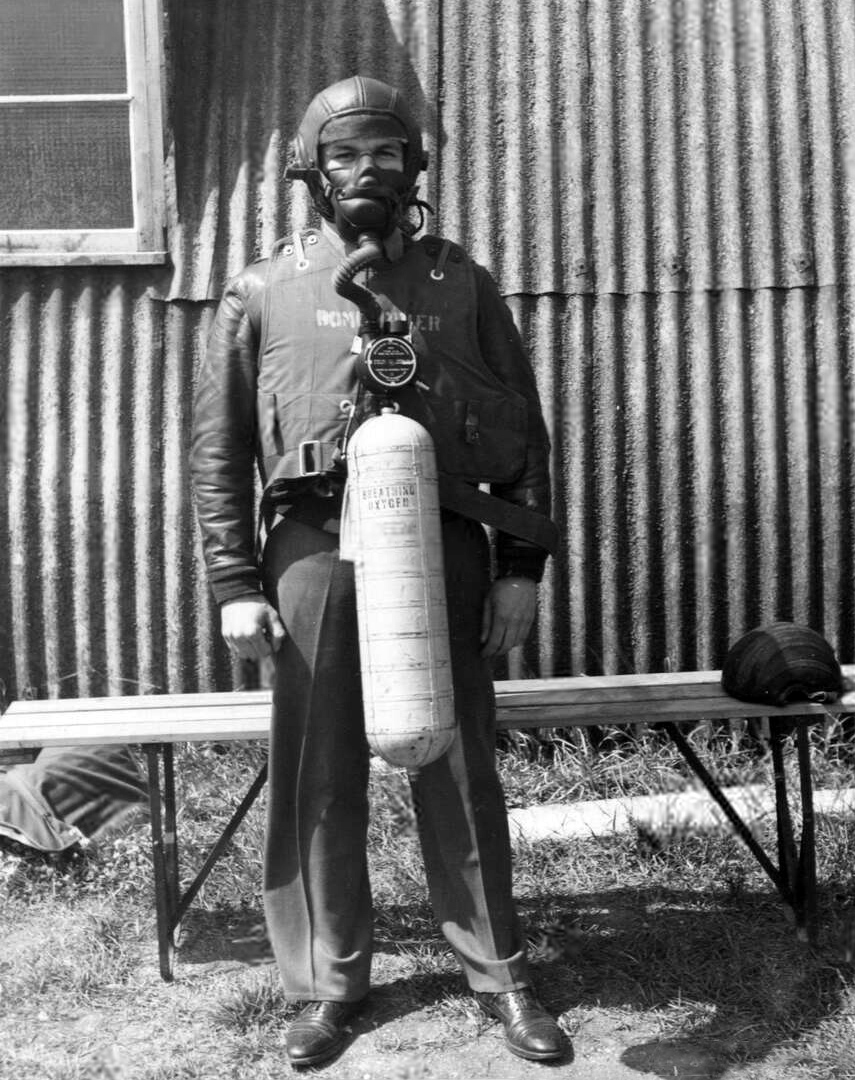
An airman with the 379BG poses with Type A-4 and D-2 Oxygen Bottles for a photoshoot detailing flight equipment.
Photos taken 19 June 1944.
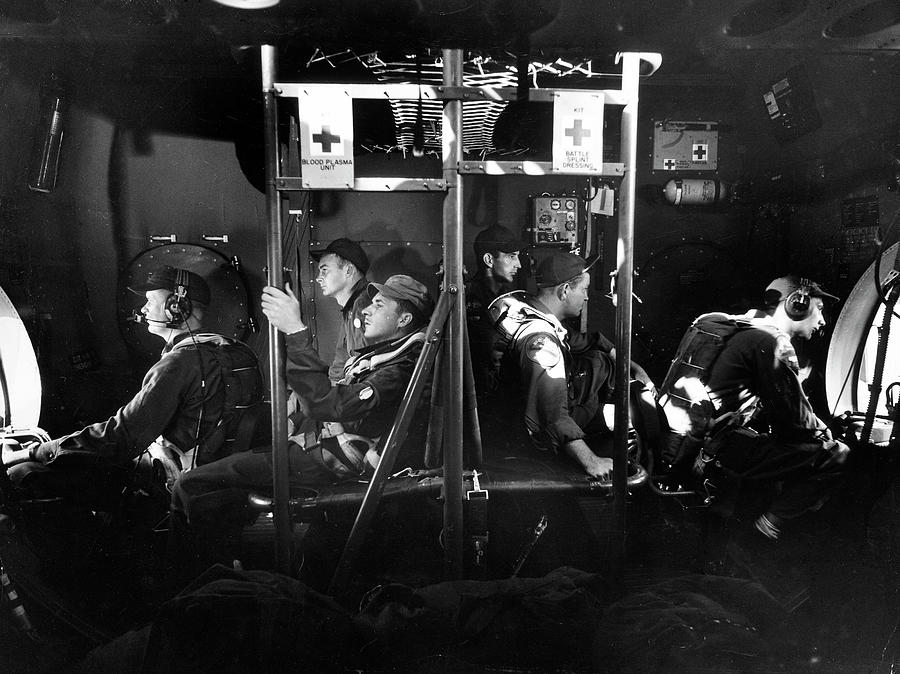
Airmen in the gunner’s compartment aboard a Convair B-36, as part of a photoshoot by Margaret Bourke White. An A-6 walkaround bottle is visible in the upper right corner.
The Type A-6 Walkaround Bottle is a common sight on the collector’s market though, in reality, it was never used on the B-17 or B-24. The D-2 was large and clumsy, to the extent that the Army issued slings for its use despite having the ability to clip it to their clothing. As such, the A-6 was considerably smaller, having a 280 cub in capacity. However, the A-6 was able to match the D-2’s 30 min cycle by replacing the Type A-13 Regulator with the Type A-15, which had the added benefit of carrying its own diluter.
The Type A-15 Regulator was standardized on 25 September 1944 and designed with the A-6 bottle in mind. However, since we not have access to the the aircraft’s blueprints, we are unclear as to exactly when these bottles reached the Boeing B-29. We do now that the A-6 had a long shelf life, as they were a common sight as late as the Vietnam War.
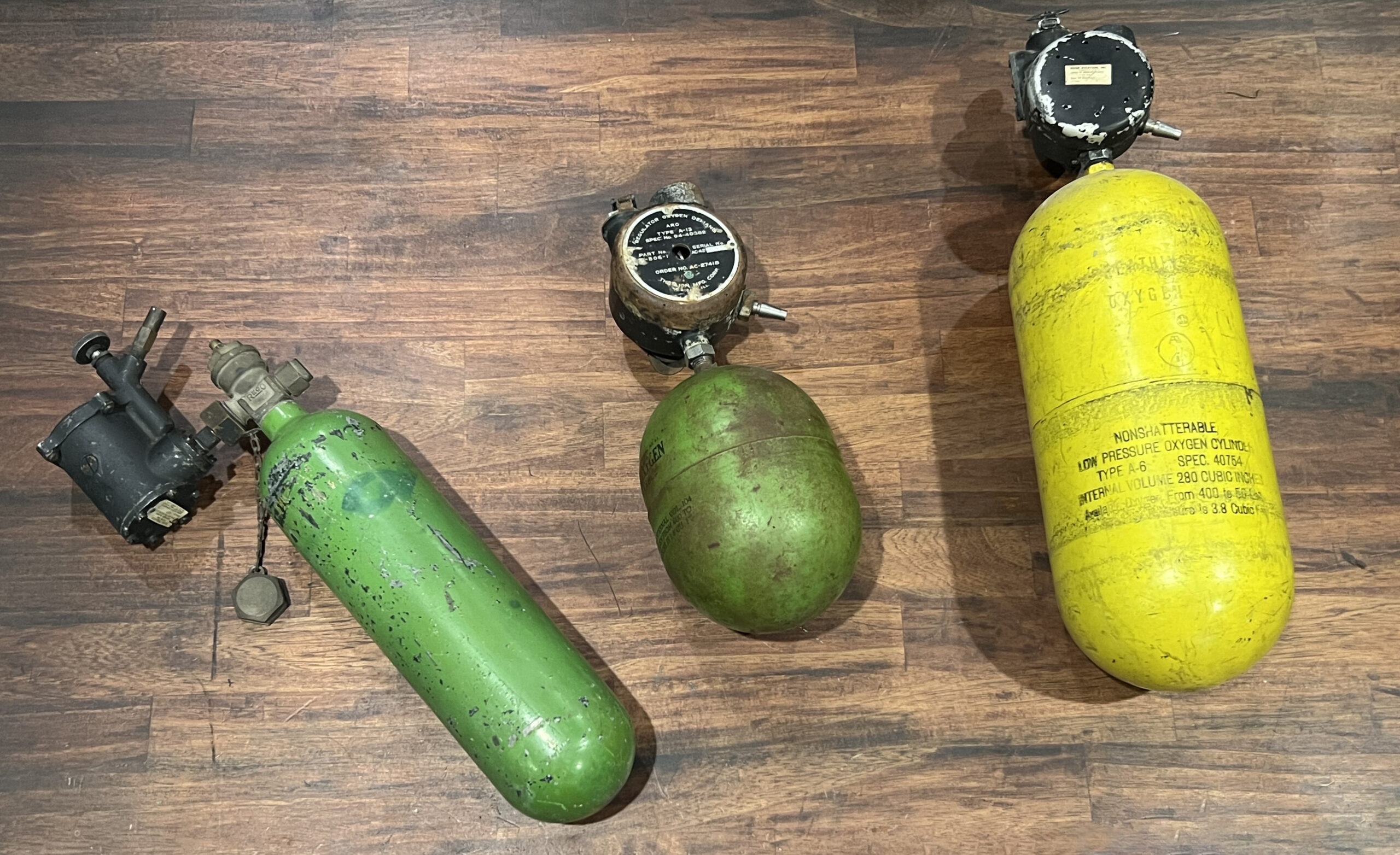
2025 saw Hangar Thirteen move from Asheville Regional Airport to a nearby farm. Our new facility is larger than the old hangar and was once used to house agricultural equipment. Some pieces still remain, which the family is planning to move. Once this happens, we are planning to set aside some space for a museum display area. One of the planned displays will center on oxygen equipment and feature these pieces.
They are, from left to right: an A-2, A-4, and A-6 walkaround oxygen bottle. The only missing piece from this line-up is a D-2, though one has been promised to us. The A-2 is also missing its valve handle, so we are hoping to find a replacement. Likewise, aside from the A-4, the appropriate mounting brackets will have to be acquired, as the A-2 used the same brackets as CO2 fire extinguishers and the D-2 and A-6 had their own, unique mounts.
But we are really excited about the prospect of designing museum displays, and hope people will enjoy seeing the sort of little details featured in our infamously long updates.
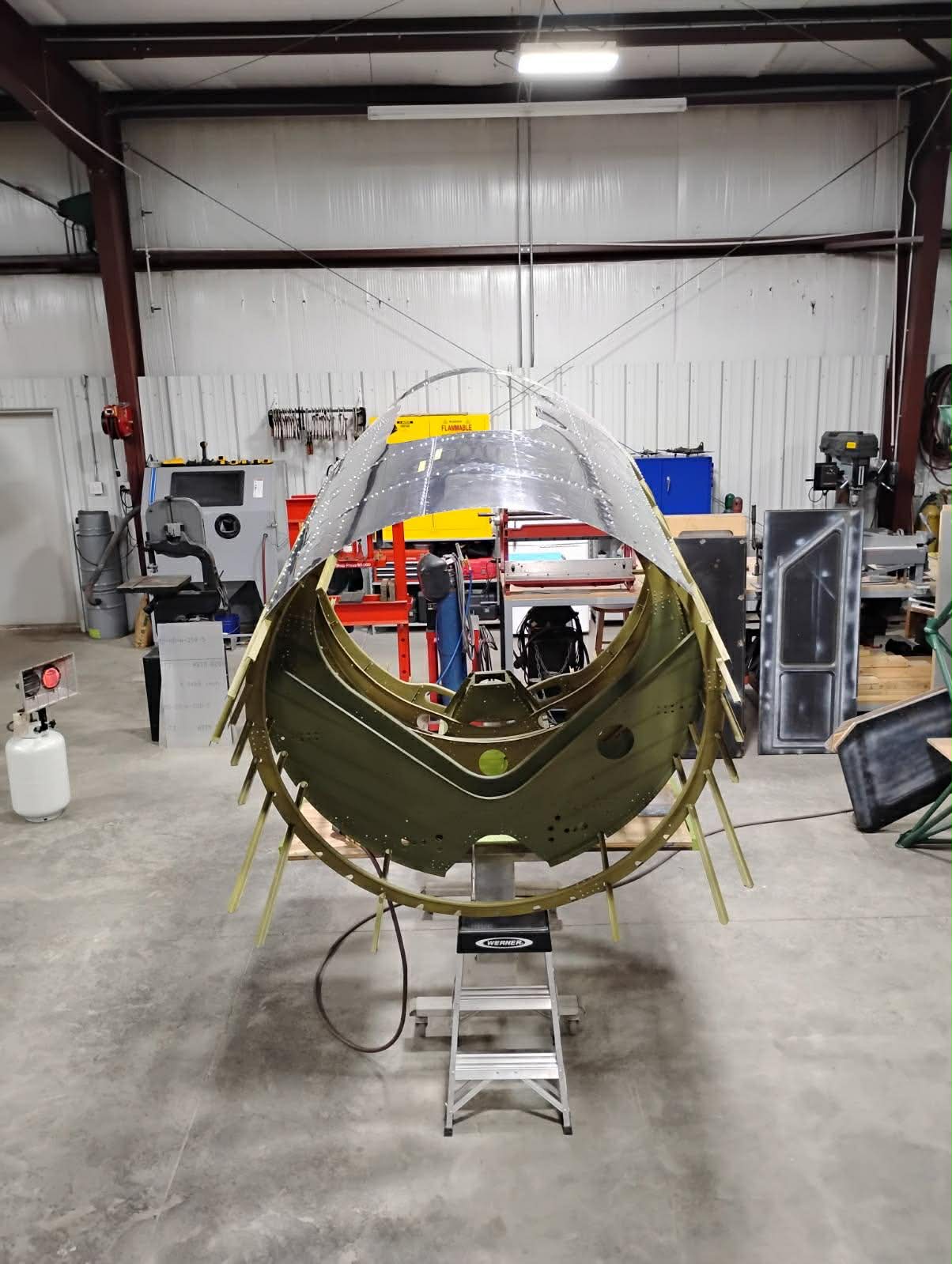
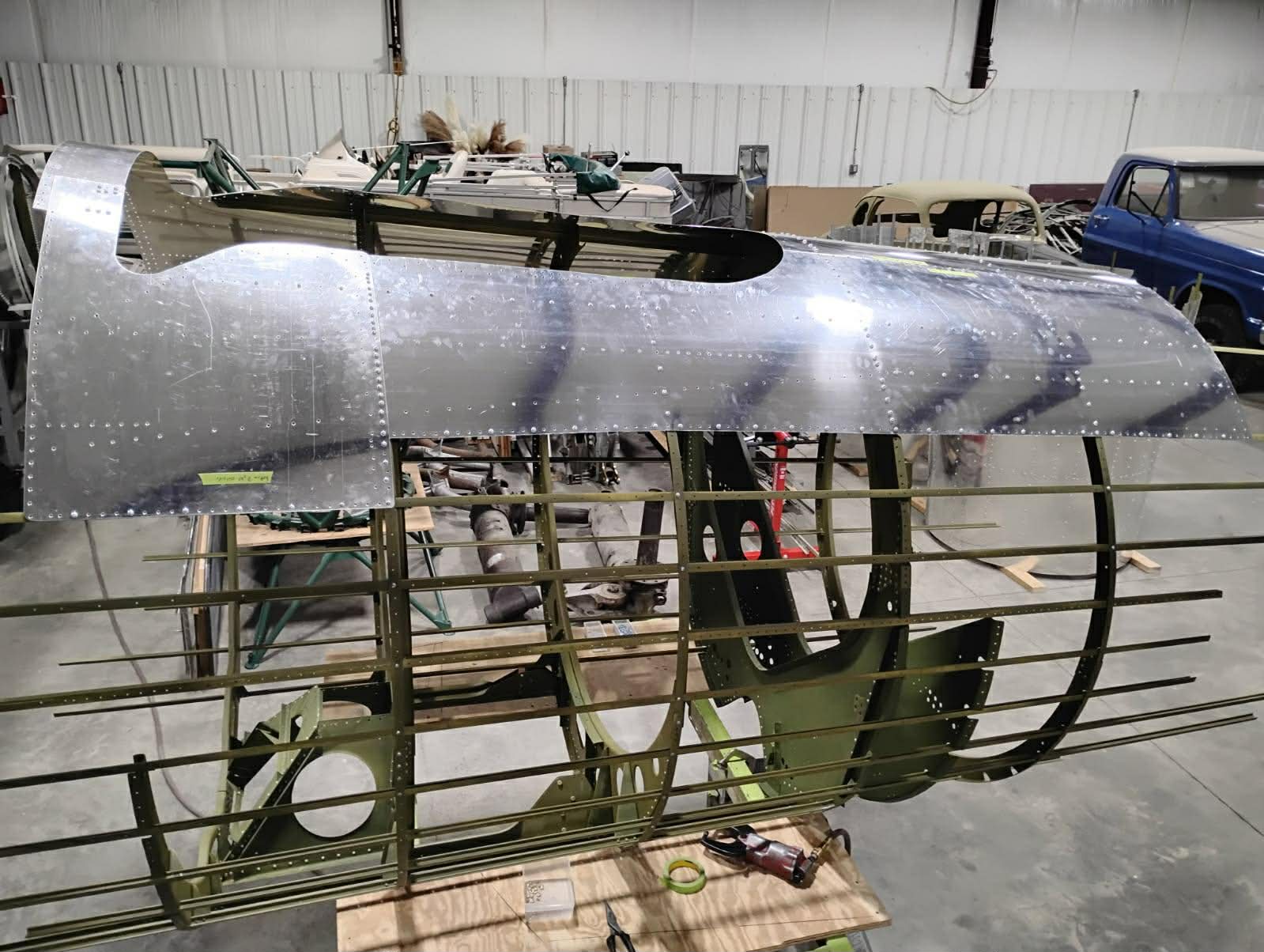
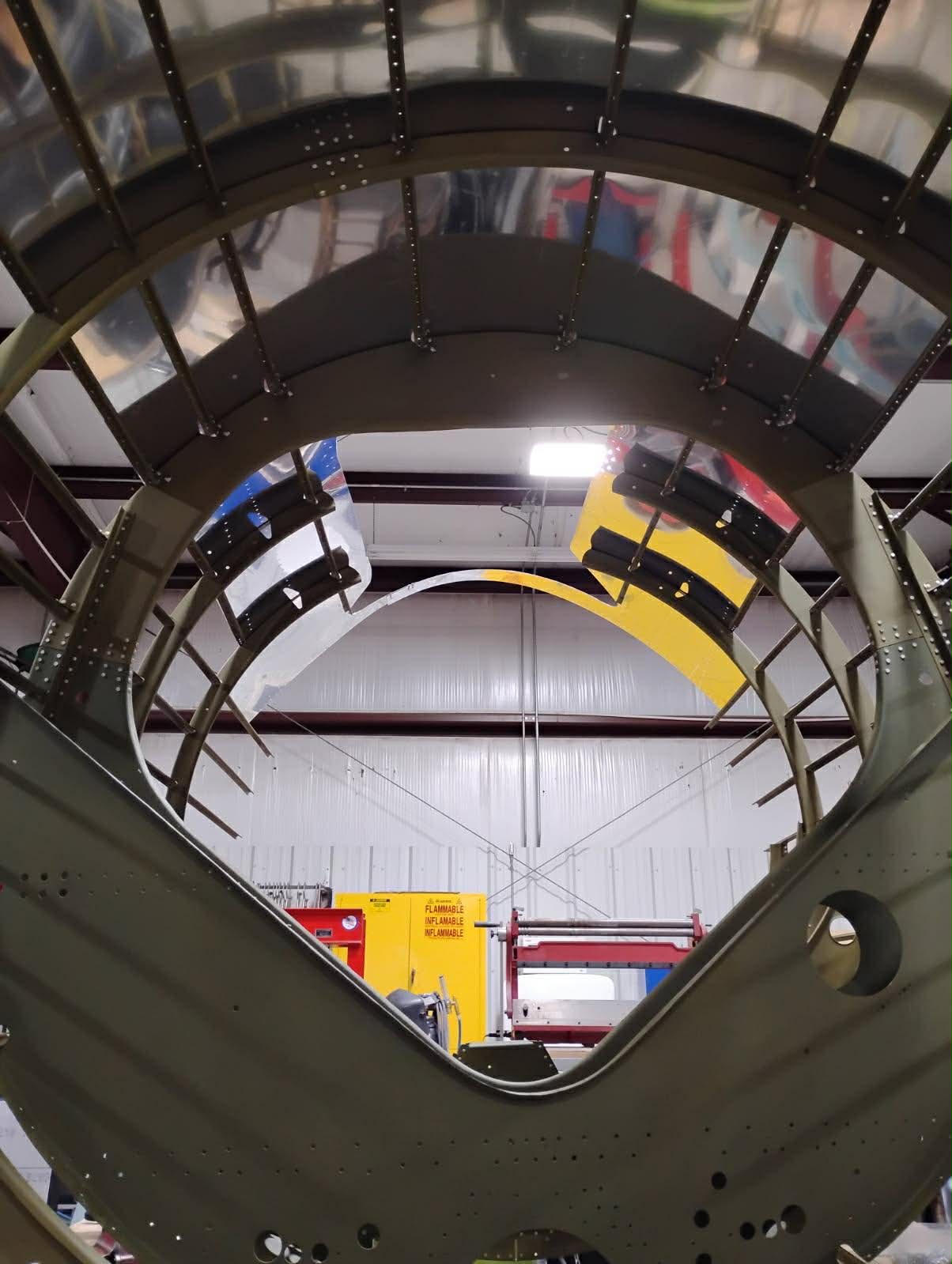
Lastly, we wanted to share some photos of the Lake Dyke B-17G aft fuselage, which is being rebuilt alongside Lucky Thirteen.
The dipping of the ribs and stringers in zinc chromate is now complete and we can begin reassembling the aft fuselage. This being accomplished, we can now begin the zinc chromate for Lucky Thirteen’s ribs and stringers. (It is always wiser to keep one together for reference.)
Some additional materials are required to proceed on these two aft fuslages but they are on the way. Speaking for myself, I cannot wait for the aft fuselage skins to be ready for their ALCLAD stamps.
Photos taken 9 January 2026.
The Hangar Thirteen Foundation is a 501c3 nonprofit charity dedicated to bringing back a B-17F representative of the bloody counter-air campaign of June 1943 through March 1944. Donations to this project are tax deductible. If you can spare a little to help this project, you can guarantee that you will see the results on Facebook and here on our website.
You can contribute through the Donate page or, to avoid a PayPal fee, you can send something via the mail to:
Gerad Allen Blume
Hangar Thirteen Foundation
442 Old Chalk Bed Road
Batesburg, SC 29006
Volunteers are also always welcome. In fact, you need not be an Asheville resident – you can work from home! Persons skilled with metal fabrication, machining, CAD modeling, metal casting, 3D scanning, and laser/waterjet cutting, are particularly helpful. Just reach out to us to get started.
Keep the show on the road!