
After leaving the Pima Air & Space Museum, 12 August saw us drive up to see our friend Robert Kropp of GossHawk Unlimited in Casa Grande, Arizona.
Since we have already covered our visit to Robert in another update, I will pick up the travelogue from there.
That same day saw us visit the Lauridsen Aviation Museum in Buckeye, Arizona. The museum is now closed but we secured permission to look around. Here was the Arizona that I had always heard about: for the first time, I could look in every direction and see open desert. Naturally, this was when the heat was at it greatest. 115 (F) in the shade. Many had teased us about the heat, scoffing at southerners who say “it’s not the heat but the humidity.” I hate to be contradictory, but from my experience, that is absolutely true. Despite the intense heat, Eric and I found the weather out west far more forgiving that what we are used to at home. A dry heat is better any day!

The museum’s most noteworthy piece is this Fairchild C-119 Boxcar.
This aircraft was delivered on 29 July 1953, serving some 14 years in the Royal Canadian Air Force. Purchased by Hawkins and Powers Aviation, this C-119 saw regular use as a firefighter from 1976 to 2005. Most famously, she performed the aerial sequences for the 2004 remake of Flight of the Phoenix. Purchased by Hans Lauridsen when Hawkins and Powers closed in 2006, she was moved to the desert in 2009.
The C-119 was a real military workhorse throughout the 1950s and 60s and, in my opinion, it would be nice if one was kept airworthy on the airshow circuit.

This Grumman C-1 BuNo 136752 was released from US service in 1980, joining the Lauridsen collection in 2005.
The Clarktor CT-6 tug was a particular treat for me. My first restoration experience was working on a CT-40, a postwar tug very similar to this model.
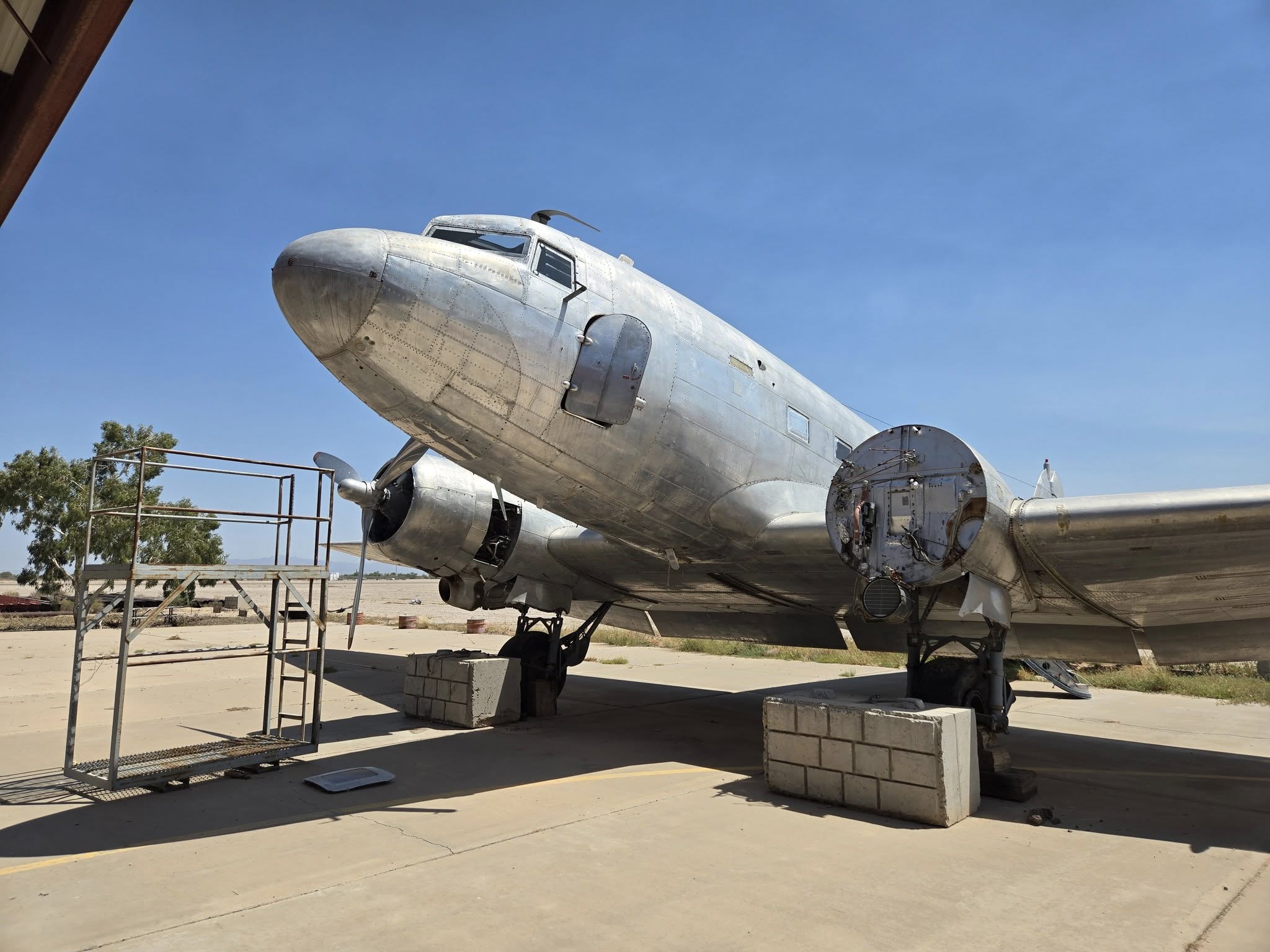

This Douglas C-47 (42-23385) was converted into a business aircraft after the war, with companies like Sears and Singer being amongst it owners.
It joined the Lauridsen collection in 2004.
Photos taken 12 August 2025.
The next day saw us arrive in Chino, California, the Mecca for warbird restorers.
With names like Frank Tallman and Paul Mantz, the west coast was always a hotbed for vintage aviation. The proximity of Hollywood’s wealth was an aiding factor, and that is precisely where Chino’s connection sprang. Known for its cow pastures, Chino served as a Hollywood go-to for rural filming locations, which is how, in 1964, the town’s airport became the setting for the “Twelve O’clock High” television series. The sleepy airfield grew into a hub for old warbirds, remaining so long after the series concluded. Chino’s is now home to three of the world’s premier restoration facilities: AeroTrader, Planes of Fame, and Yanks.
Now, I must preface that, because of various scheduling factors, we could only spend one day in the area. And since a good friend at AeroTrader could not make it, it made sense that they be the one taken off the day’s itinerary. Just going to Yanks and Planes of Fame alone, we barely had time to see everyone that we wanted to.
But it was such an awesome experience and I definitely want to to go back.
I should stress that the photos shared below are only those that were highlights for us, as the collections of these museums are far larger than can be covered in a short article. If the opportunity should arise, we highly suggest you check them out for yourselves.

The first thing we had to see was the ongoing Helldiver restoration at Yanks Air Museum. 2025 was a big year for the Helldiver. It is a truly wonderful thing to go from a single airworthy example (the CAF’s BuNo 83589) to three (Fagen Fighters’ BuNo 83393 and the National Museum of WWII Aviation’s BuNo 75552) in one year.
A replacement for the SBD Dauntless, the SB2C Helldiver II was not well-loved in wartime. The aircraft handled poorly, due to design concessions intended to make the aircraft more attractive for carrier use. This, combined with a scandal where it was revealed that Curtiss knowingly sold defective engines to the US military, soured the company’s reputation to the point that it never recovered postwar. Regardless, the SB2C was the primary US Navy dive bomber throughout 1944 and 1945, and was instrumental in the sinking of battleships Musashi and Yamato.
When completed, this example (BuNo 19075) will be the fourth airworthy example, and we will finally be able to see a finger-four formation for the first time in 80 years.
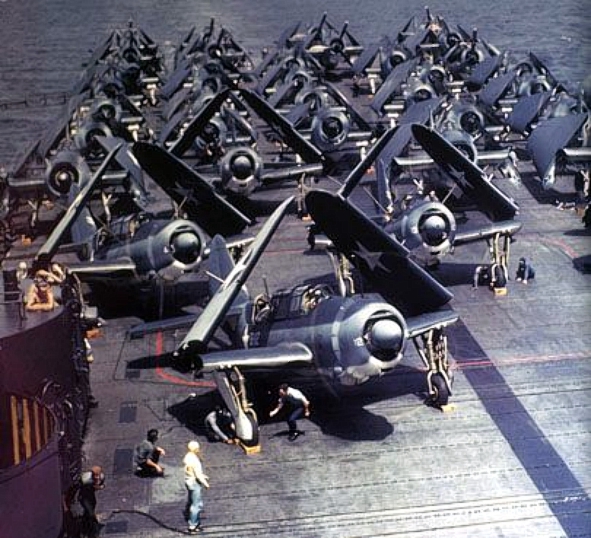
SB2Cs aboard the carrier USS Yorktown (CV-10).
Surviving examples of the Helldiver II are incredibly rare. Today there are eight survivors including those mentioned above. Even the Yorktown, who still survives as a museum ship in Charleston, South Carolina, lacks a Helldiver amongst its displays.
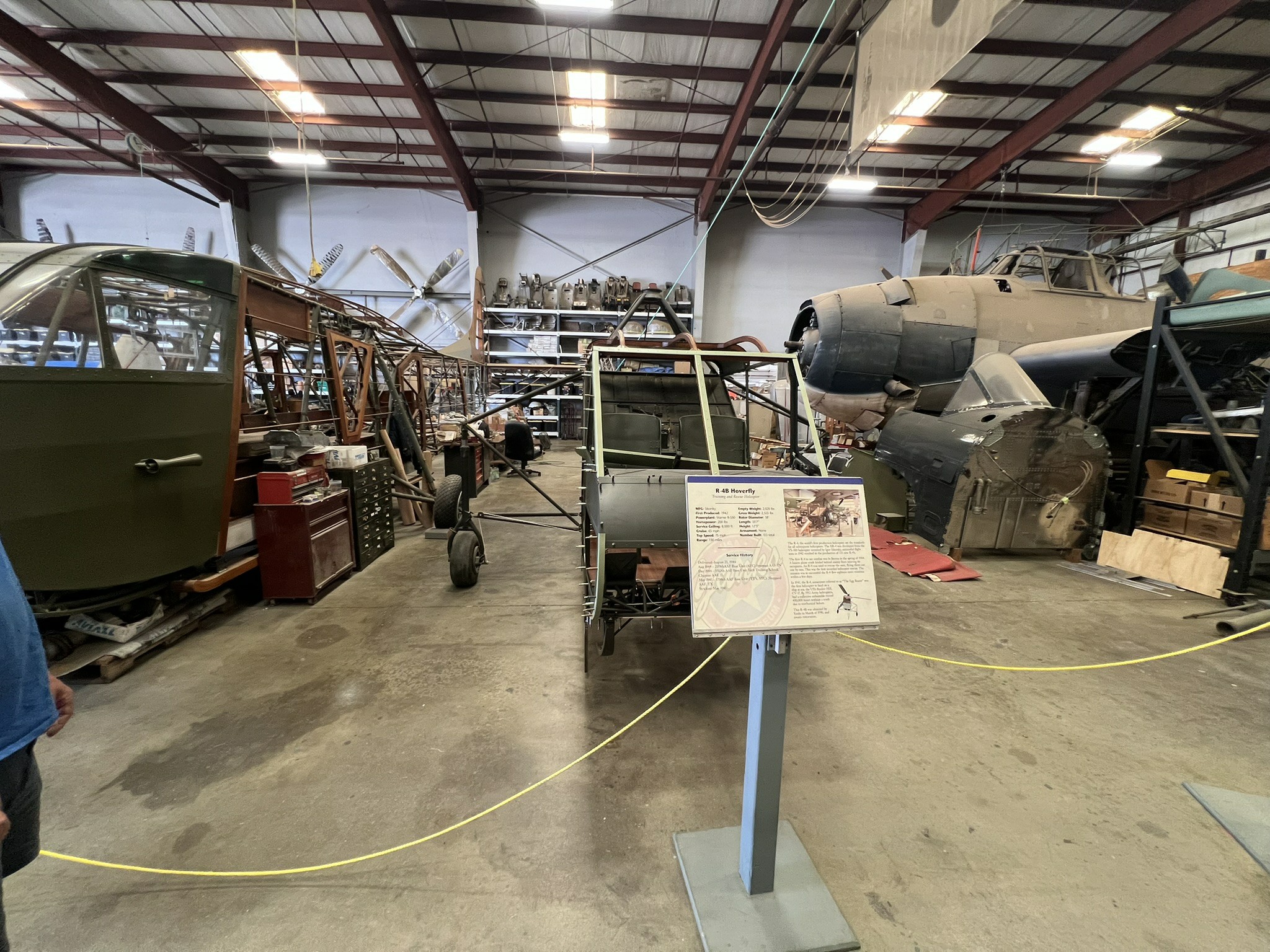
Three incredibly rare restoration projects, all beside one another in the shop at Yanks: from left to right, a Waco CG-4 Combat Glider (45-13696), Sikorsky R-4 Helicopter (43-46534), and TBF Avenger torpedo bomber.
Said Avenger is rarer than it might appear. While there are nearly 80 surviving Avengers today, only seven were actually built by the original designer, Grumman Aircraft. The vast majority were built under license by General Motors, meaning they are TBMs rather than TBFs. This particular TBF, BuNo 05997, is one of only three in the United States.
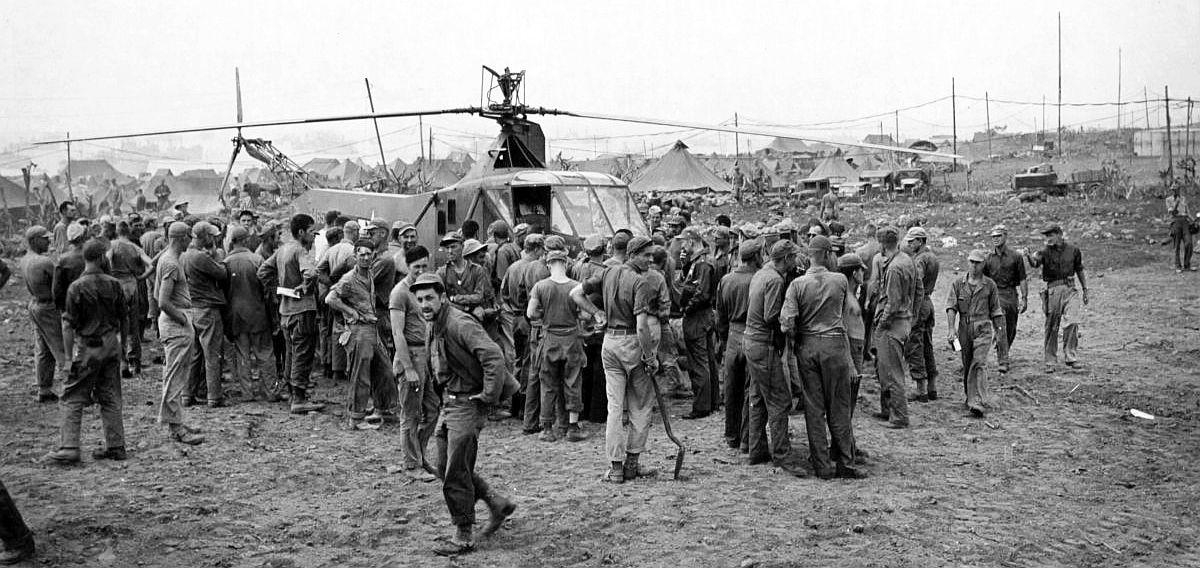
Curious US Marines gather around to gawk at a Sikorsky R-4 on Iwo Jima.
It is not widely known that the Second World War saw the first combat deployment of helicopters. The R-4 first entered combat in the China-Burma-India theater on 22 April 1944, flying search and rescue operations. Today there are ten surviving examples, none of which are airworthy (so far).
Photo taken 23 March 1945.

Unlike modern helicopters, the blades of the Sikorsky R-4 were made of wooden ribs wrapped around a steel spar, covered with doped fabric like miniature wings. Here one of the blades is undergoing restoration, with the museum’s carpenter doing amazing work to preserve and repair the original wood.
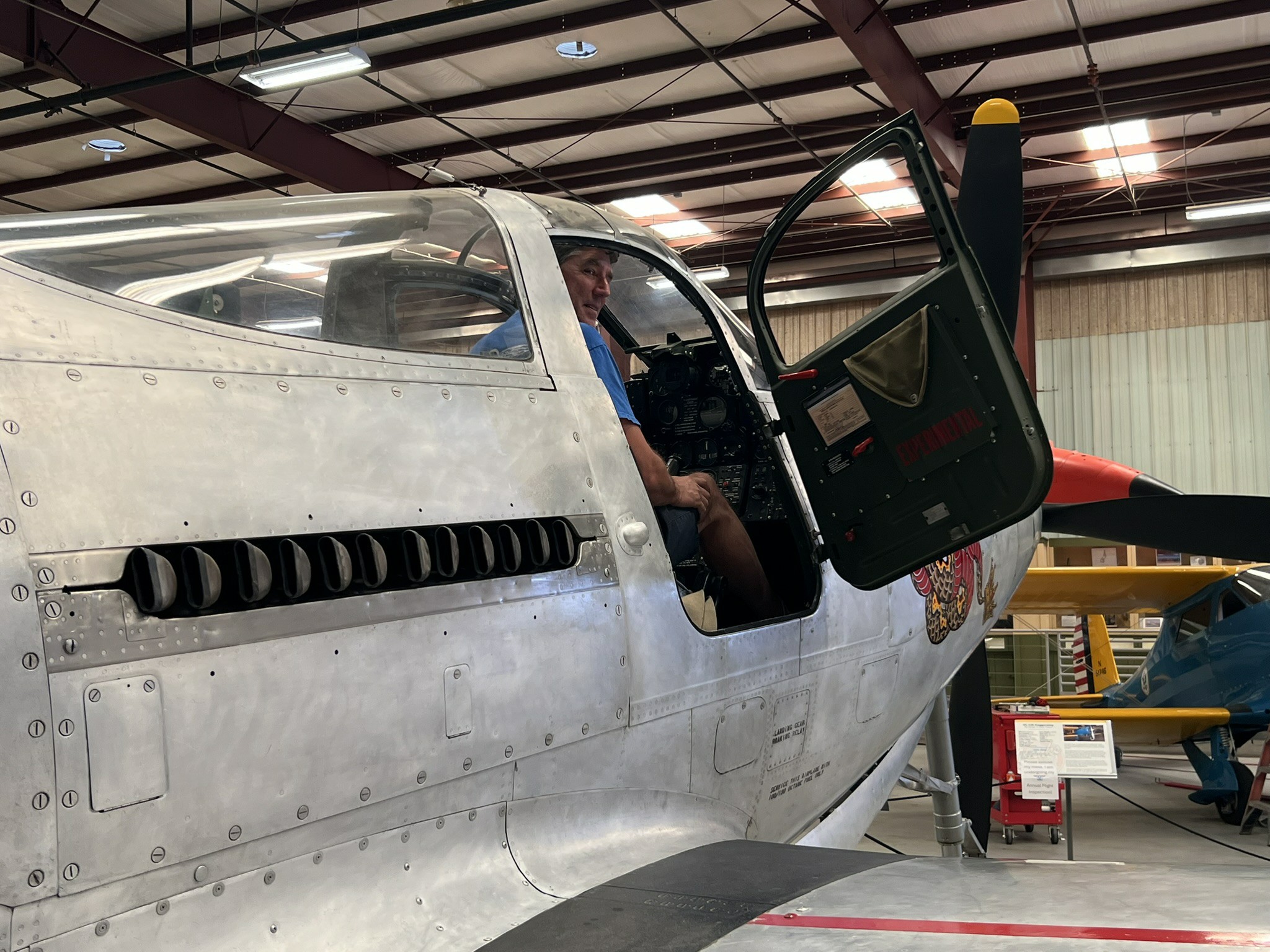
Some of you may be aware that, prior to taking on the Liberator II Maid of Athens, Eric’s primary focus at Project Warbird was a Bell P-63. Said aircraft project has since been sold.
Having that connection, Casey was kind enough to invite us to crawl inside their Kingcobra, Fatal Fang (42-69080).
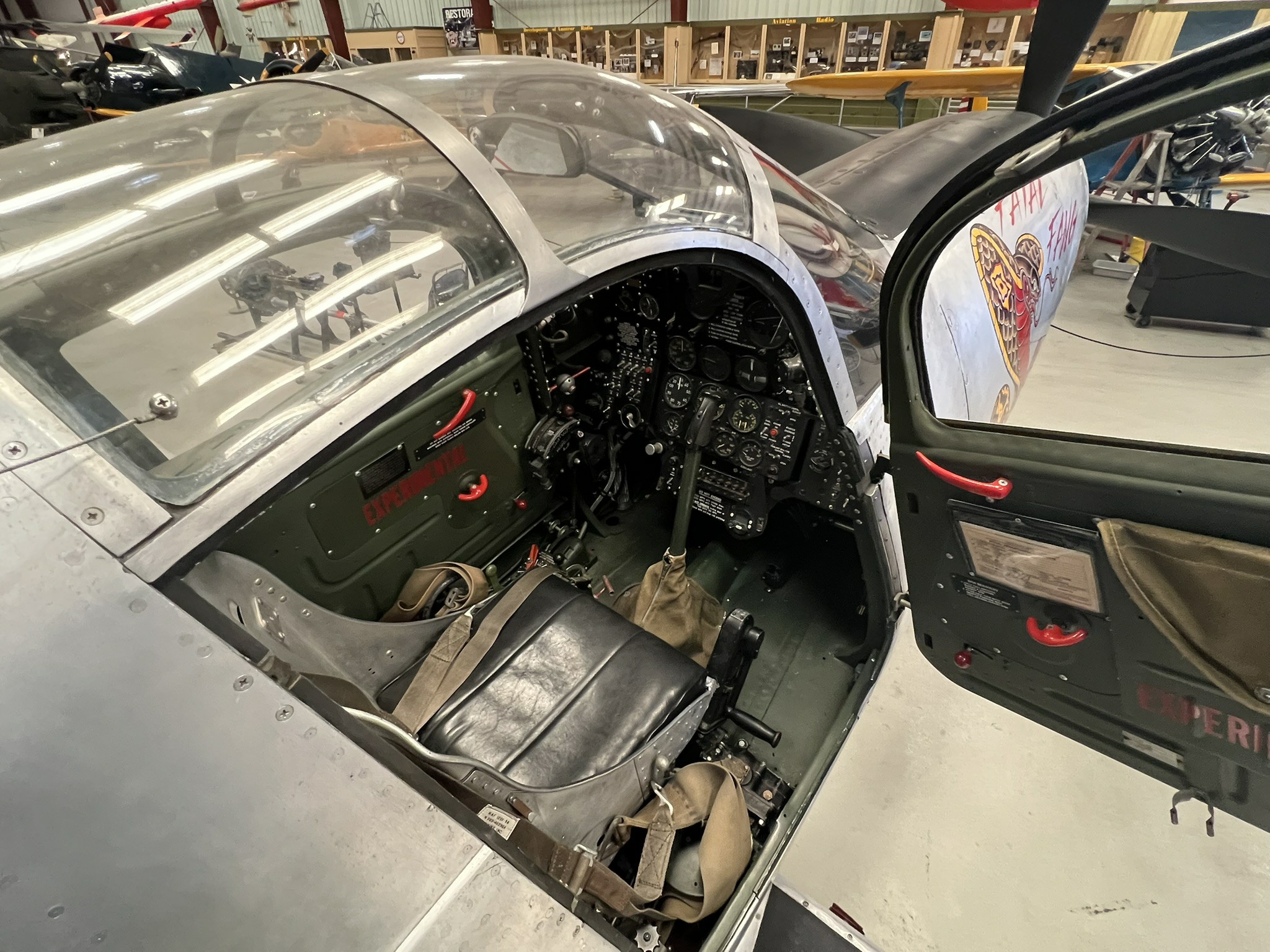
Looking inside the P-63’s cockpit at Yanks.
The P-63 and its predecessor, the P-39, featured an unusual arrangement where the engine was mounted behind the pilot. This afforded the cockpit a lower center than her contemporaries, as there was considerably less material needed to fit underneath. As such, one of the trademarks of the two Cobras was their car-type entry doors.

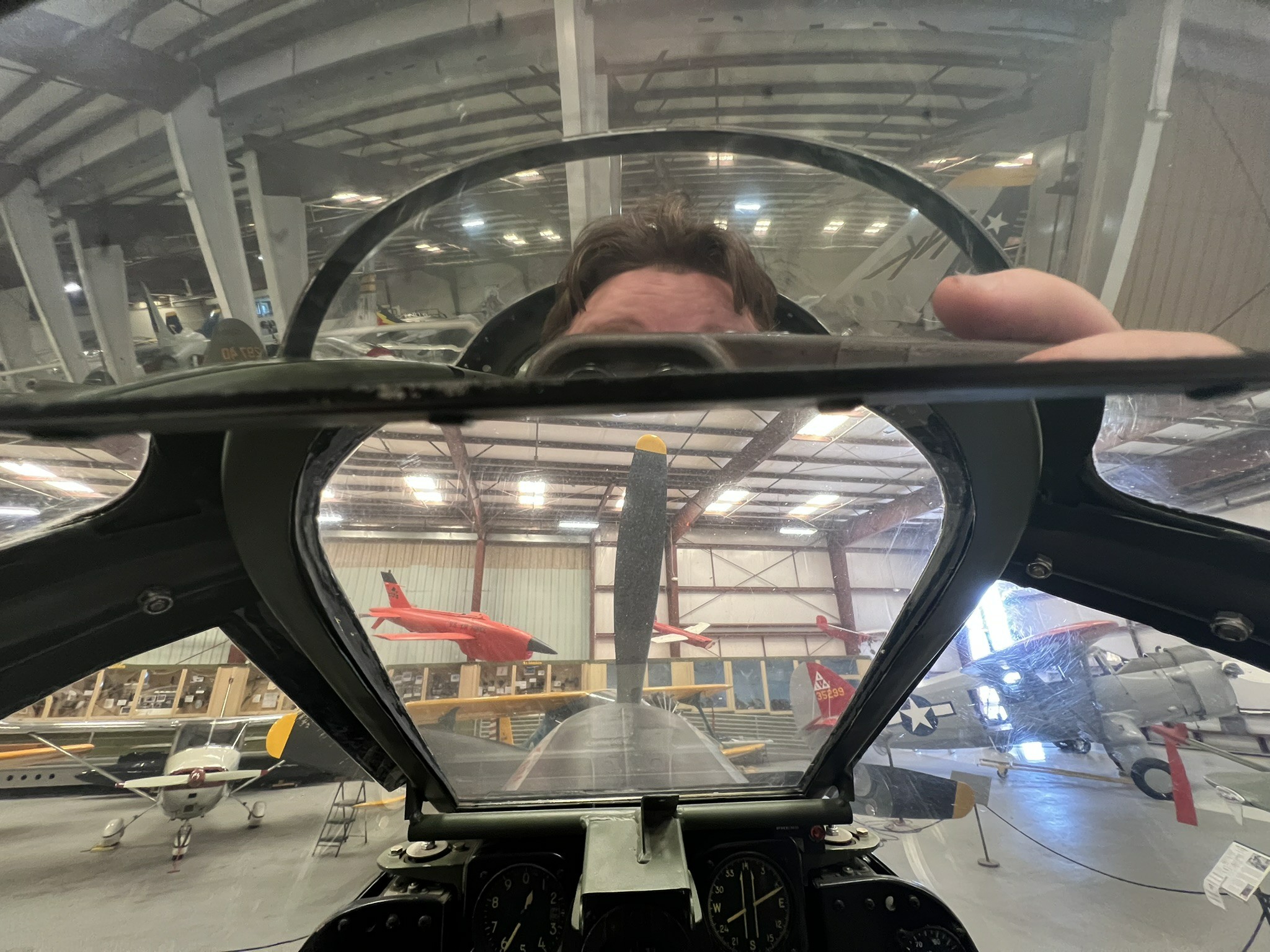
Can the G-man fit inside a Kingcobra? Turns out, yes. He can.
It is always a treat to see an airworthy aircraft with a period correct instrument panel. Kudos to the team at Yanks for their phenomenal work on this aircraft.
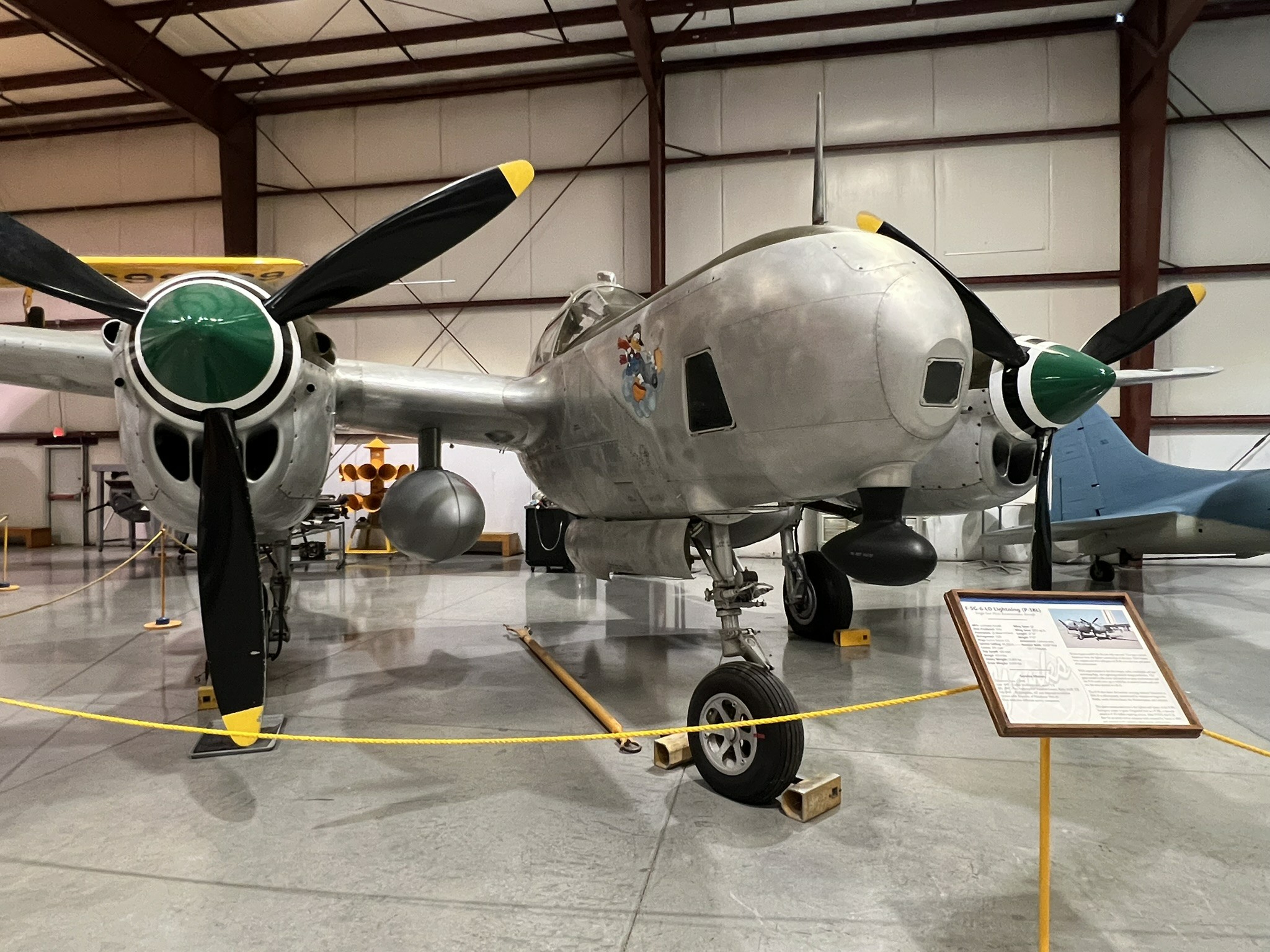
Alongside its use as a fighter, the Lockheed P-38 was a prolific photo reconnaissance aircraft. These P-38s were known as F-4s and F-5s.
This example, 44-27183, is an F-5, seeing heavy use after the war in aerial surveying. Several of today’s P-38 survivors are, in actuality, recon aircraft that were converted back into fighters during restoration. Considering how important reconnaissance was to the war effort, it is nice to see an F-5 preserved in its original configuration. The black shapes on the nose are windows for the aircraft’s cameras.
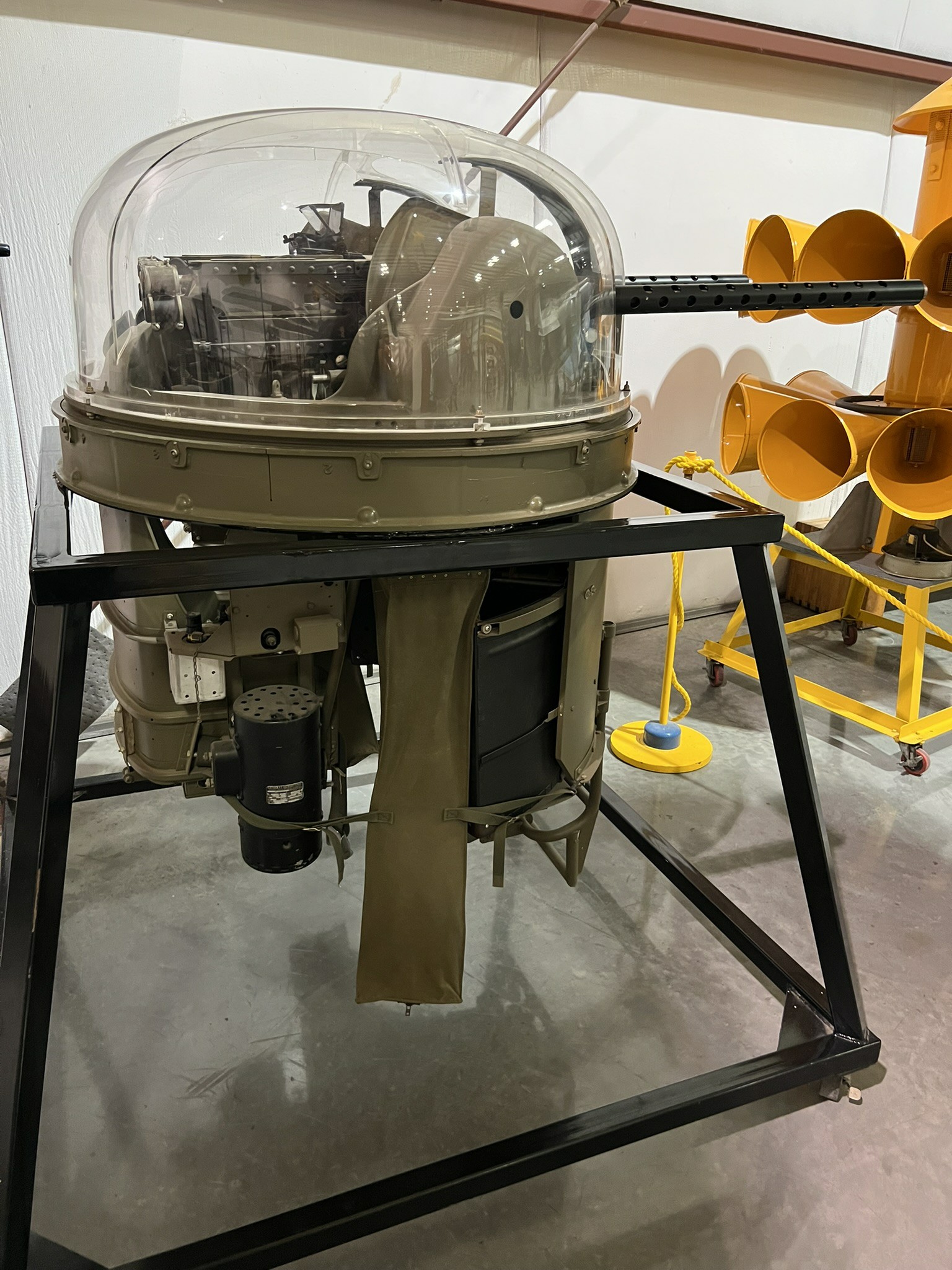
Naturally, I found my way over to the turrets.
The Martin 250CE series of turrets, encompassing the Army A-3, A-11, A-14, and A-20, were easily the most successful powered gun turrets in aviation history. Originally designed for the B-26 Marauder, they saw use on a multitude of aircraft, including the Douglas A-20, Consolidated B-24, Martin A-30, Consolidated B-32, PV-2 Harpoon, Boeing YB-40, PB4Y-2 Privateer, and Canadian-built Avro Lancasters.
The dataplate was missing from this example so I could not identify the exact variant and which aircraft this turret was originally mounted to.
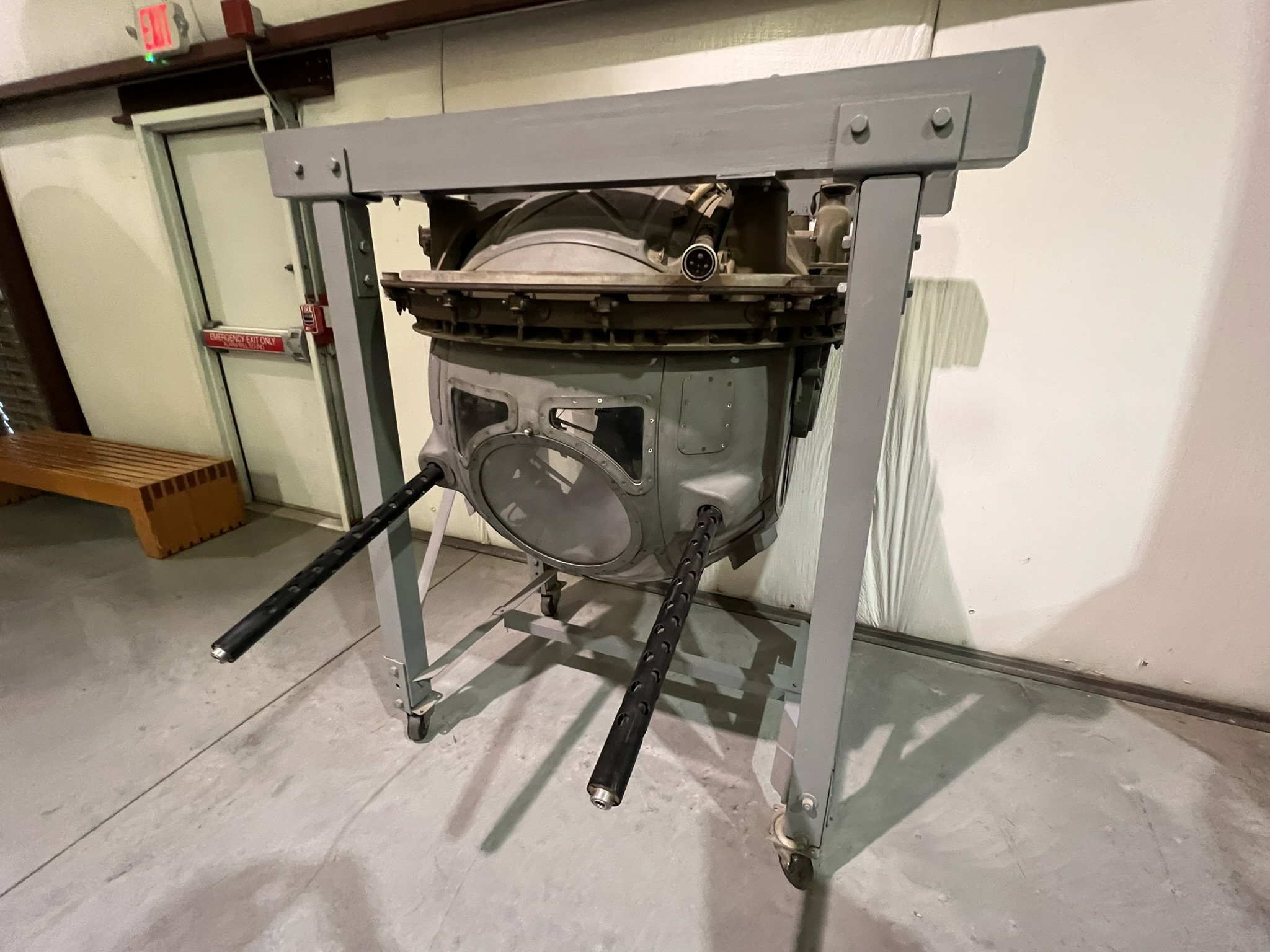
Oh, be still my heart – a ball turret.
This example is a Type A-13, meaning that it was originally mounted to a Consolidated B-24. Most surviving ball turrets today are from B-24s. The B-24 notoriously suffered from weight issues and in 1945, when it became apparent that the Luftwaffe was no longer a serious threat, many B-24s had their turrets removed and placed into storage. Ironically, this act saved many turrets from the scrapyard.
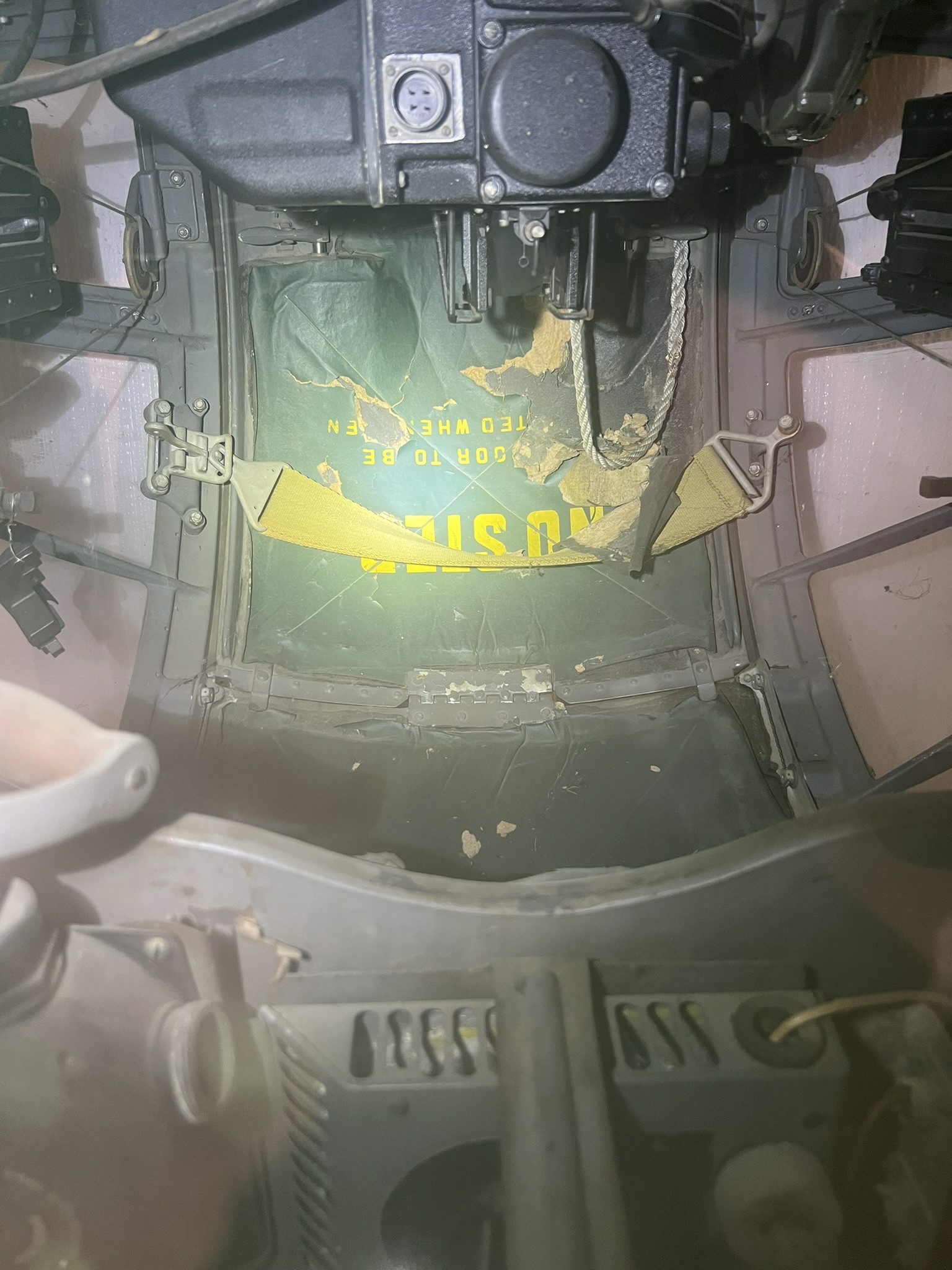
The ball on display at Yanks was built by Briggs Manufacturing of Detroit, Michigan.
While Sperry Gyroscope designed the turret, they did not actually manufacture it, with all ball turrets being license built. Briggs was the primary manufacturer though, due to increased demand, Emerson Electric was a supplemental manufacturer. The easiest way to tell them apart is the paint scheme: Briggs turrets had gray interiors and olive drab trunnion/hangers; Emerson turrets painted these pieces dark green.
I teased Casey that, if they should ever decide to part with it, let us know! He said they would be happy to help us with photos/measurements/etc. of their example as we move forward restoring ours. Super awesome of him.
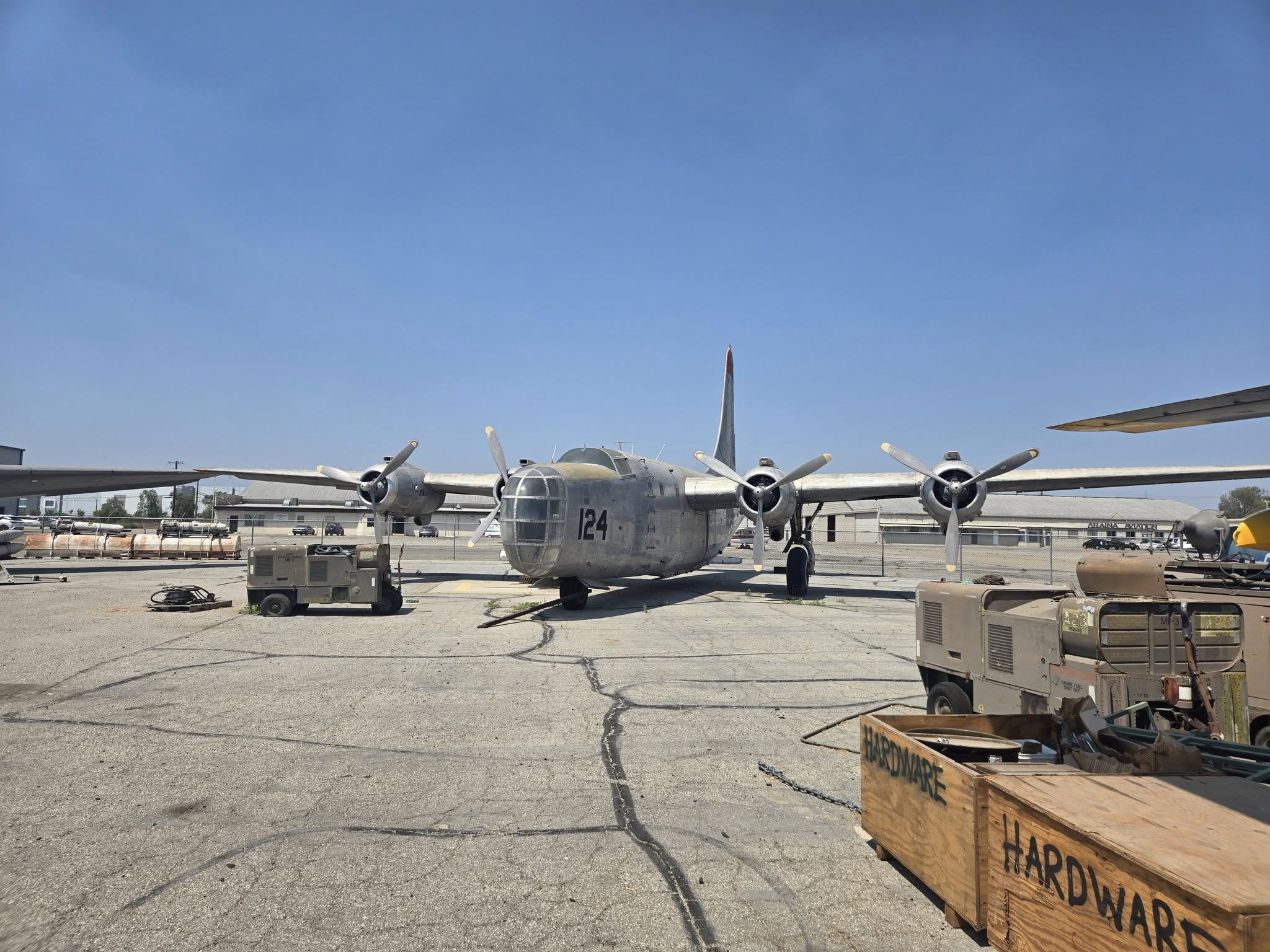
Considering our work on Consolidated Liberator II Maid of Athens (via Project Warbird), we had to take a look at the Privateer in the Yanks collection.
Delivered to the US Navy on 31 August 1945 at BuNo 66300, this aircraft’s history mirrors 66302 of Gosshawk almost exactly. Transferred to the Coast Guard and converted into a PB4Y-2G in 1951, she was released in 1958, converted into a Super Privateer, and used as a firefighting tanker by Hawkins and Powers Aviation. When Hawkins and Powers closed in 2006, she was acquired by Yanks and flown to California.
It was around this time that I made my way over to Planes of Fame to see my friend Steve Salinas.
Steve is a volunteer there and we usually chat on a weekly basis about B-17s. After all this time, we had never actually met face-to-face, so I was super excited. He has actually been through a lot lately, as Steve is well-known for his custom bike shop in Altadena, which was lost in the 2025 Los Angeles Fires. If it were not for the hard work of Steve and his family, they may very well have lost their homes. Words can hardly describe the videos he was sending me throughout that week.
Rebuilding in the aftermath, it was really humbling that Steve took the day off to see me. Thanks buddy.

Steve in the front door of his bike shop in Altadena.
All of this was destroyed in the fires.

Steve made the front page of the LA Times. That’s him in the photo, trying to save his neighbor’s house.
(I wouldn’t embarrass you for the world, man, but people should know about this.)
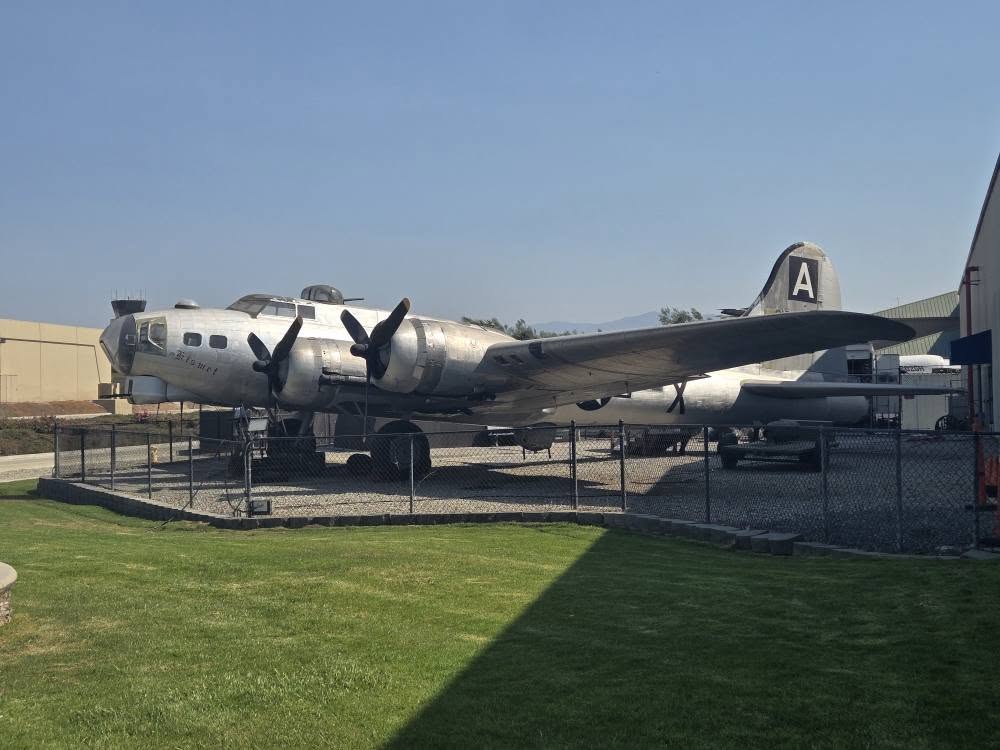
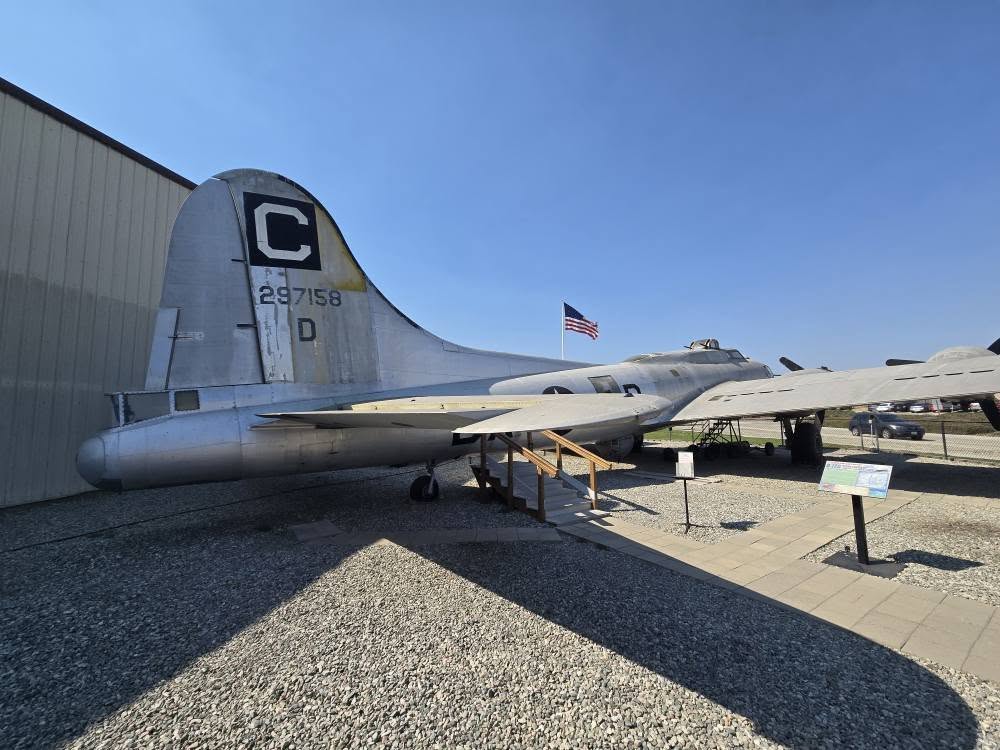
Often called Piccadilly Lilly II, though her noseart now reads Kismet (meaning “fate”), 44-83684 was the last Boeing B-17 to see active duty with the US Air Force. Serving as a drone mothership (a DB-17), her crews radio-controlled unmanned drones (QB-17s) for missile and nuclear weapons testing. Retired in 1959, she was immediately acquired by Planes of Fame, seeing regular use in Hollywood film and television productions.
Kismet was grounded in 1971 and has sat ever since.
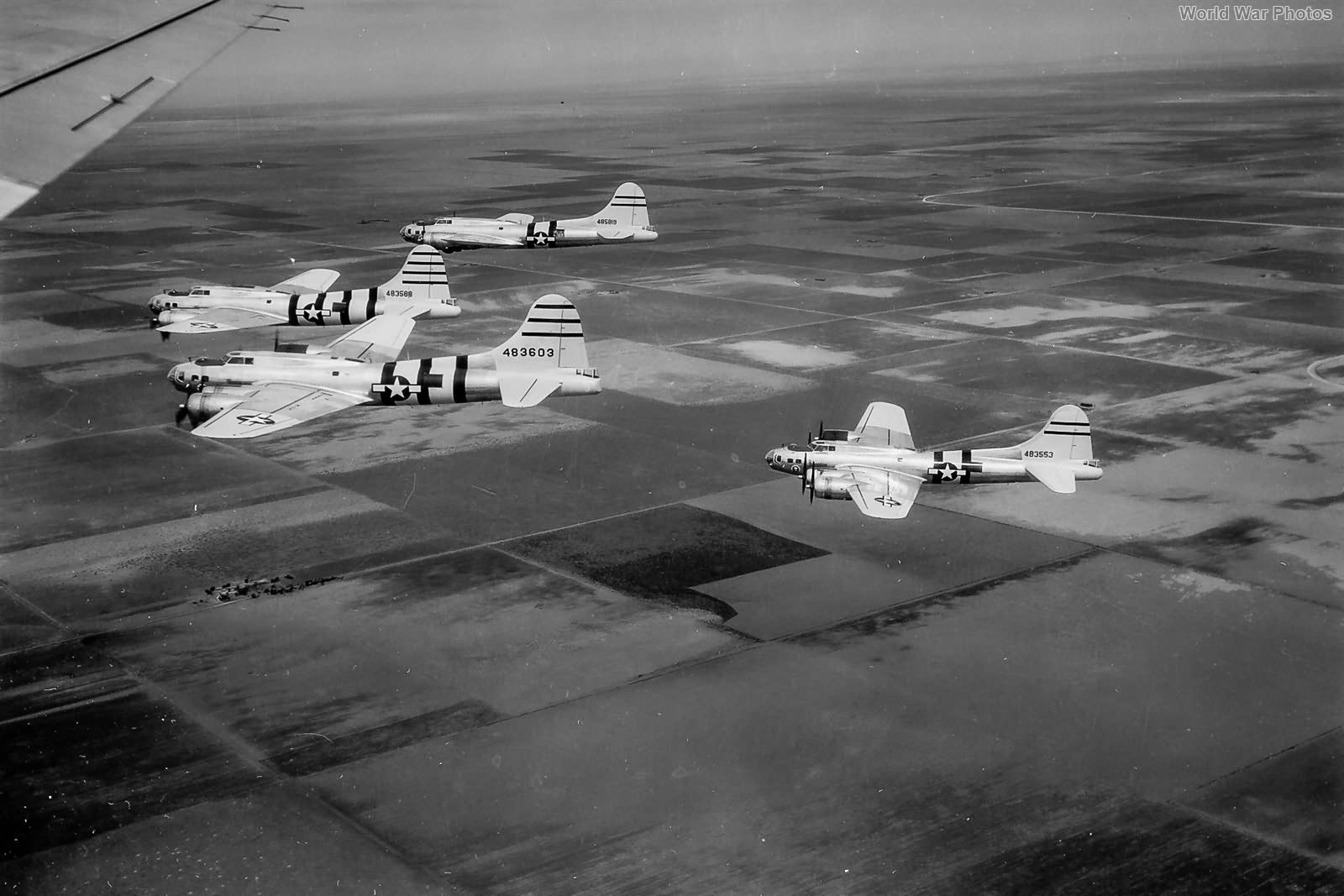
QB-17G and DB-17Gs in flight over Roswell, New Mexico.
Photo taken 15 April 1946.
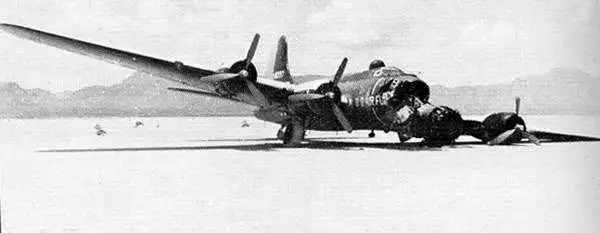
The last operation using QB-17 drones saw Kismet control 44-83717 in an air-to-air missile test over Holloman AFB, New Mexico. The aircraft was subjected to two AIM-4 Falcons and one AIM-9 Sidewinder, fired by a McDonnell F-101 Voodoo.
Rather than carry warheads, the missiles were outfitted with telemetry packages to transfer data and minimize damage to the drones (so they could be reused). The Falcons burst through the aircraft’s waist and nose compartments, while the Sidewinder impacted one of the engines, starting a fire. The controller aboard Kismet dived the drone to put out the fire and, noticing that one of the landing gear was damaged, crashlanded it at White Sands Missile Range. Kismet was retired five days later, on 11 August 1959.
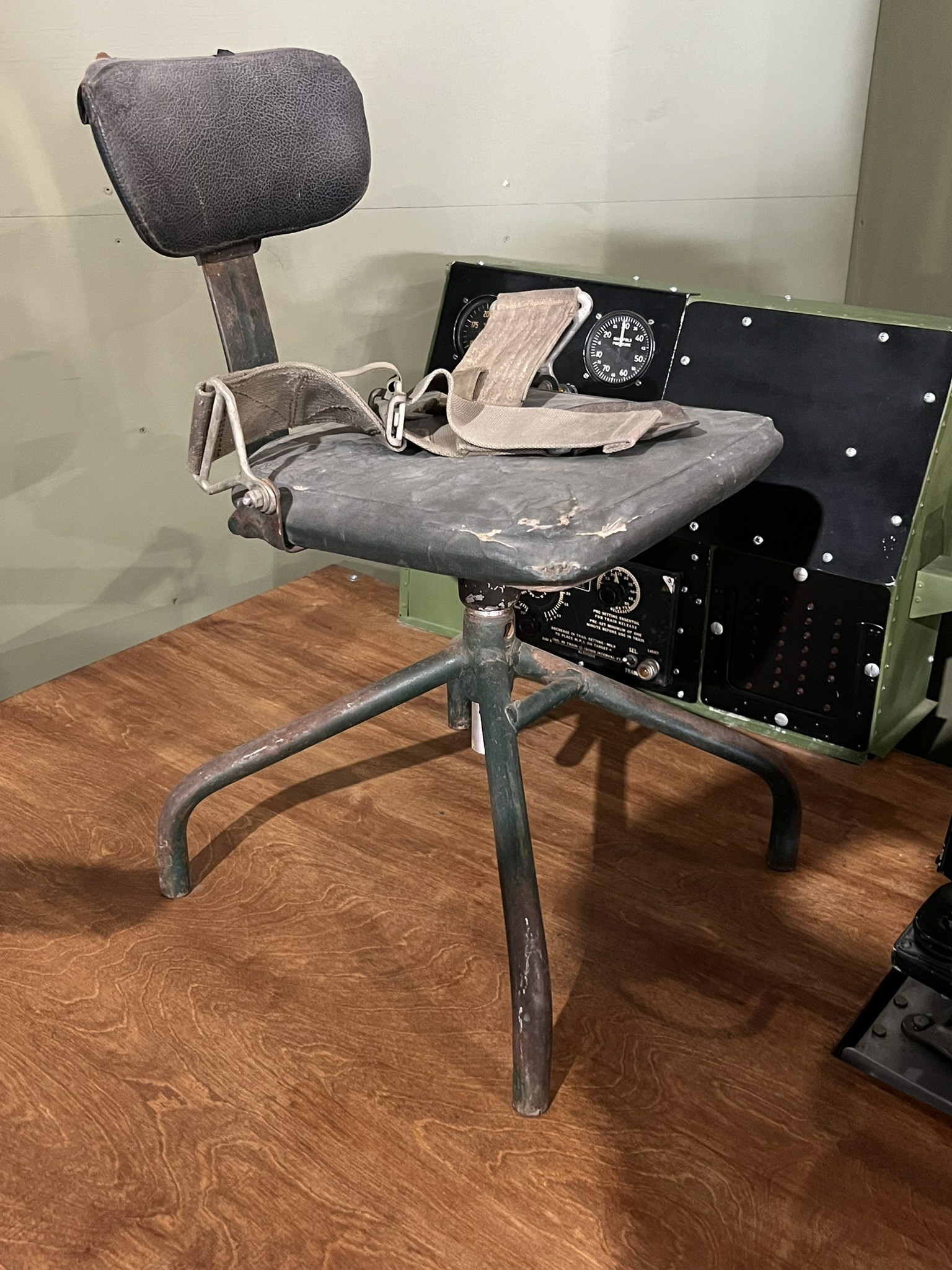
Part of a series of displays at Planes of Fame, on behalf of the 91st Bomb Group, this display features an untouched Cramer posture chair.
Based out of St. Louis, Missouri and still in existence today, Cramer’s AirFlow Posture series saw military use aboard the Boeing B-17 and B-29/B-50. Most examples today are from the latter, though there are important differences. B-29/B-50 seats had three legs and cushions made from OD canvas. B-17 chairs had four legs and dark green vinyl cushions.
This rare B-17 example is in remarkably good shape. Judging from the backrest and leg length, this chair is either from the navigator position aboard a B-17F or the radio operator’s position on a late-F/early-G.
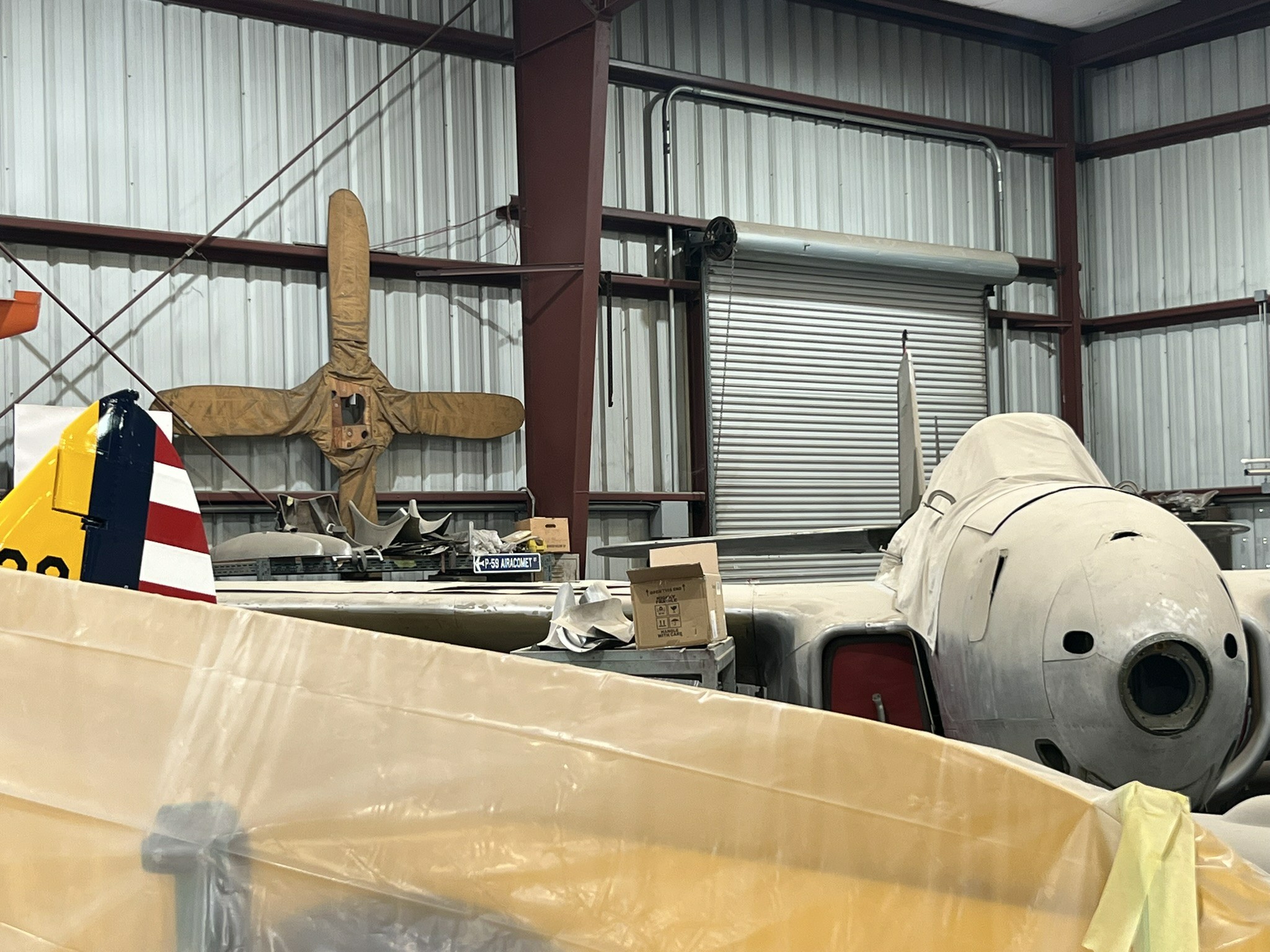
In one of the many workshops at Planes of Fame sits this Bell P-59, the first US jet aircraft.
Designed around an engine copied from Frank Whittle’s centrifugal design, the P-59 was flight tested at Muroc Field, better known today as Edwards AFB. A mock propeller was attached to the aircraft’s nose when on the ground to hide the aircraft’s true nature.
This particular P-59, 42-108777, is the second oldest of today’s six survivors and is under restoration to flying condition.
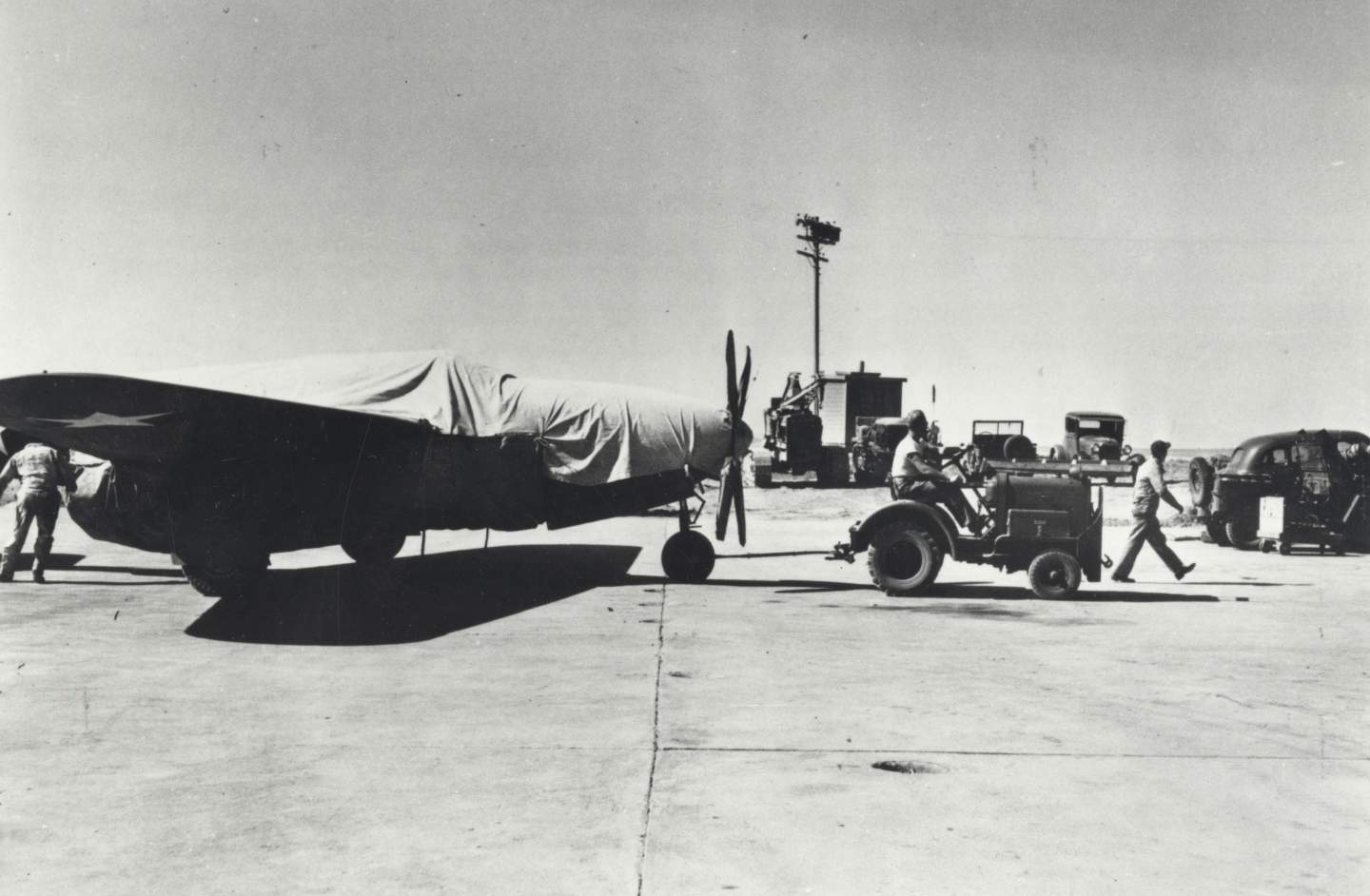
One of my favorite stories about the P-59 concerns test pilot Jack Woolams, who was known to be a practical joker.
A favorite prank of his was to don a bowler hat and gorilla mask, light up a cigar, and fly alongside student pilots, waving as he flew by in his propellerless airplane. Woolams knew well that nobody would believe them.
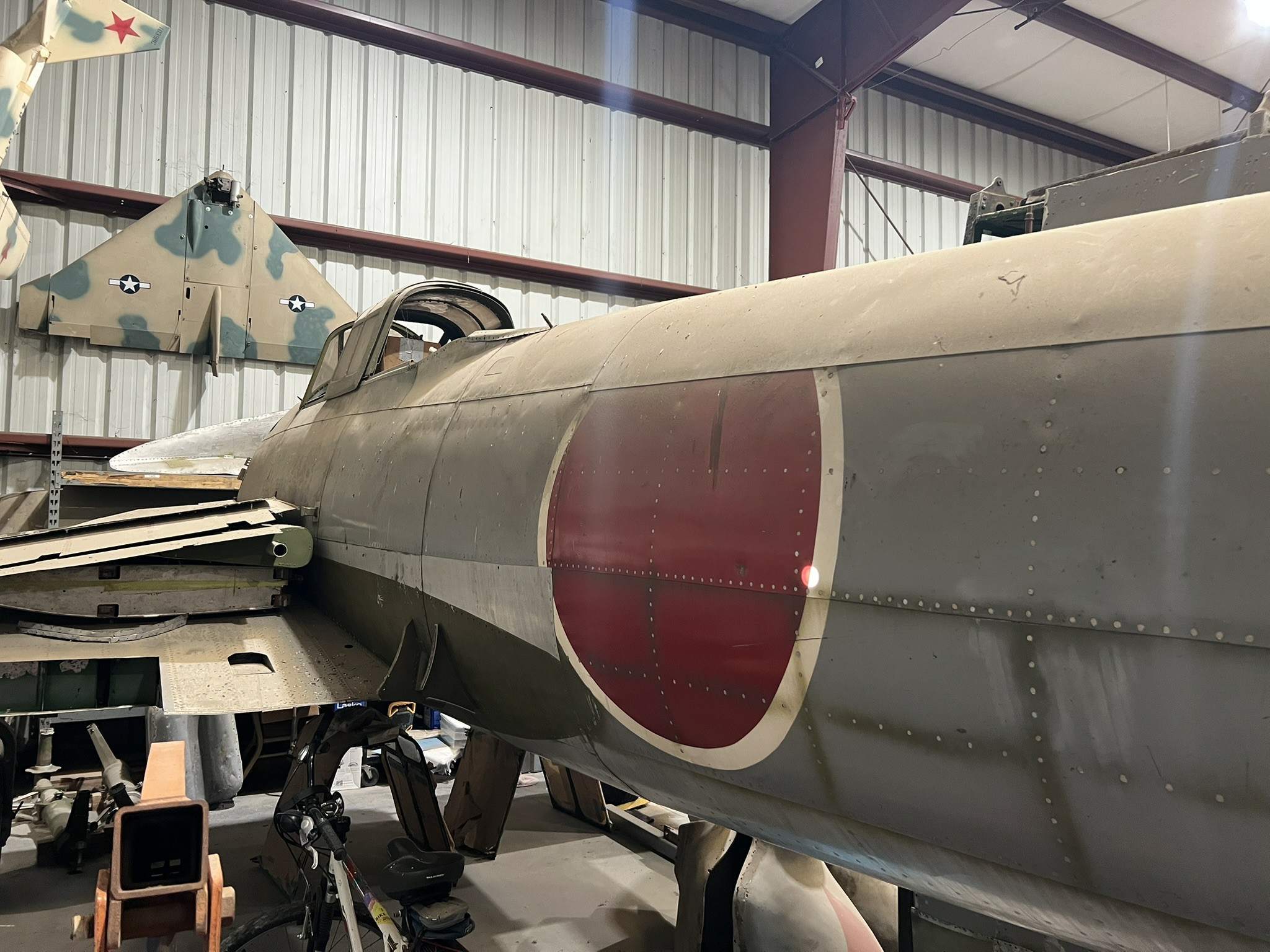
One of the more unique aspects of Planes of Fame is the surprising number of Axis aircraft in their collection.
This aircraft, for example, is an Aichi D3A Val torpedo bomber. The Val was the Japanese navy’s primary torpedo bomber in the first half of the Second World War. In fact, the Val was responsible for sinking more Allied shipping than any other type of Axis aircraft. This makes it all the more surprising that only three Vals remain, all in wreckage form. Kudos to the POF restoration staff for taking this project on.
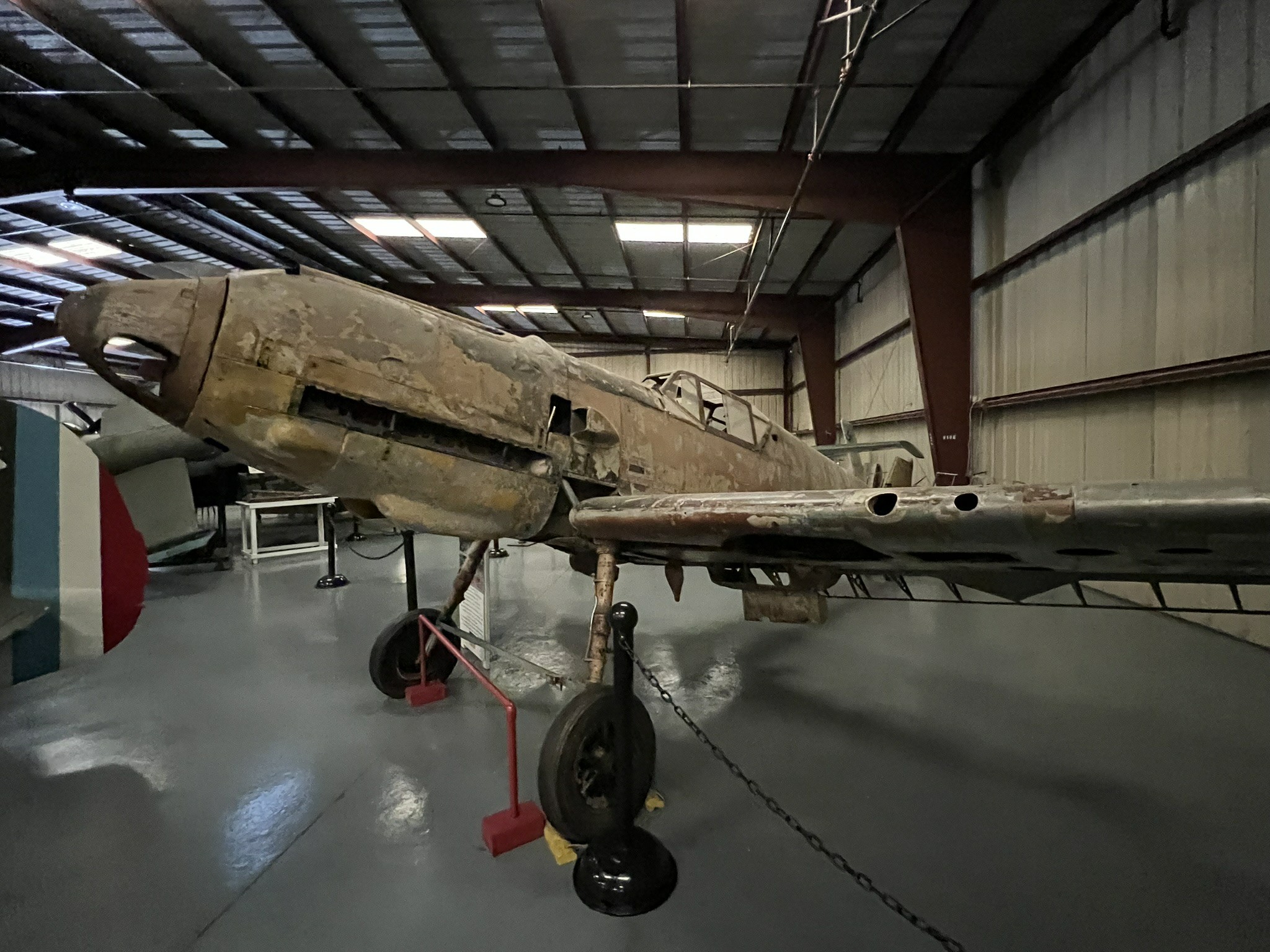
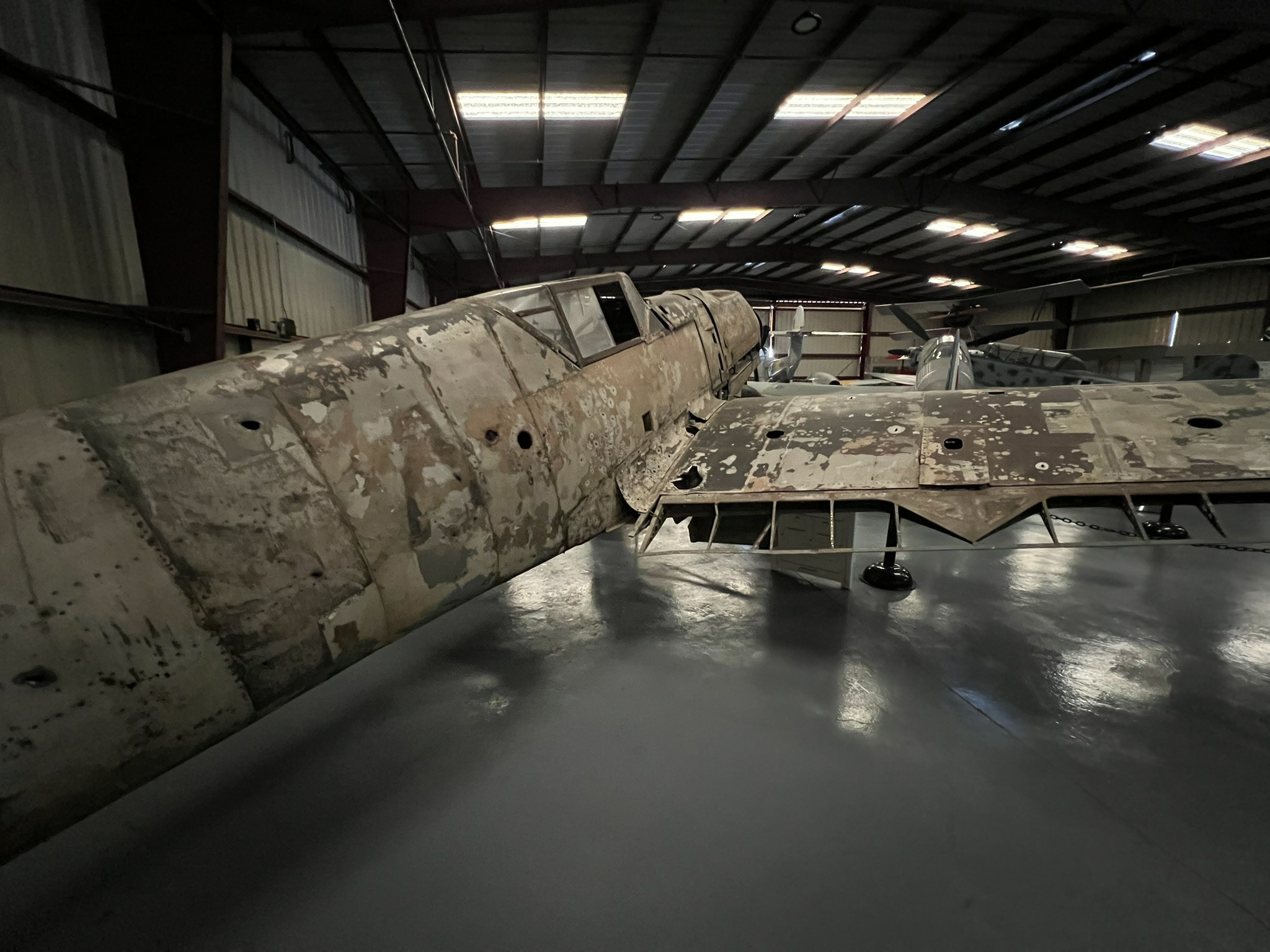
One of the most amazing things I got to see on my trip: Messerschmitt Bf 109E “Rote 6” (JG5).
This aircraft was shot down by Soviet Hawker Hurricanes on 4 April 1942 near Pestamo, Finland. Recovered from a lake in 2002, “Rote 6” is displayed relatively untouched, to the extent that much of her original paint is still visible. The right side is peppered with .303 impacts, with the large hole at the wing root most likely coming from a 20mm autocannon.
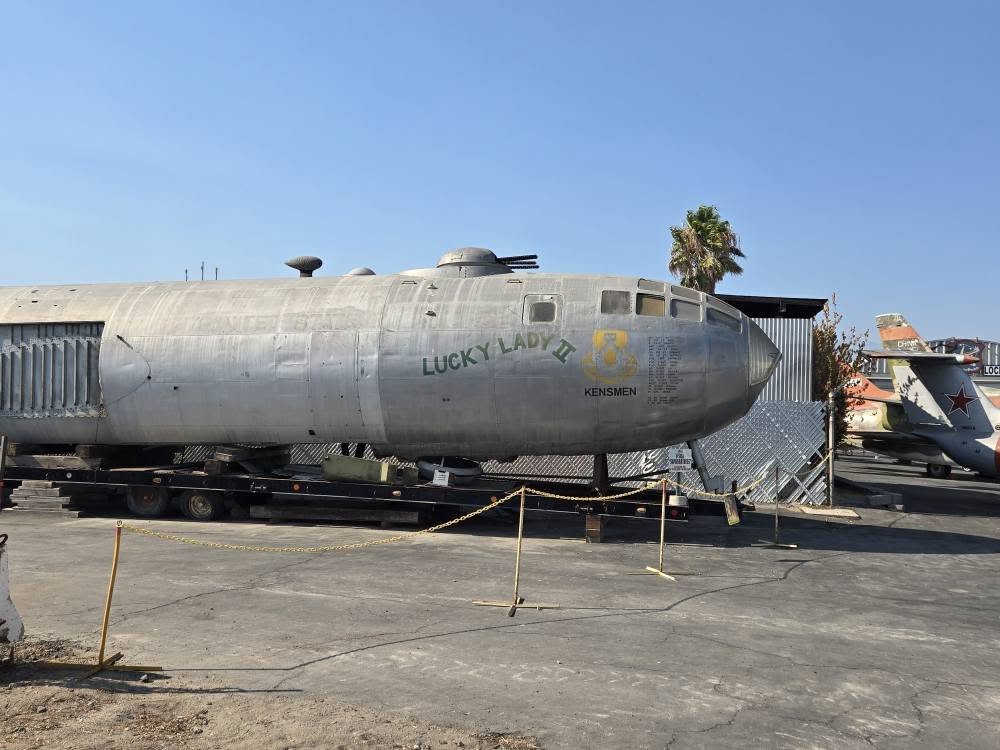
Here is one that is near and dear to my heart: Boeing B-50 Superfortress II 46-0010.
I have long maintained that, money notwithstanding, my dream projects are 1. our own Lucky Thirteen, 2. a radar carrying B-17G pathfinder, and 3. Lucky Lady II.
This airplane warrants awe and respect as Lucky Lady II is the first aircraft to circumnavigate the world without stopping.
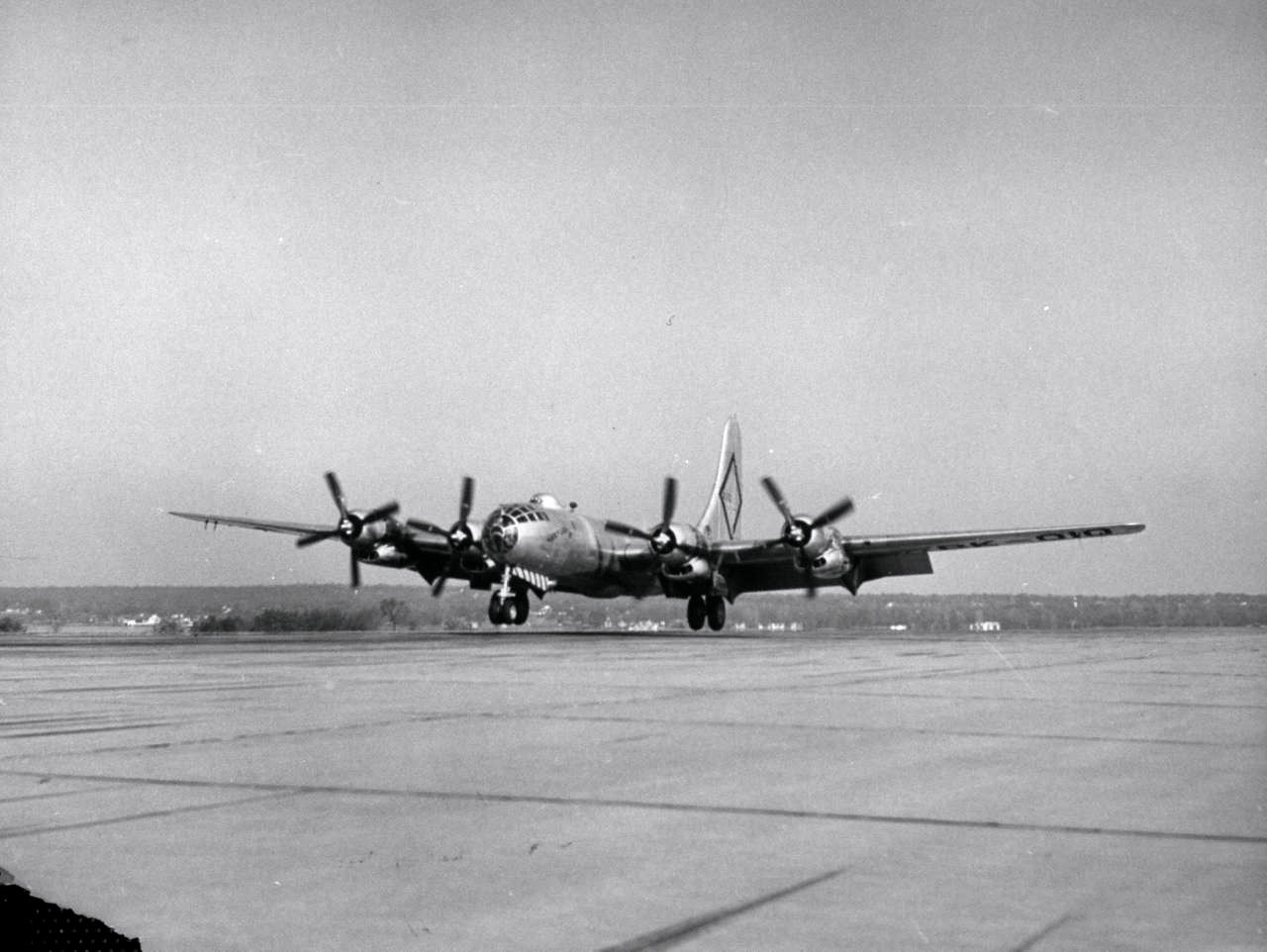
A demonstration of the USAF’s ability to counter the Soviet Union, the Boeing B-50 (a reengined B-29, originally designated the B-29D) took off from Carswell AFB, Texas on 26 February 1949, heading east. She returned to Carswell on 2 March, having covered 23,452 miles and being mid-air refueled four times by KB-29 tankers.
On 13 August 1950, she crashlanded near Davis-Monthan AFB, Arizona after an engine failure. Deemed damaged beyond repair, her fuselage was mounted to a semi trailer. It is unclear when Lucky Lady II arrived at Planes of Fame but she has remained in their backlot a long, long time. At some point, a set of replacement wings, taken from a C-97 Stratocruiser (which were identical), were placed nearby for a possible future restoration.
Who knows, maybe one day Hangar Thirteen will get a financial windfall and we can wrap up Lucky Thirteen and tackle Lucky Lady II!
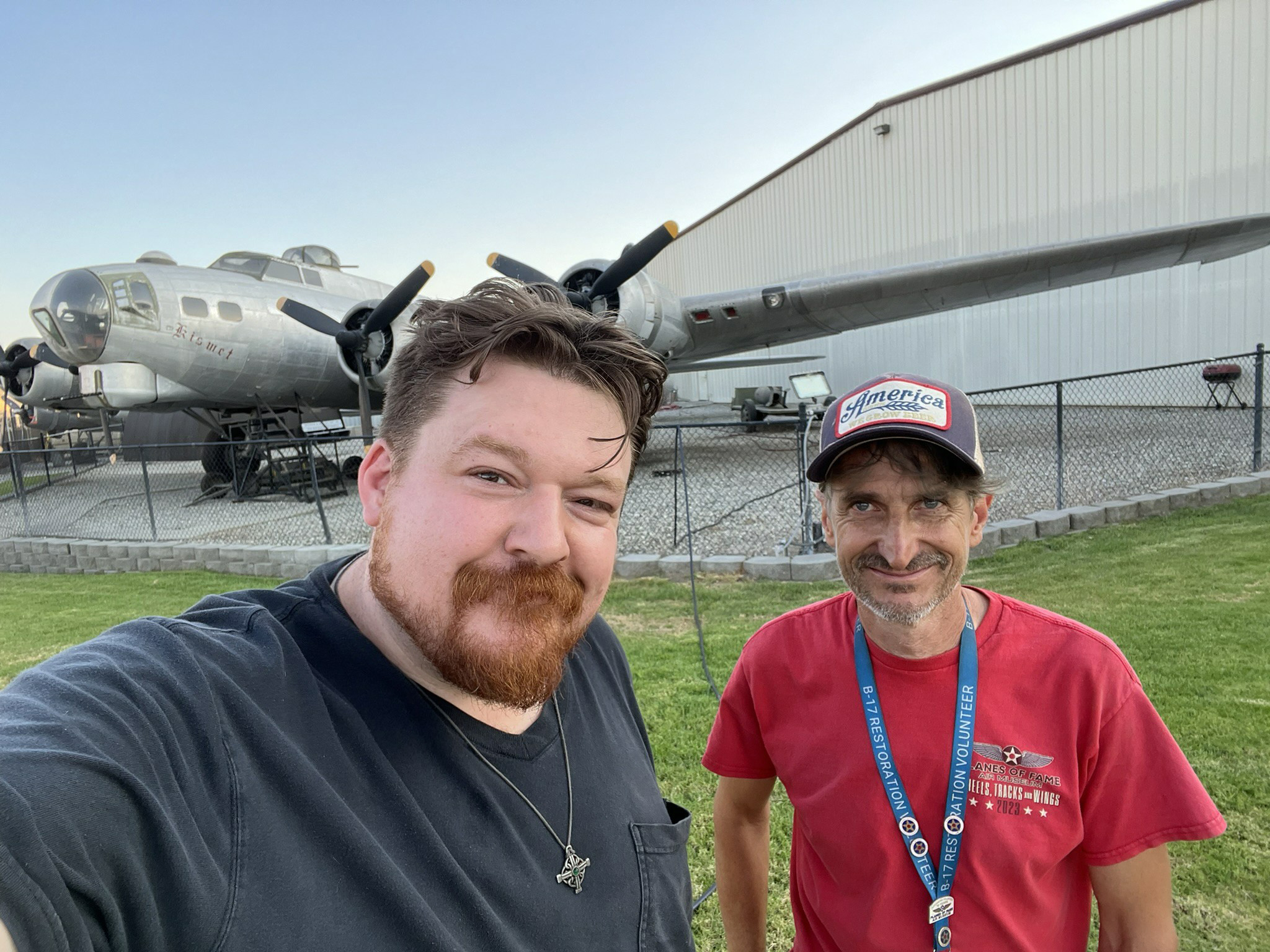
By the time we left Chino, the museums had long closed to the public and it was starting to get dark. There was just so much to see and so many people to meet, that we just barely scratched the surface.
Special thanks to Steve Salinas for taking the time to show me around. Truly an awesome experience.
Photos taken 13 August 2025.
The next day saw us begin the long track back home.
Along the way, we stopped at the 501c3 nonprofit Light Horse Legacy, based in Glendale, Arizona. Light Horse Legacy is an outreach program which uses Army aviation to support treatment for veterans with Post-Traumatic Stress Disorder. The group is partnered with the Southern Forward Air Control Museum in Anderson, South Carolina – who, as you might expect, is a neighbor and a friend. To help Mike Clary (the latter museum’s honcho), we picked up some OH-23 Raven and UH-1 Huey components to bring back home.
It was awesome to meet Light Horse director David Barron, as he is a great guy. In fact, he even gave me a gift to bring home to my dad, since he flew on Hueys around the time I was born.
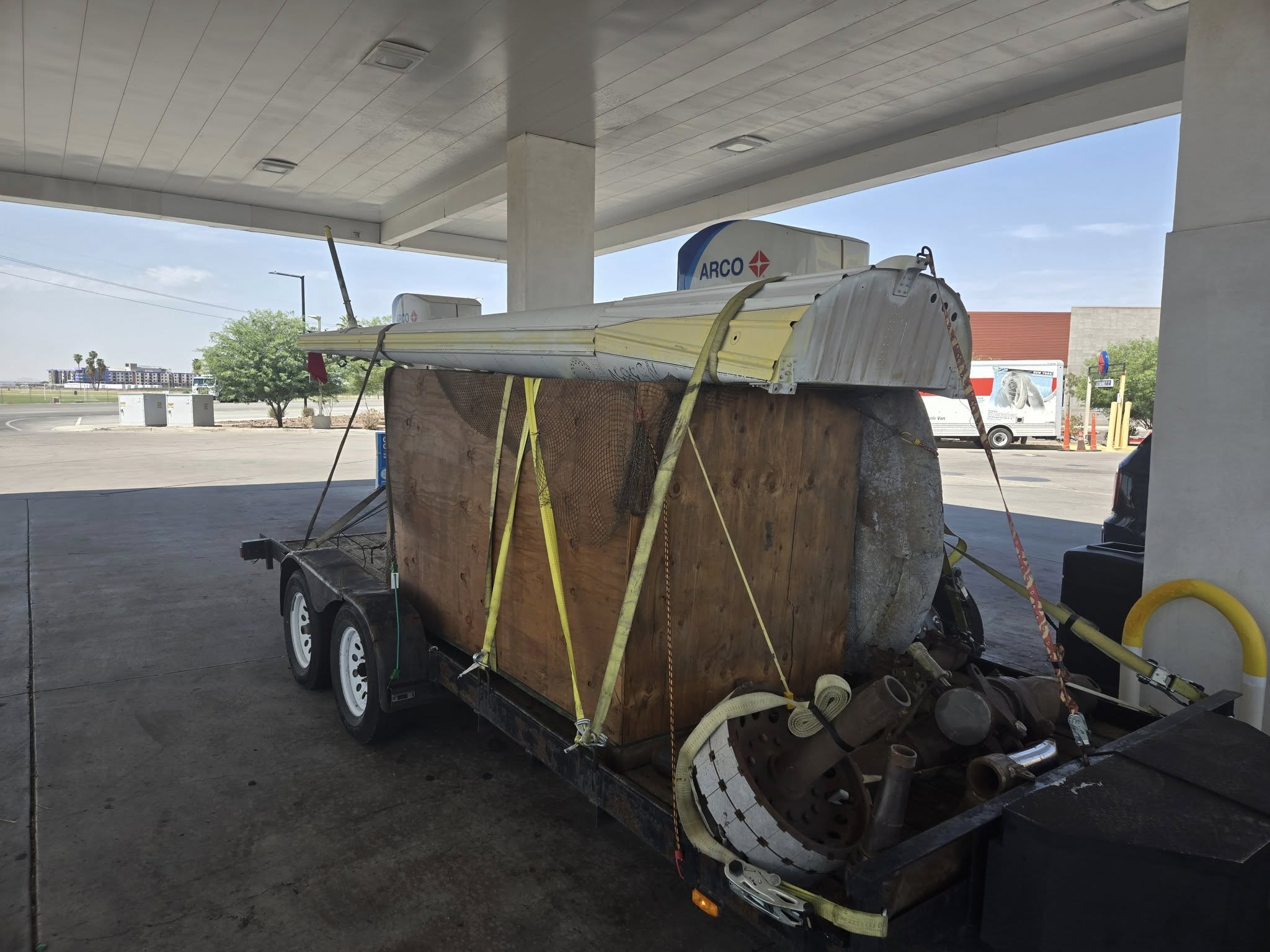
The trailer loaded up for the trip home. At the top is the tail boom to an OH-23 Raven.
The pieces at the front of the trailer are the main and nose landing gear of a Consolidated B-24. The box is likewise filled with Liberator components -all destined for Project Warbird’s Liberator II Maid of Athens.
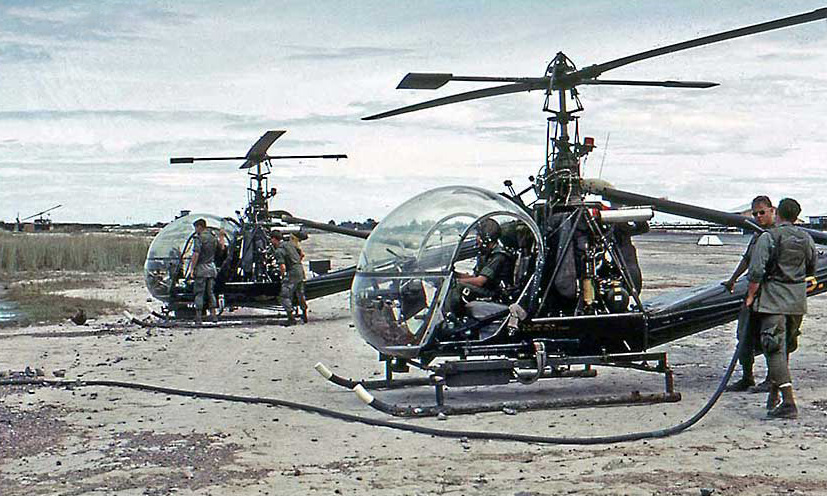
The tiny Hiller OH-23 entered service in 1948, becoming the first helicopter to fly across the United States (California to New York).
A veteran of the Korean War and the earlier part of Vietnam, the Raven is best remembered today for its role in the My Lai massacre. An OH-23 pilot, WO Hugh Thompson, Jr., was the one who intervened and put a stop to the events below.
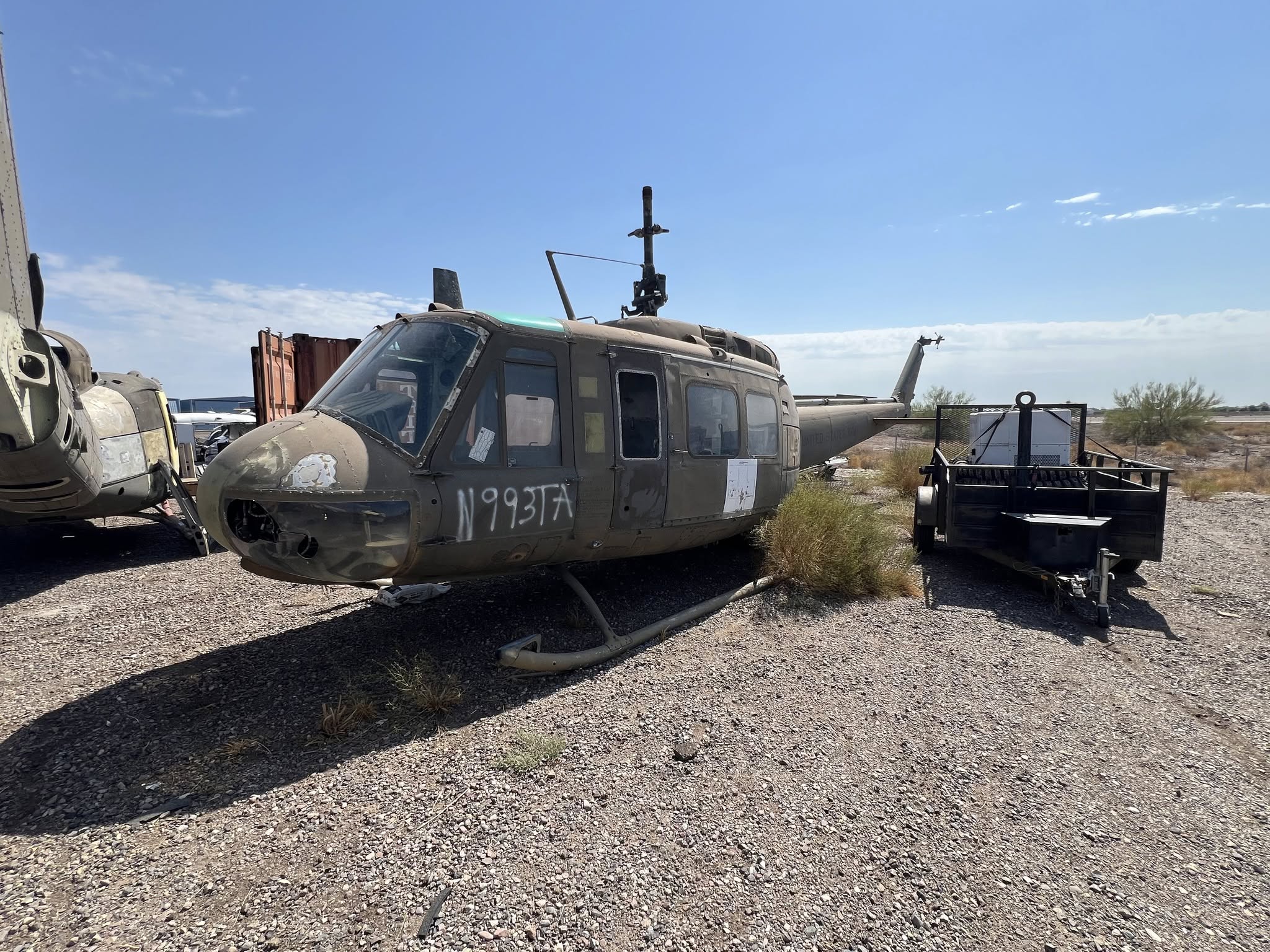
Easily the most iconic helicopter in history: the Bell UH-1 Iroquois.
Better known as, the “Huey.”
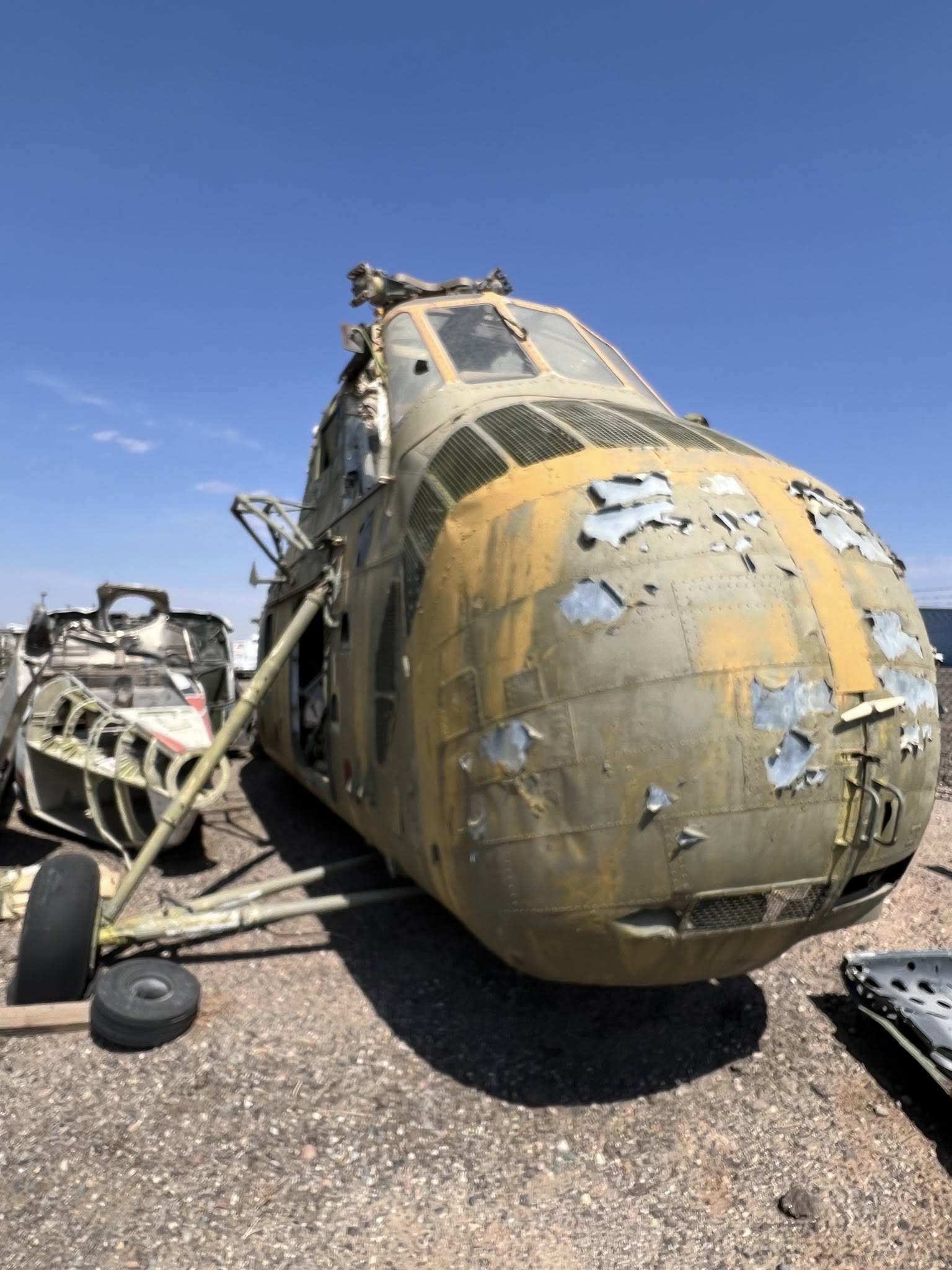
A personal favorite of mine, when it comes to military helicopters: the Sikorsky H-34 Choctaw.
Developed from the UH-19 Chickasaw from the Korean War, the large size of the two designs is due to the nose compartment carrying an upturned radial engine. In fact, the Choctaw used a variant of the R-1820, the same engine as the Boeing B-17. Choctaws were used by the US Marine Corps in Vietnam, being somewhat stronger and more reliable than the ubiquitous Huey. The H-34 was officially retired from US military service in 1973.
A few of these remain airworthy today, most of which, surprisingly, still perform civil service jobs. Personally, I would like to see more of them in wartime colors flying alongside Hueys and Cobras. But before they do, it might not hurt to spare an engine (or four) to Lucky Thirteen!
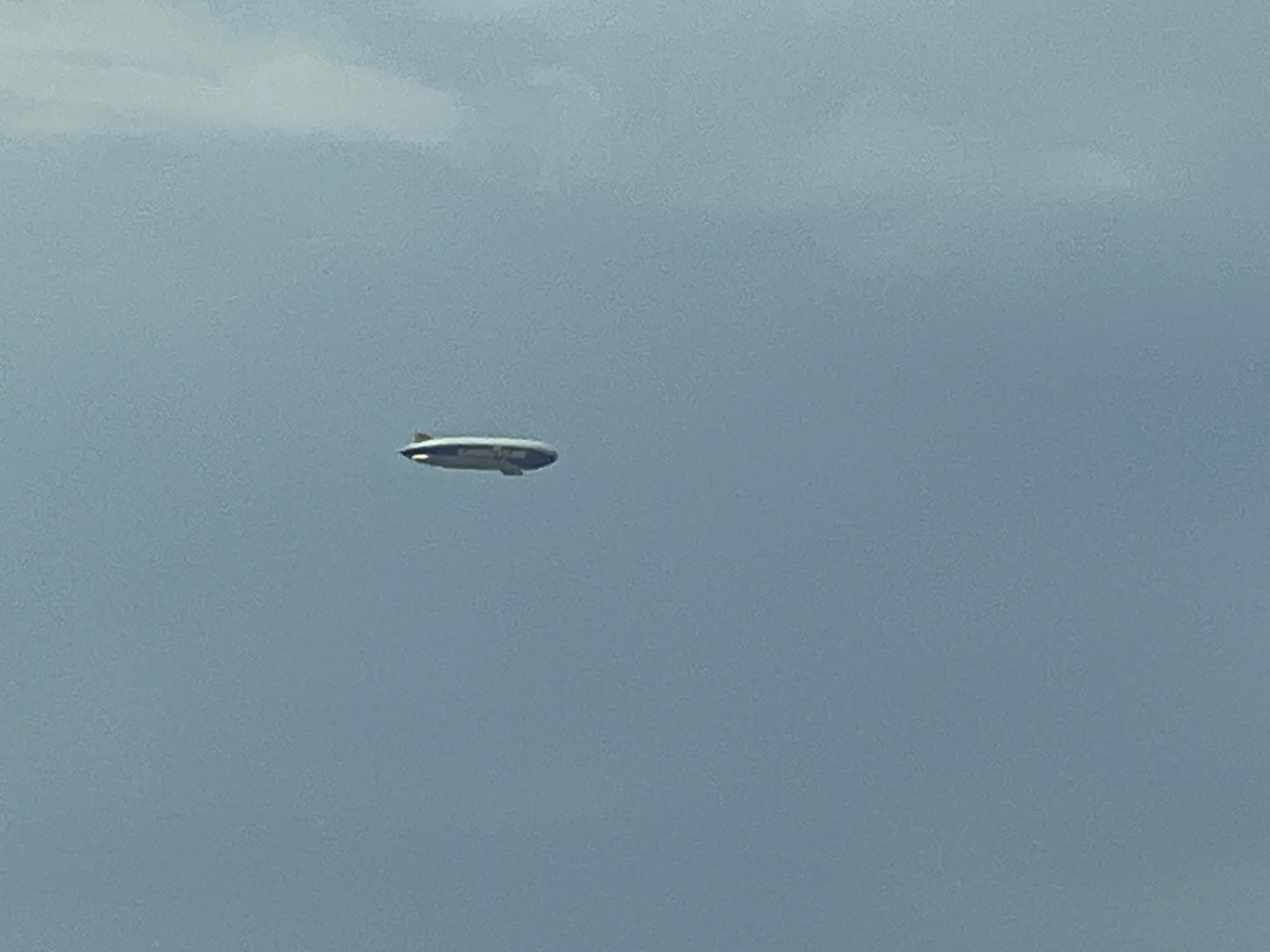
If it flies, chances are that we saw it on our trip. Here we pass one of the Goodyear blimps.
Goodyear’s association with lighter-than-air aviation is no accident. The end of Great War saw a prohibition from Germany owning or constructing dirigibles. Zeppelin CEO Hugo Eckener conceived of a brilliant way to circumvent this prohibition and keep the company from going bankrupt: he made a licensing agreement with the US Navy. Two airships would be built: one in Germany (the USS Los Angeles) and one in the United States (the USS Shenandoah), the latter built in partnership with Goodyear Tire & Rubber.
Eckener was a vocal critic of National Socialist (Nazi) Party, and following Hitler’s rise to power, was sidelined from the company he saved.
Photos taken 14 August 2025.
The following day saw us make the long drive across Texas.
Having shared on Facebook our first attempt to see the Boeing B-17 at Dyess AFB, longtime support Justin Suan reached out to us. Turns out, not only does he live nearby, but he is retired from serving at that very airbase. Justin invited us to stop by, offering to not only get us onto the Dyess AFB air park, but to take us out to his old stomping ground.
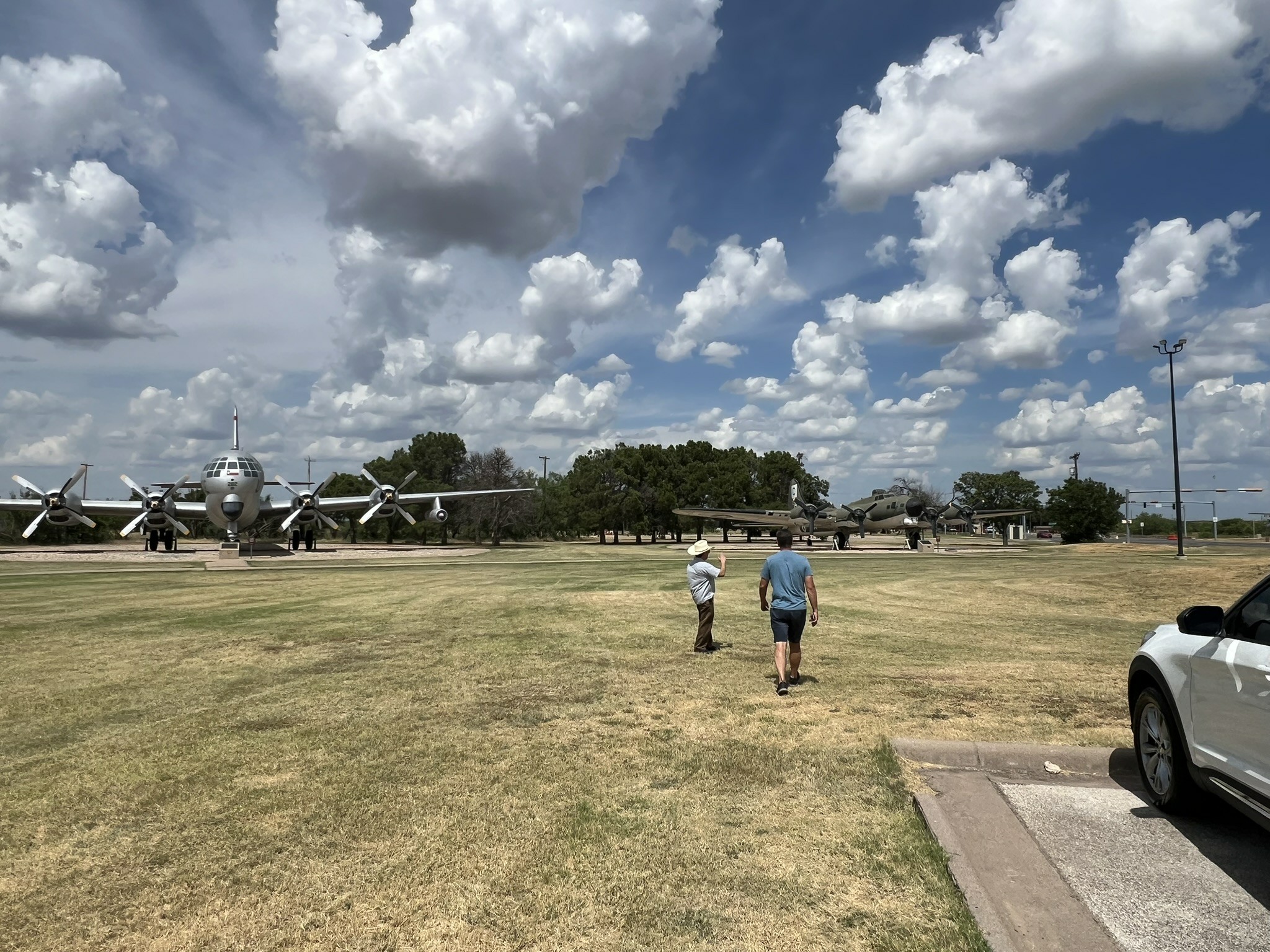
Justin and Eric walking out to Boeing B-17G Reluctant Dragon.
Dyess AFB’s air park is comprised of seven large semi-circles alongside Arnold Blvd. Most of the aircraft are late-1950s/early-1960s vintage, with the B-17, North American T-6, Douglas A-26 and Douglas C-47 standing out as the WWII vintage. A mock-Curtiss P-40 from the 1970 film Tora Tora Tora is also displayed on a pole.
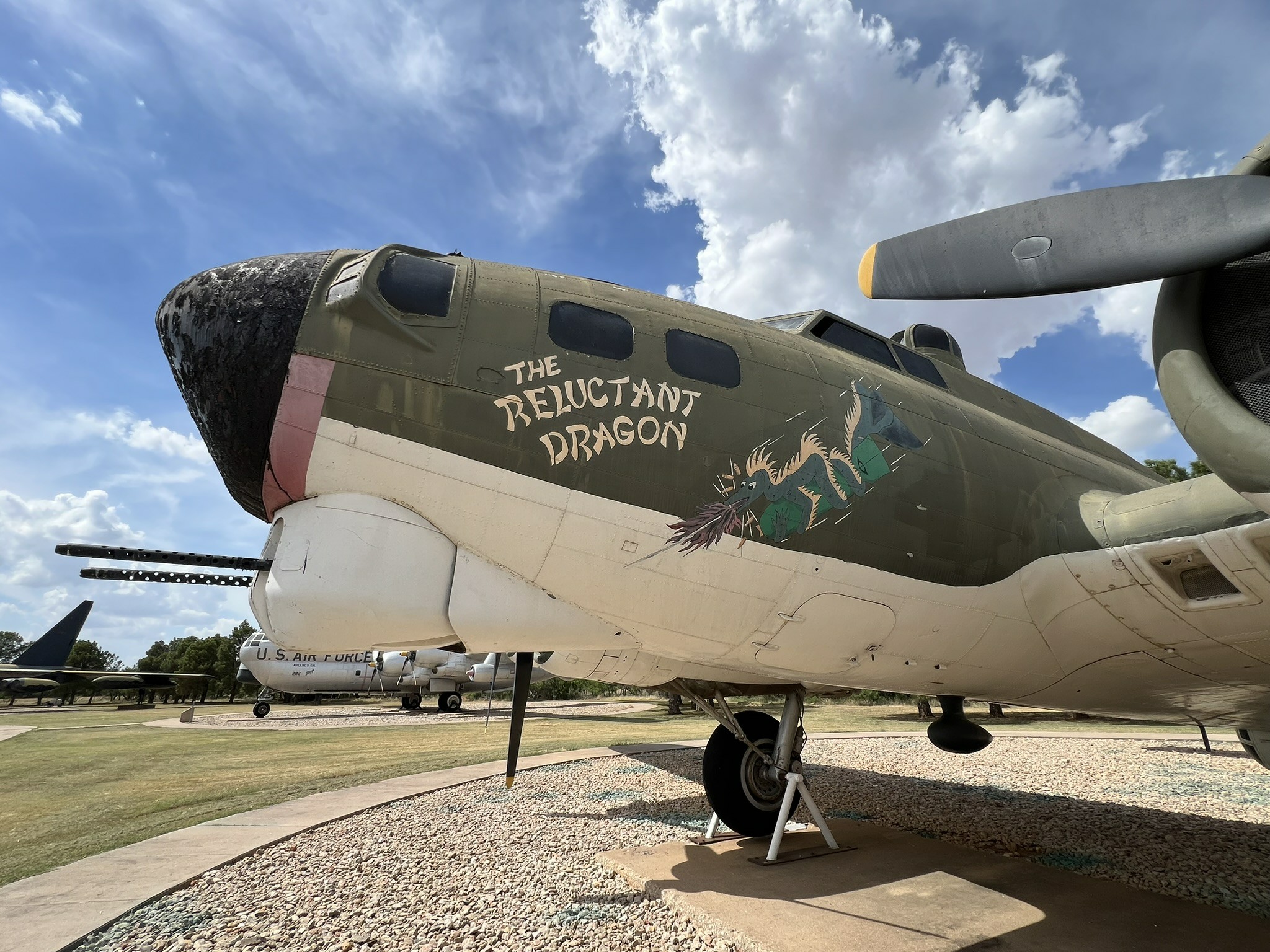
Reluctant Dragon (44-85599) at the Dyess AFB air park. The park is not open to the public and visitors must obtain a guest pass at the base entrance.
Like most survivors, she was built too late to see combat, instead serving as a drone controller throughout the 1950s. 44-85599 was placed on display at Dyess in 1977.
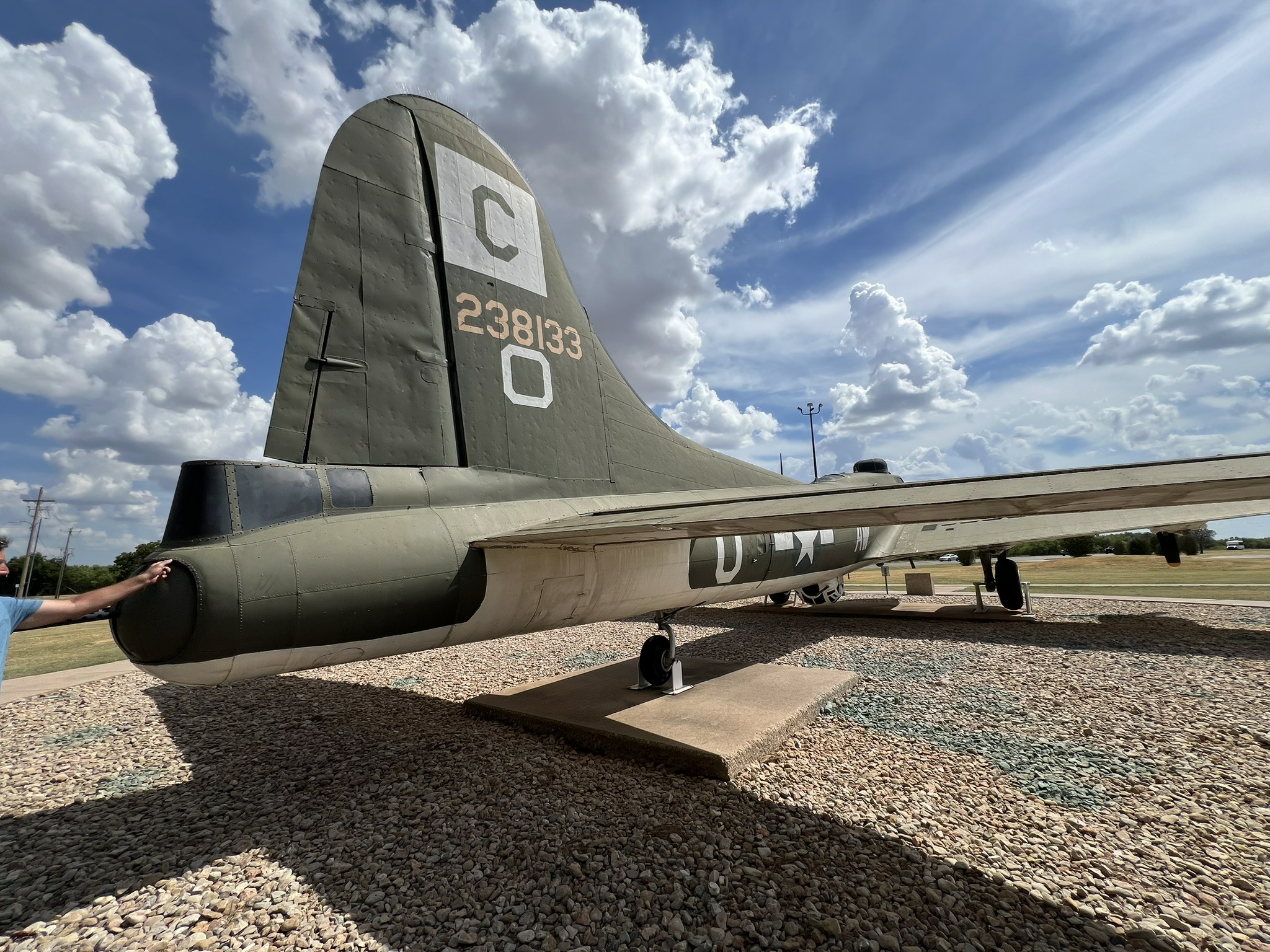
While it is tempting to condemn the aircraft’s condition, I must admit that it was in better shape than I expected.
The relative dryness of the Texas desert is a great aid in preserving these historic aircraft.
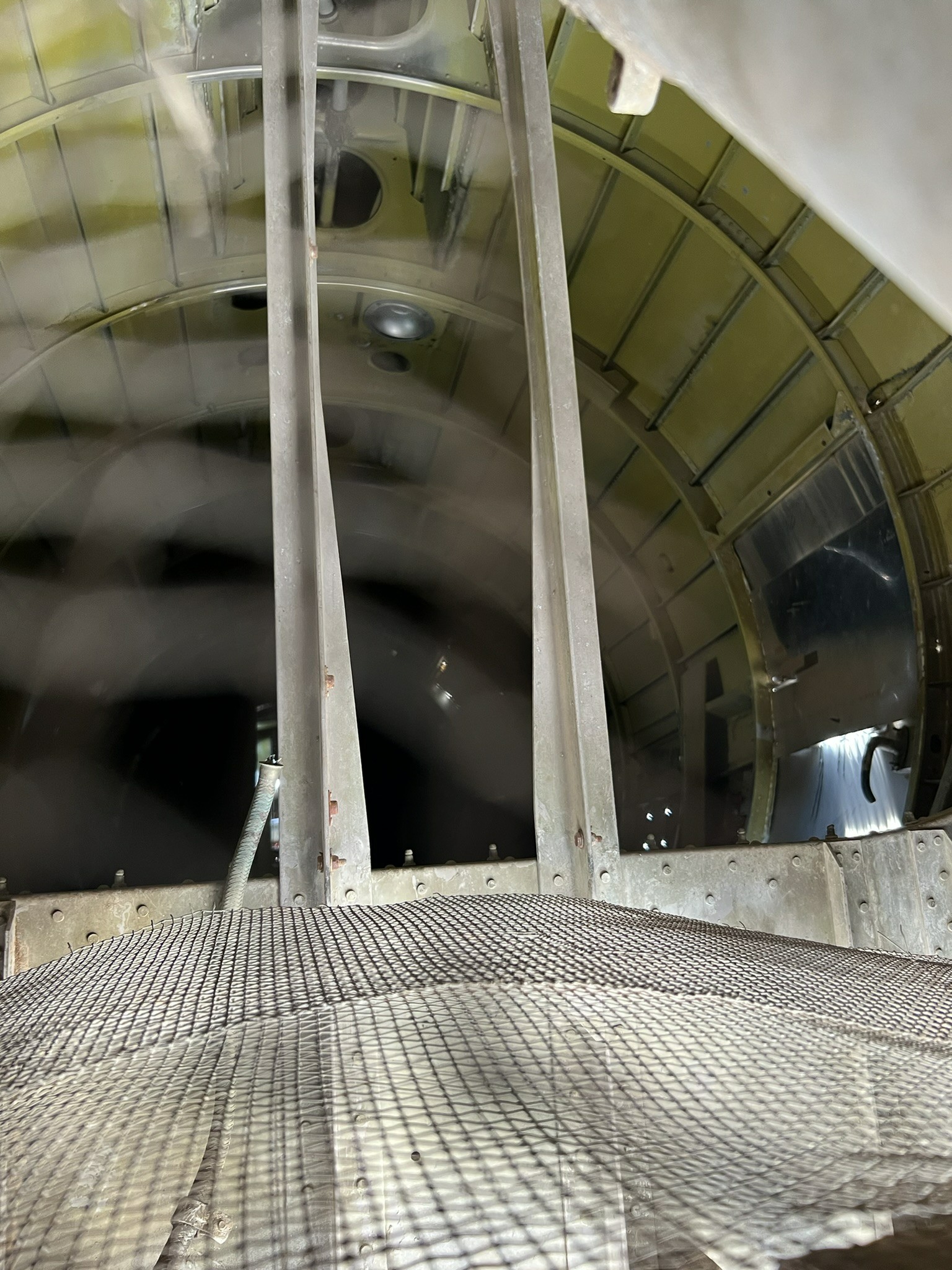
Peeking up through the tail wheel of Reluctant Dragon. The wire-mesh is to protect the inside from intruders, big and small.
I mention small as, right after this photo was taken, I was stung by a yellow-jacket under my right arm.
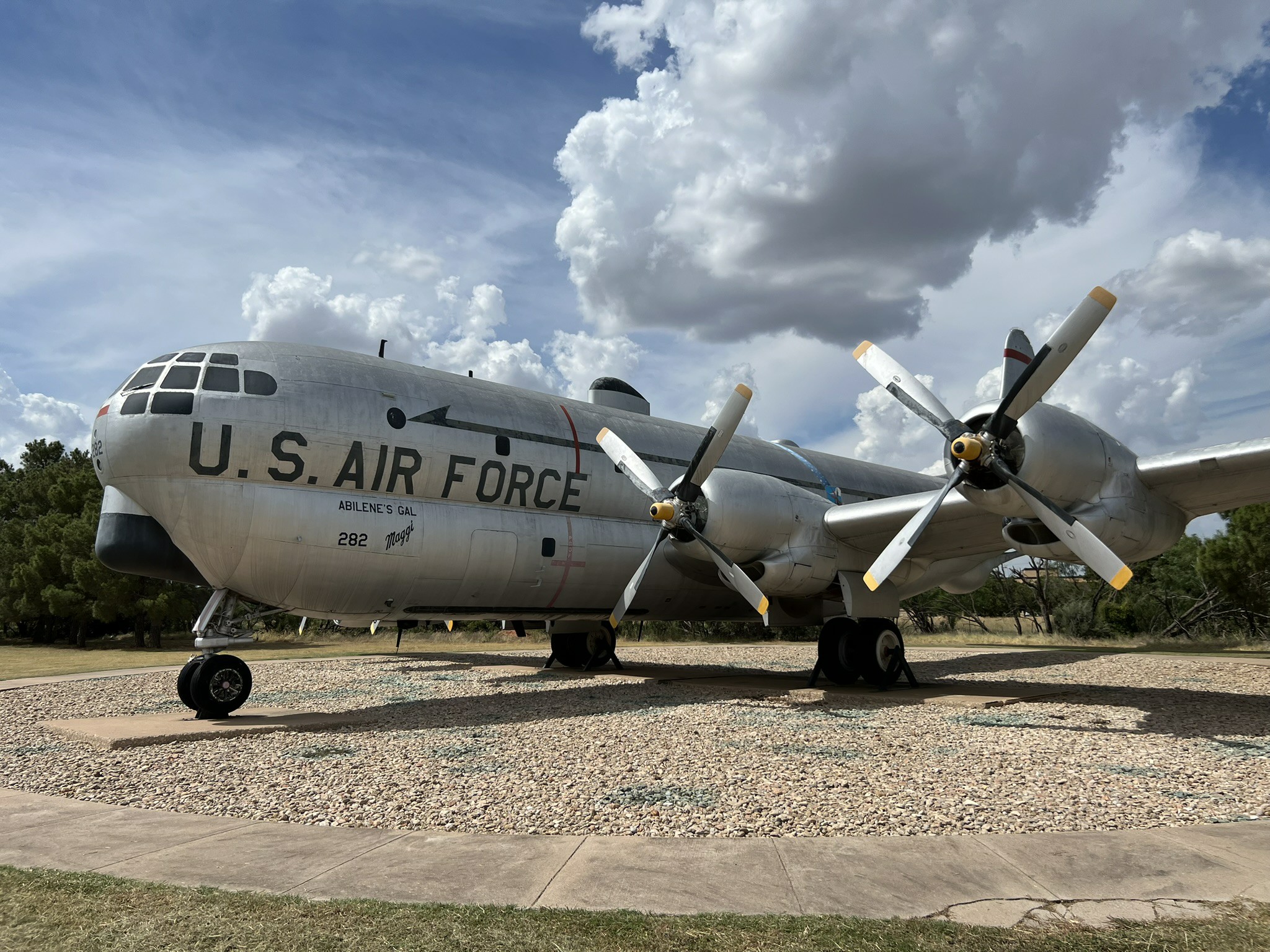
Obligatory Boeing KC-97 picture!
This example, 56-3639, entered service in 1958 and was placed on display at Dyess in 1992.
So, I mentioned that Justin took us to his old stomping grounds. It actually went farther than that…
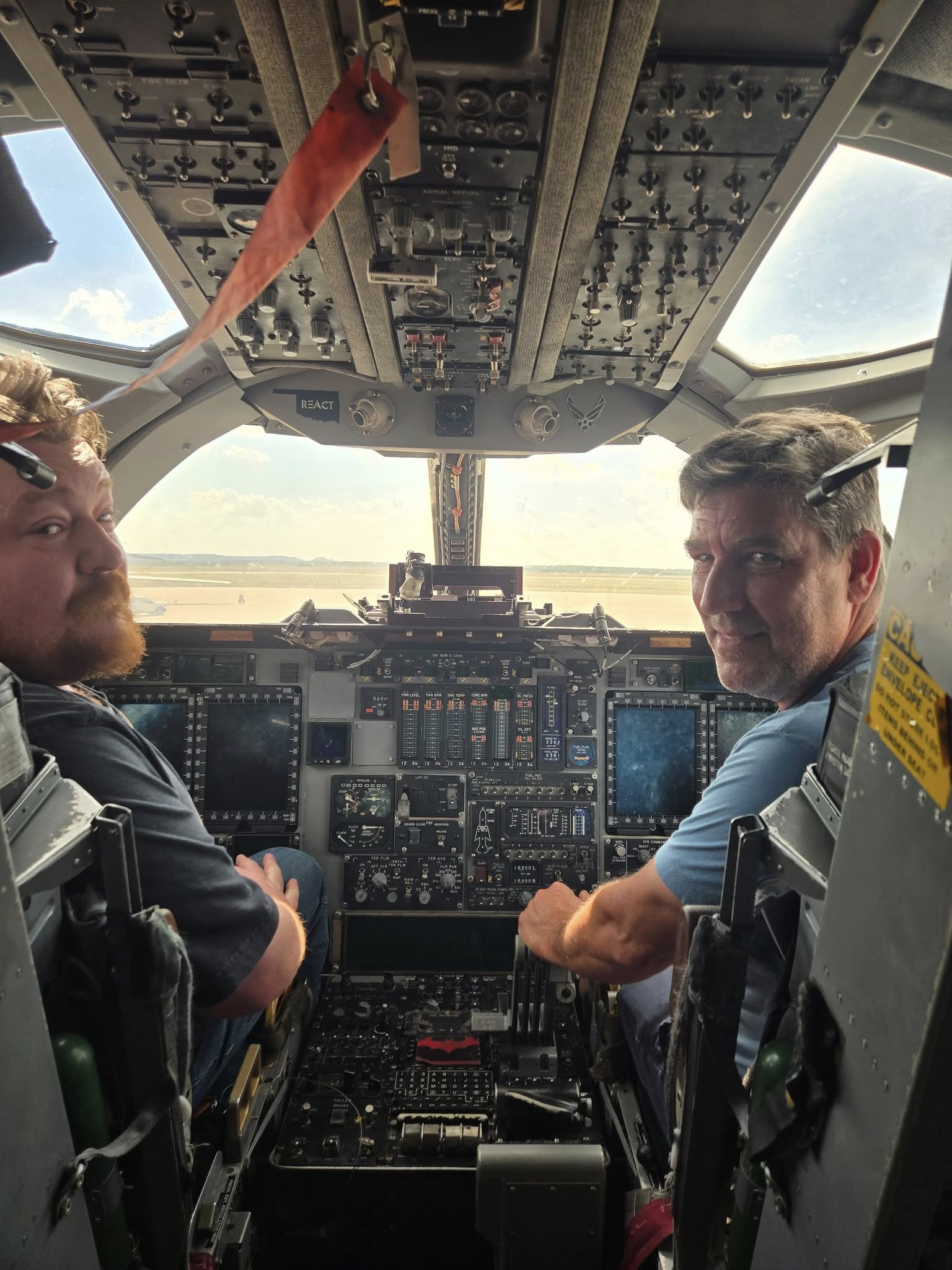
Justin introduced us to MSgt Kevin Kafer, who relayed a few messages to the tower and soon we were in a crew van driving out to the flight line. We were given 45 minutes to check out a Rockwell B-1 Lancer. Words can hardly describe how cool this was.
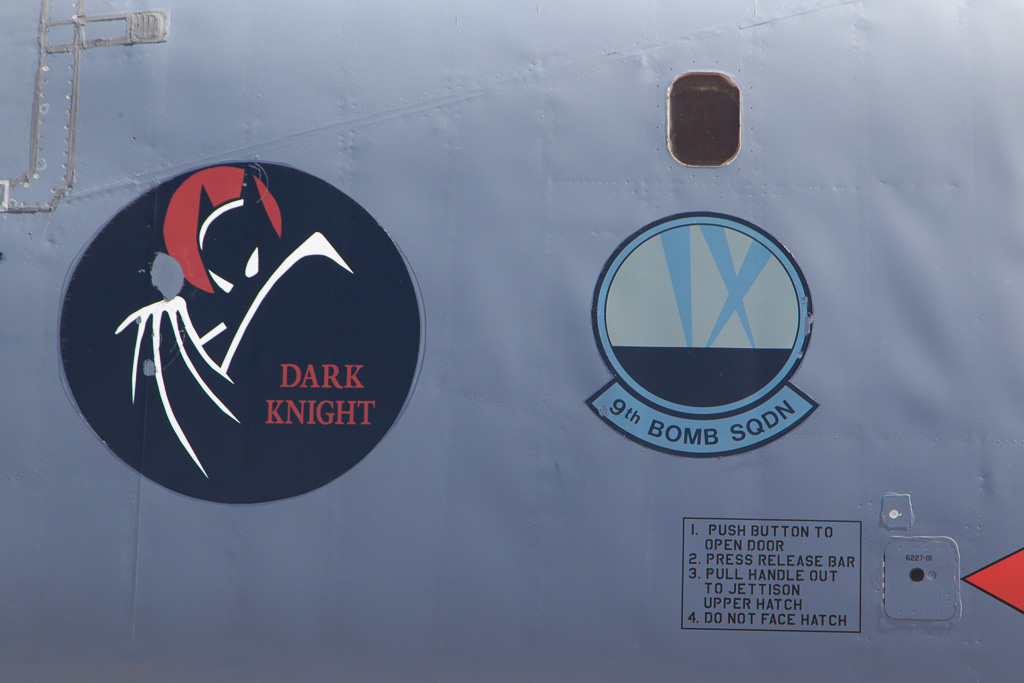
The aircraft we got to visit was Dark Knight (85-0073) of the 7th Bomb Wing.
As we did not take any pictures outside of the aircraft, this is an older photo of Dark Knight found online.
Photo taken by Norman Graf in 2016.
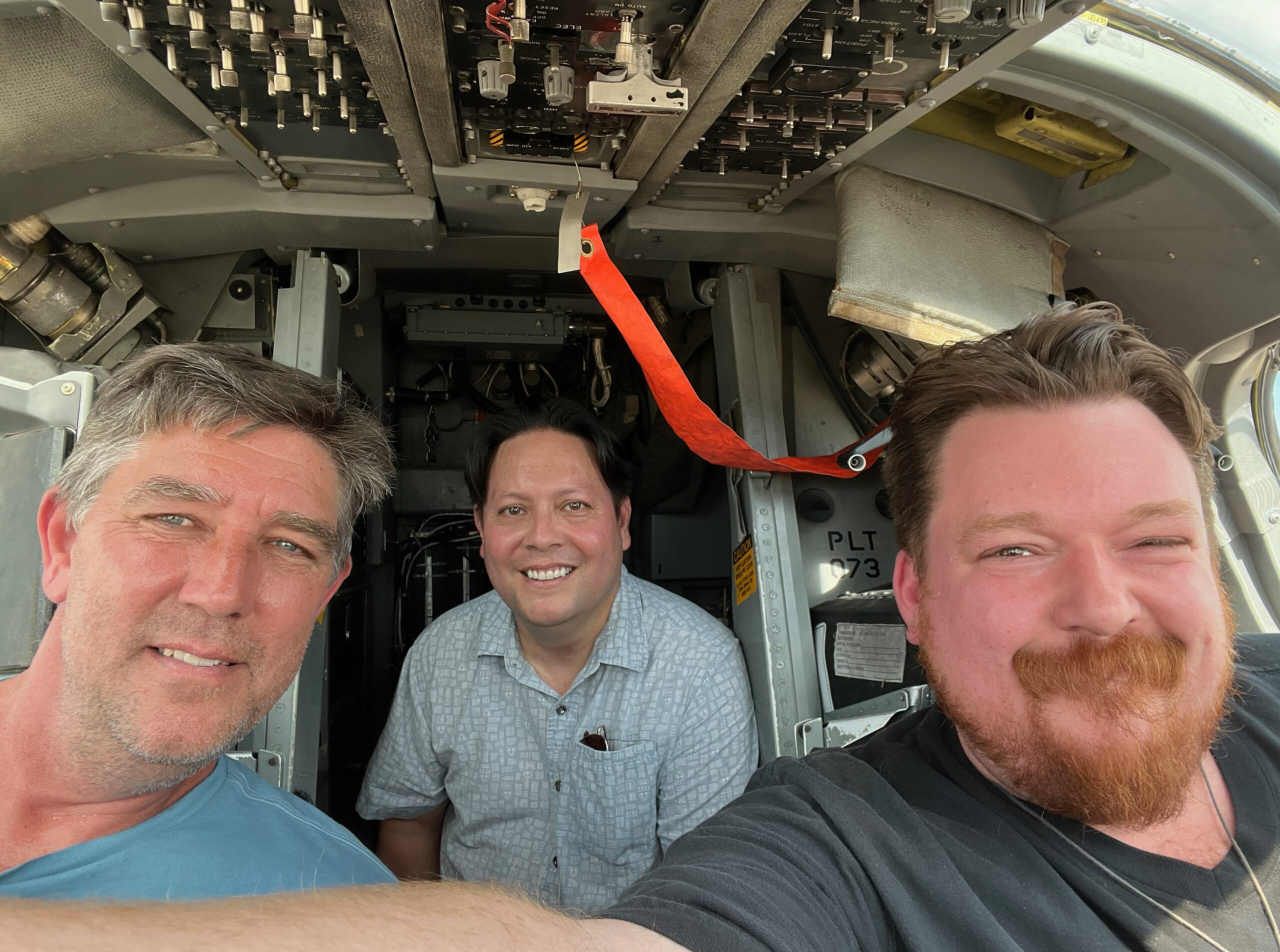
Eric, Justin, and I in the cockpit of Rockwell B-1 Dark Knight.
While the aircraft has an air conditioner, it cannot run unless the APU is also running. So, it was REALLY hot in there…
Thanks again to Justin for supporting our projects and for making this happen. Truly awesome of you.
Photos taken 15 August 2025.
With our Project Warbird work on Liberator II Maid of Athens, a trip through Texas would not be complete without visiting Liberator I Diamond Lil. So, the next day saw our final stop before heading home, the Dallas-Forth Worth area of Texas. Here we met up with our friend Rory Cahoon, who spent the day shuttling us around.
This time, however, most of the day was spent at the Vintage Flying Museum in Fort Worth.
I must say, this was a real treat, as I finally got to meet Chuckie Hospers (more on her below). Chuckie is an incredible lady and she went out of her way to show us around. In fact, we had such a great time that we hardly wanted to leave.
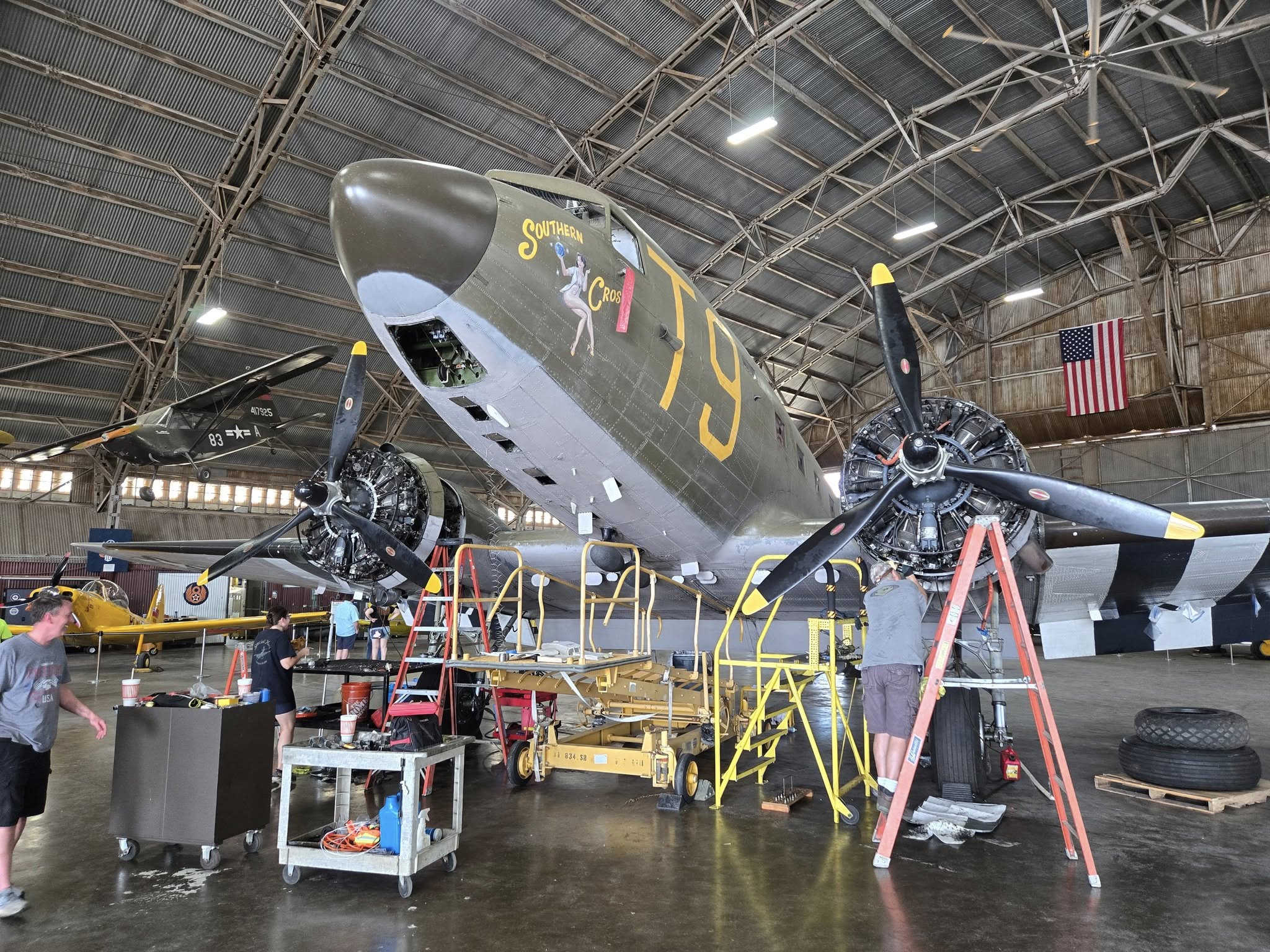
Undergoing maintenance during our visit was Southern Cross. While she appears to be a Douglas C-47 at first glance, in actuality, she is a C-49.
The difference is minimal. Southern Cross was originally built under a civilian contract as a DC-3 for American Airlines, being equipped with R-1820 engines rather than the R-1830s more common to Skytrains.
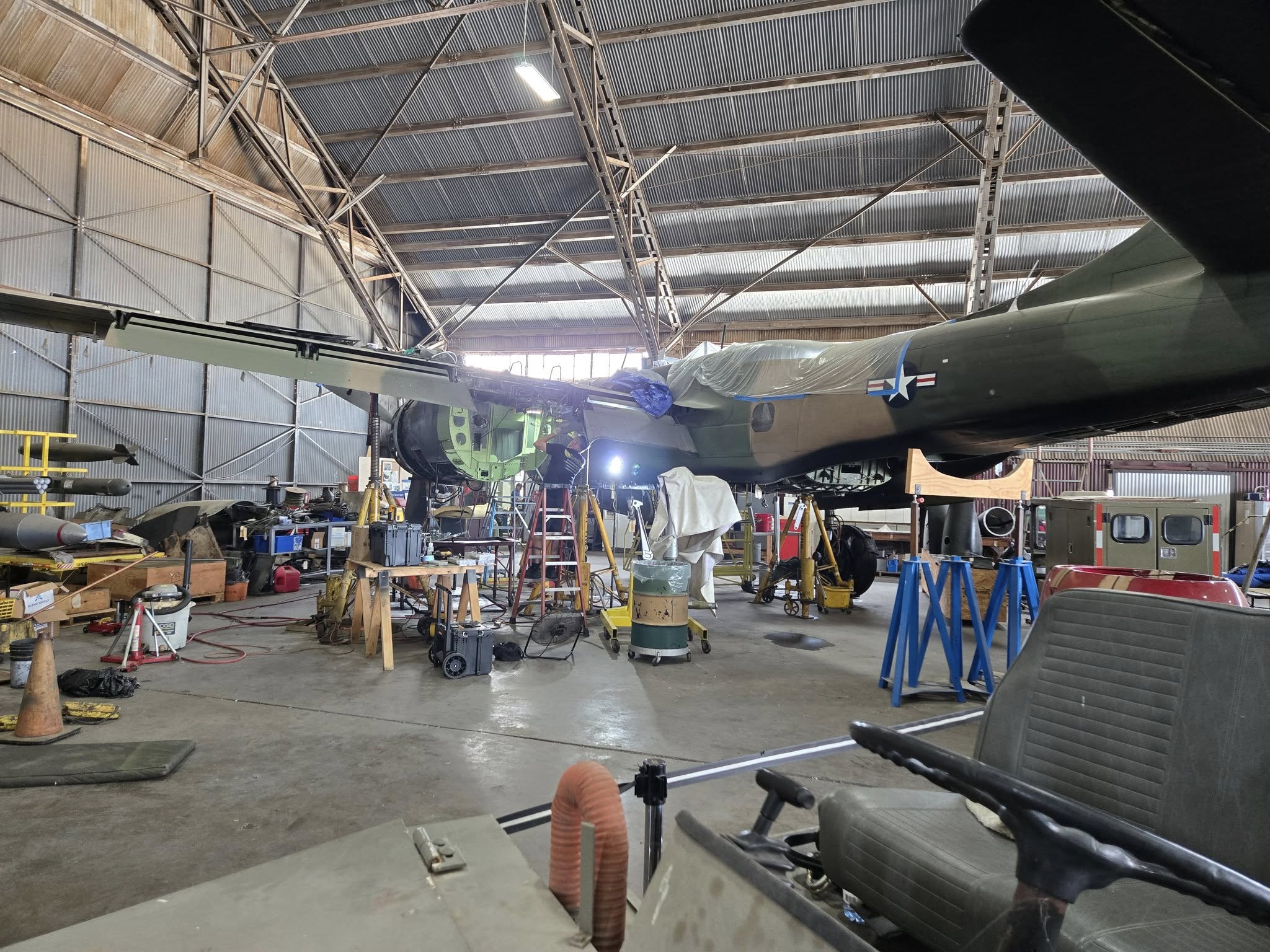
Despite the postwar fascination with all things jet-age, the Vietnam War revealed the superiority of propeller-driven aircraft in the close air support/counter insurgency role. In the process, holdovers from the 1940s like the Douglas A-1 Skyraider, C-47 Skytrain (more on that later), and A-26 Invader found themselves in high demand over Southeast Asia.
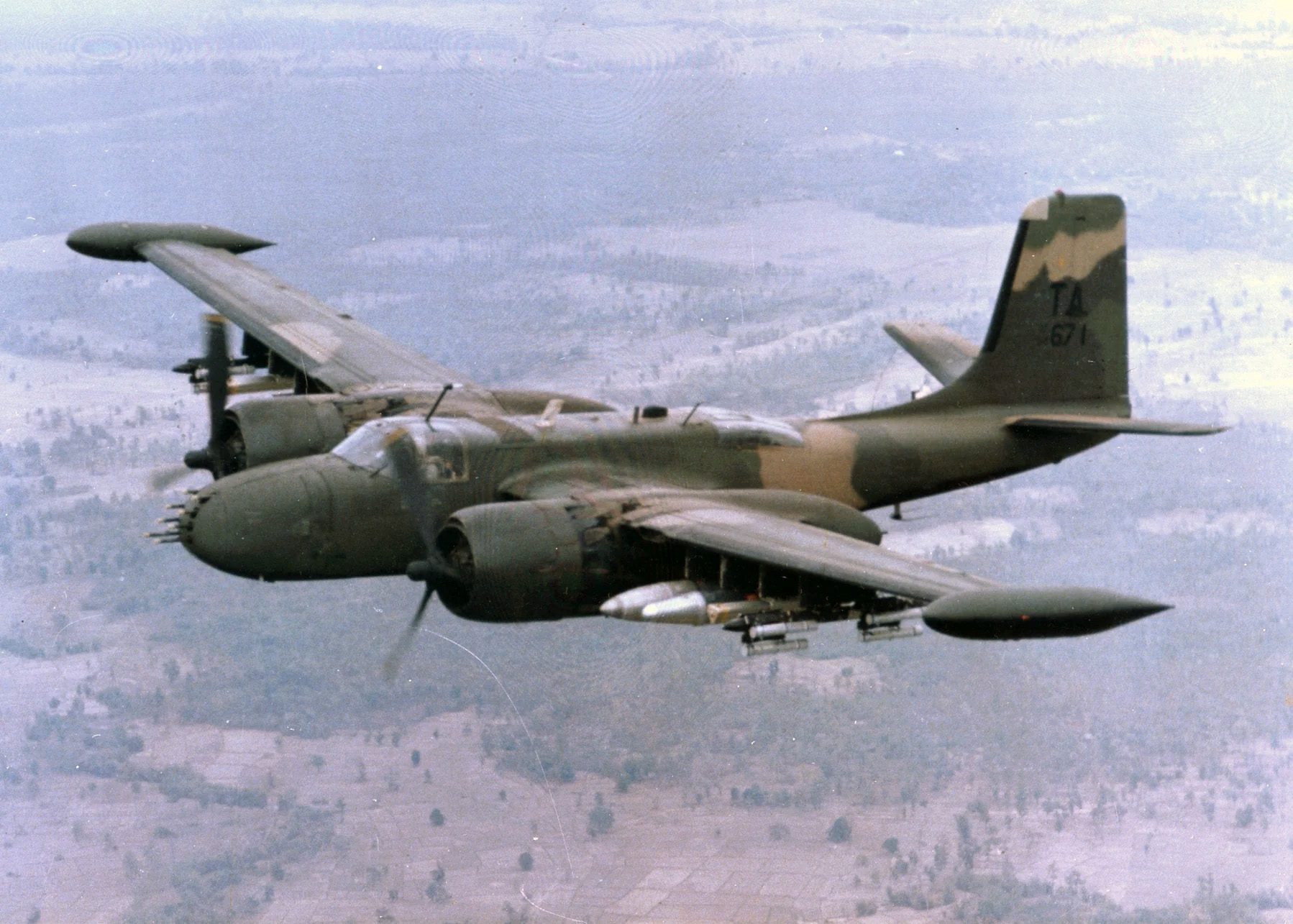
A Douglas B-26K of the 609th Special Ops Squadron over South Vietnam, circa 1969.
Redesignated the B-26 after the Second World War (not to be confused with the wartime Martin B-26), the A-26 received a lease on life in the counter-insurgency role. Mark Engineering of Van Nuys, California were contracted to overhaul the aging bombers, enlarging the tail and completely rebuilding the wings as, by this point, the original wings suffered from frequent spar failures. The type saw heavy use interdicting Communist supplies on the Ho Chi Minh trail (a series of supply routes North Vietnam used to supply insurgents in South Vietnam, which webbed in and out of neighboring “neutral” nations).
The museum’s example, 64-17679, is the only airworthy Counter-Invader still in existence.
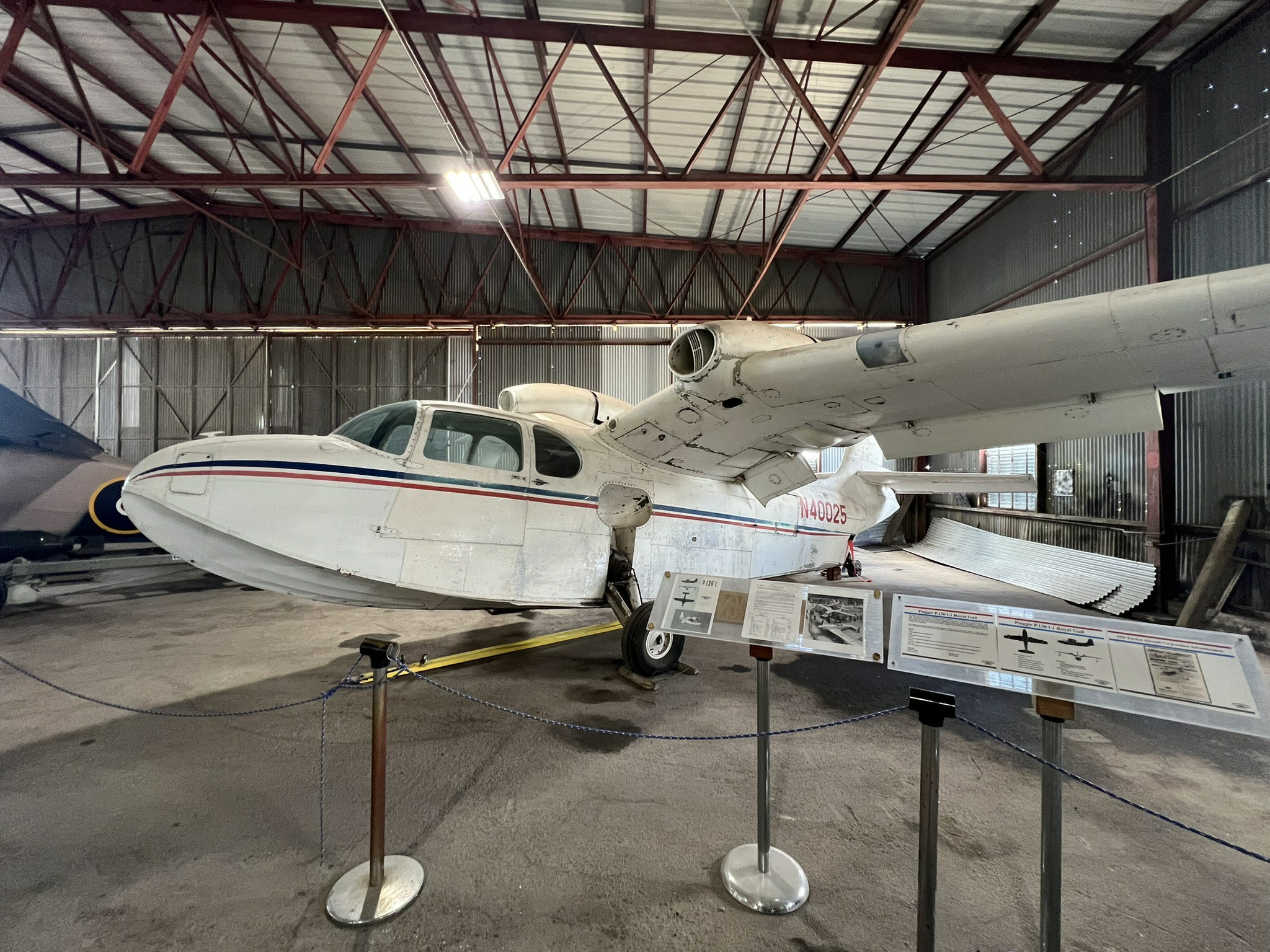
This aircraft was new to me but I wanted to highlight it because, frankly, it is a beautiful design.
The Piaggio P.136 was an Italian amphibian produced between 1948 and 1961. Supposedly, this was museum founder Doc Hosper’s favorite aircraft before purchasing the Boeing B-17.
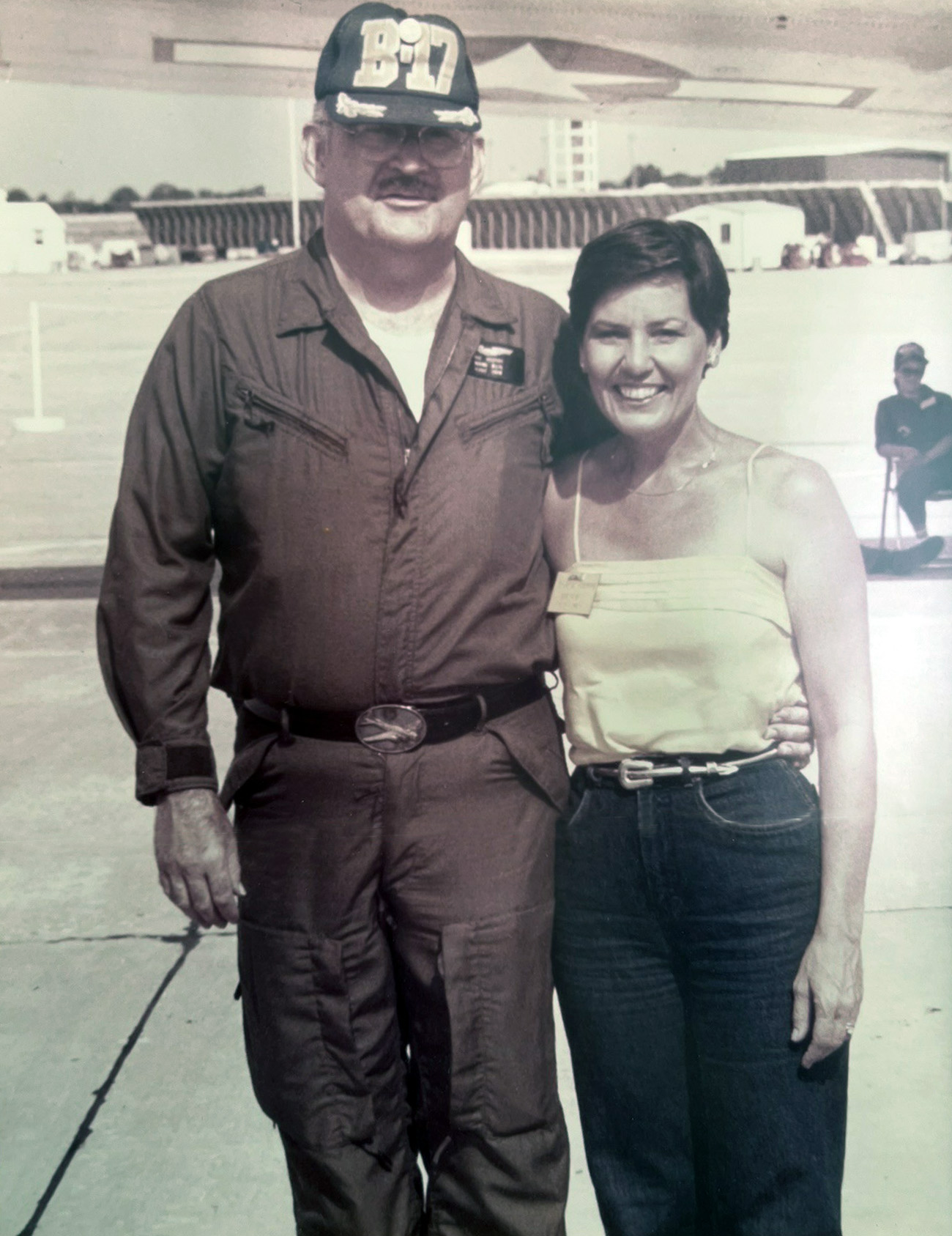
William D. Hospers was a medical orthopedic, having retired from the Army after 43 years as a flight surgeon.
When Doc purchased Boeing B-17G 44-8543 in 1979, he did so without telling his wife first. When she asked “What is this?” he answered, “Ours.”
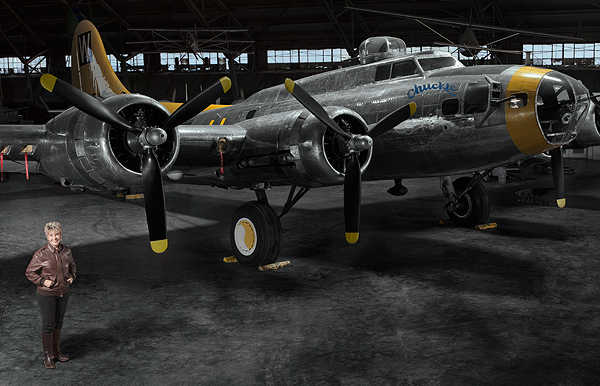
Doc named the bomber Chuckie after his wife. And it must be said that the real Chuckie is an amazing woman. Once she recovered from the initial shock of the B-17’s purchase, she took it upon herself to learn the aircraft inside and out. In the end, the B-17 became just as much her airplane as it was Doc’s, the two of them sharing something special in the old bomber.
It is a story that I honestly admire. May we all know a love that special. Doc and Chuckie had been married for 50 years when Doc passed in 2010.
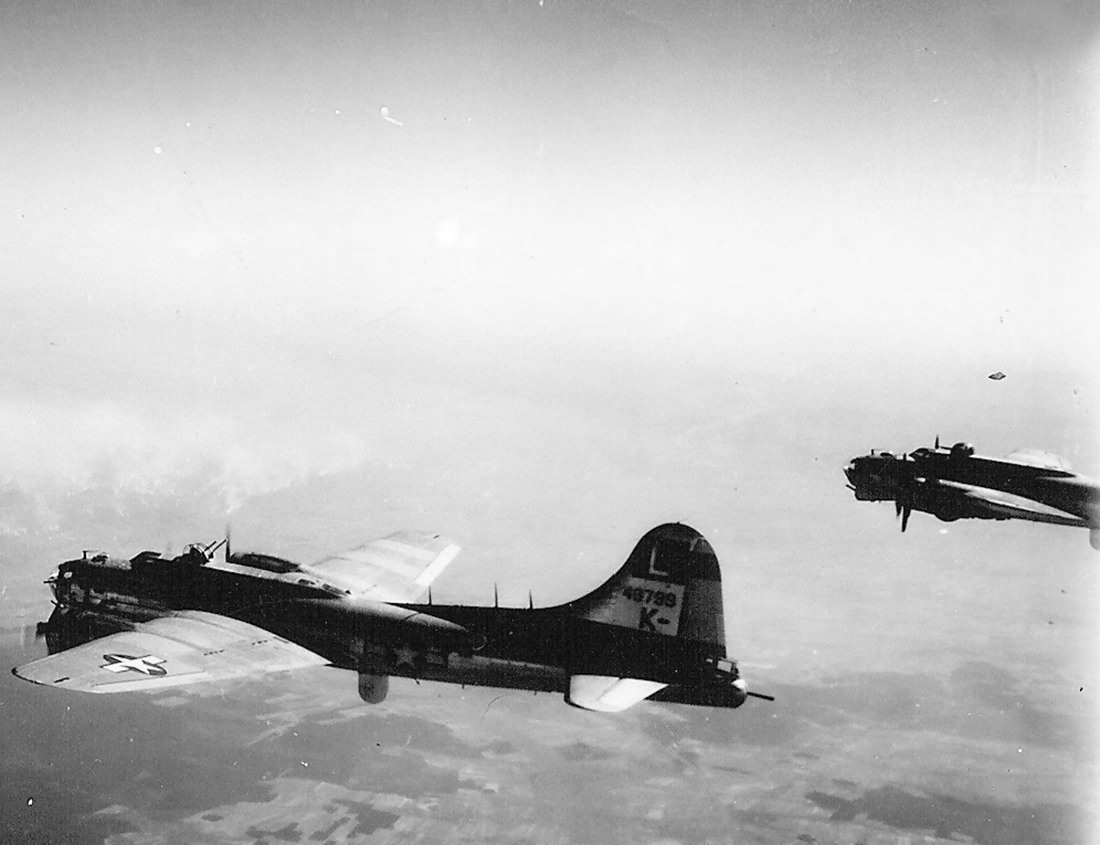
Chuckie has the unique distinction of being one of two surviving B-17s which, in wartime, were radar carrying Pathfinders. The other, Pink Lady (44-8846), saw combat with the 351BG in the last months of the war. Chuckie, on the other hand, was a radar training aircraft.
Doc’s declining health and a battle with local bureaucracy regarding the taxiway in front of the hangar added up, and the aircraft was ultimately sold in 2009. There was some talk about restoring Chuckie to her pathfinder configuration and the original agreement saw that she would retain her name. However, this was negated when the aircraft was resold in 2013. She currently flies as a mock-F under the name Ye Olde Pub.
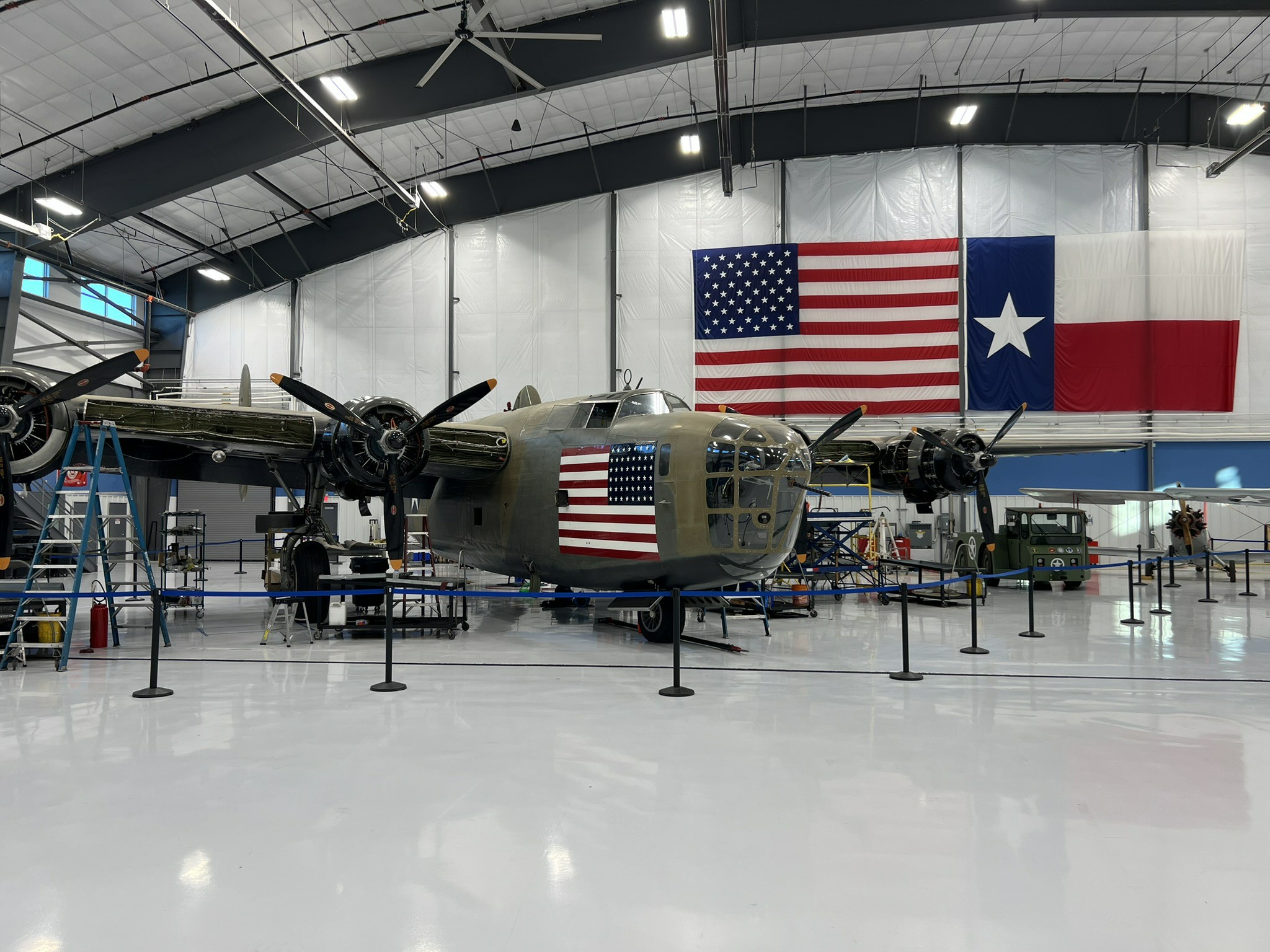
After leaving the Vintage Flying Museum, we were off to the Commemorative Air Force headquarters in Dallas to see Diamond Lil.
By this time, the place had closed, but Rory let us in to look around just the same.
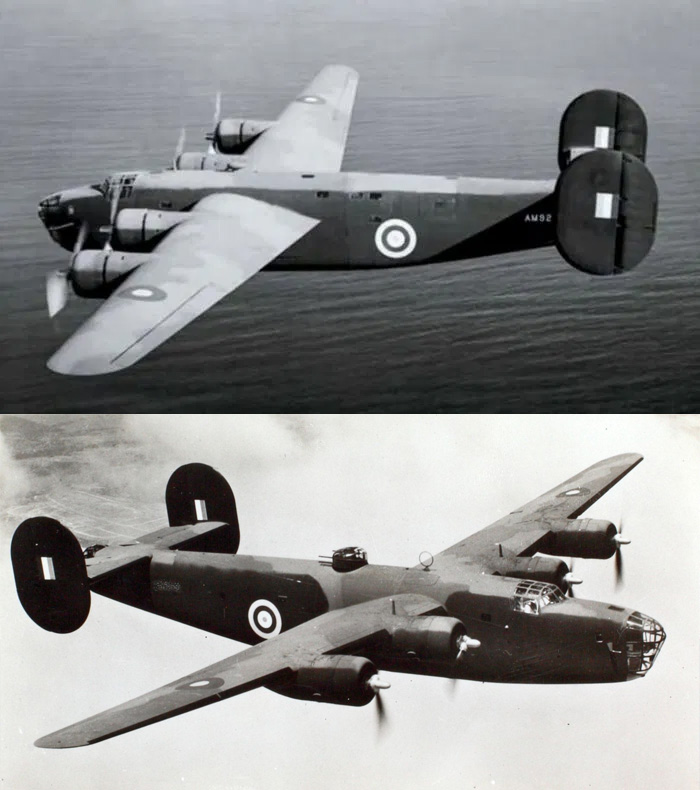
To clear up a common point of confusion –
The Liberator was initially designed and sold prior to the US entry into the Second World War. As such, initial orders were sold to France and Great Britain. Since this predated the US Army’s contract, these initial sales were titled LB.30s rather than B-24s, which was the US Army’s designation.
There were two variants of the LB.30: the Liberator I and the Liberator II. While the US Army did purchase some Liberator Is (as the B-24A), the Liberator II was strictly a foreign contract. The easiest way to distinguish them is the length of the nose, as the Liberator I had a short nose and the Liberator II a long nose. When the US entered the war, the few Liberator IIs still on the production line were conscripted into US service as LB-30s (notice the hyphen instead of the decimal).
The CAF’s LB.30, Diamond Lil, is a Liberator I. Project Warbird’s LB.30, Maid of Athens, is a Liberator II and an RAF combat veteran.
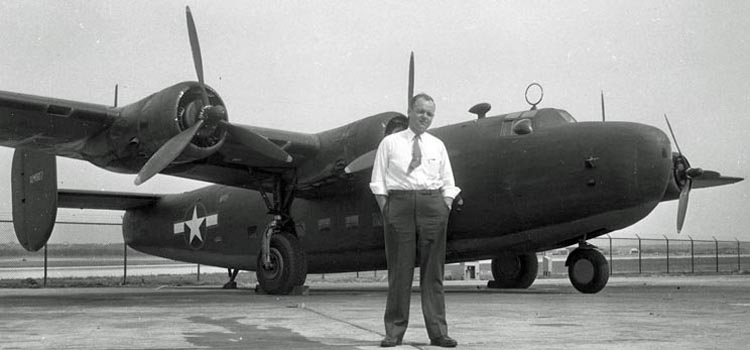
Diamond Lil never saw combat, as Lil suffered an accident before she could be delivered overseas. Returned to the factory in San Diego, California, the bomber served as a testbed for multiple improvements to the B-24 design, the most notable being the C-87 Liberator Express cargo conversion.
Her current configuration is a hybrid of types. While her nose is longer than original, she still has the characteristic flat bulkhead behind her greenhouse nose. The bulkhead on Maid of Athens, by contrast, turns inward toward the bottom, having the same greenhouse configuration typically associated with the B-24D.
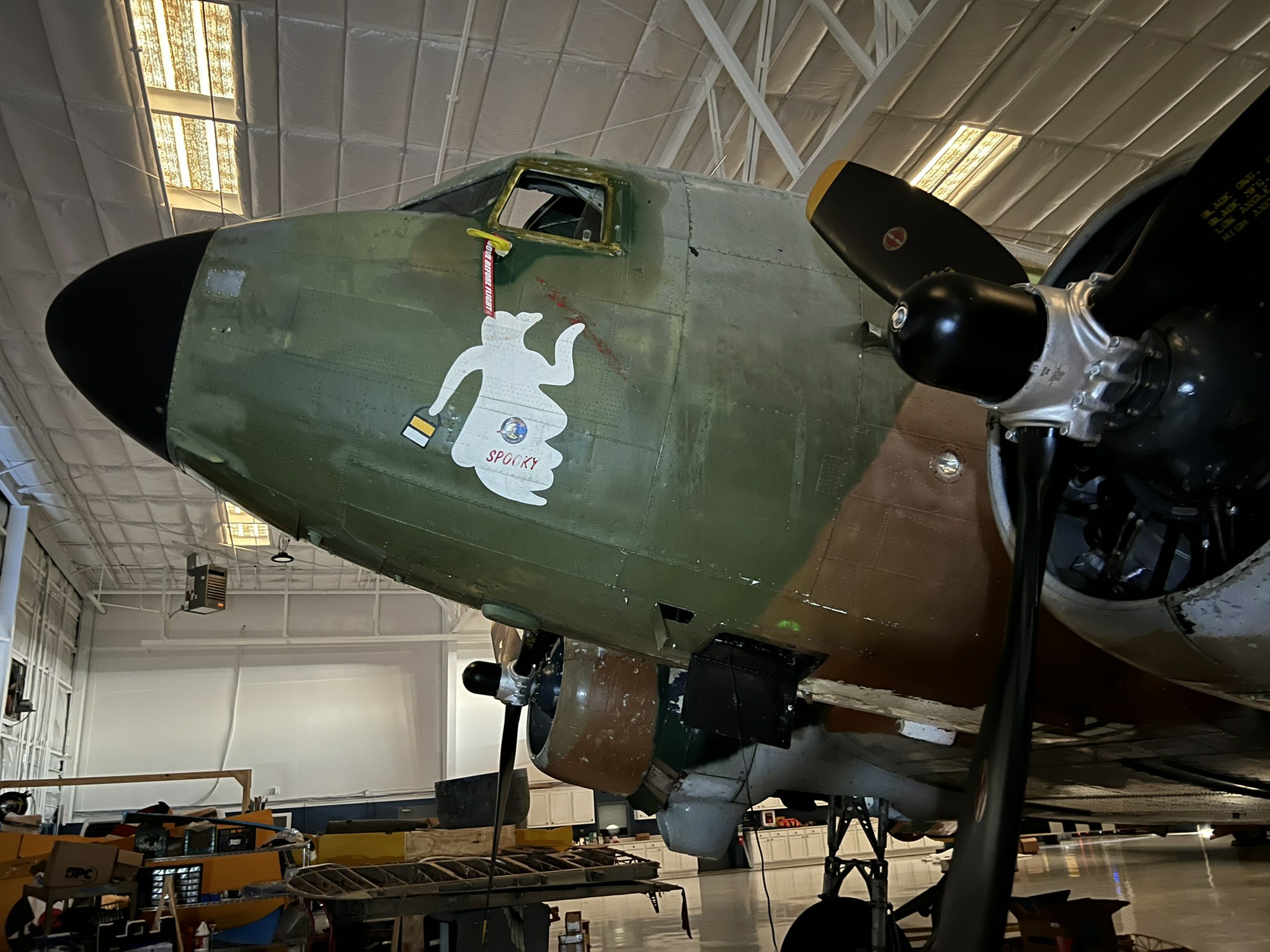
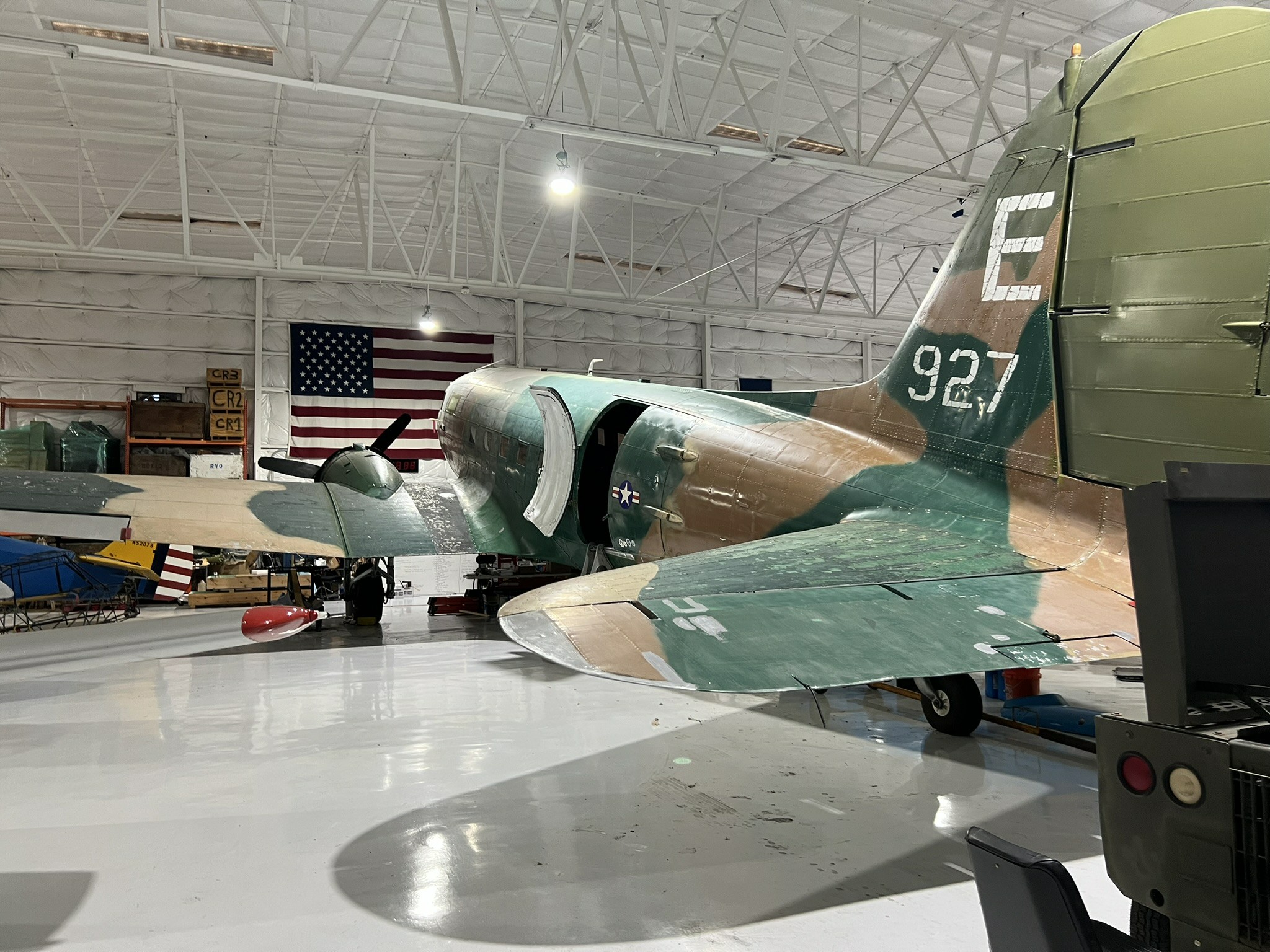
Following the horrific loss of Boeing B-17G Texas Raiders, the Gulf Coast Wing regrouped with the purchase of this C-47, 43-49297.
The aircraft is undergoing maintenance, with plans for a more in-depth restoration as an AC-47 gunship.
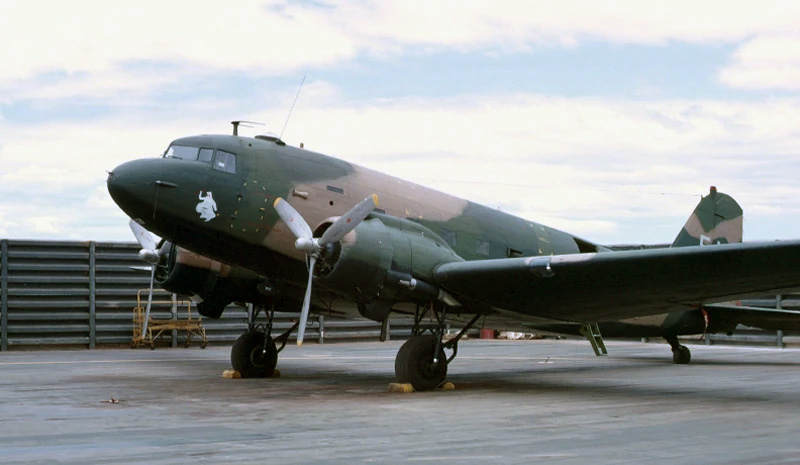
Douglas AC-47D 43-49010 with the 4th Special Ops Squadron in Vietnam, circa 1968.
Originating with Project GUNSHIP, the idea behind was to convert prop-driven cargo aircraft into counterinsurgency platforms due to their slow speed and long loiter times, allowing them to patrol and guard important positions at night. Beginning with WWII-surplus C-47s carrying a series of miniguns on their left sides, these Spooky gunships proved wildly successful. Follow-ups with Fairchild AC-119s and Lockheed AC-130s saw similar service, with the latter still in use today.
No Vietnam veteran AC-47 remains in the US today, though there are several mock AC-47s, most of which carry the colors of the aircraft pictured here.
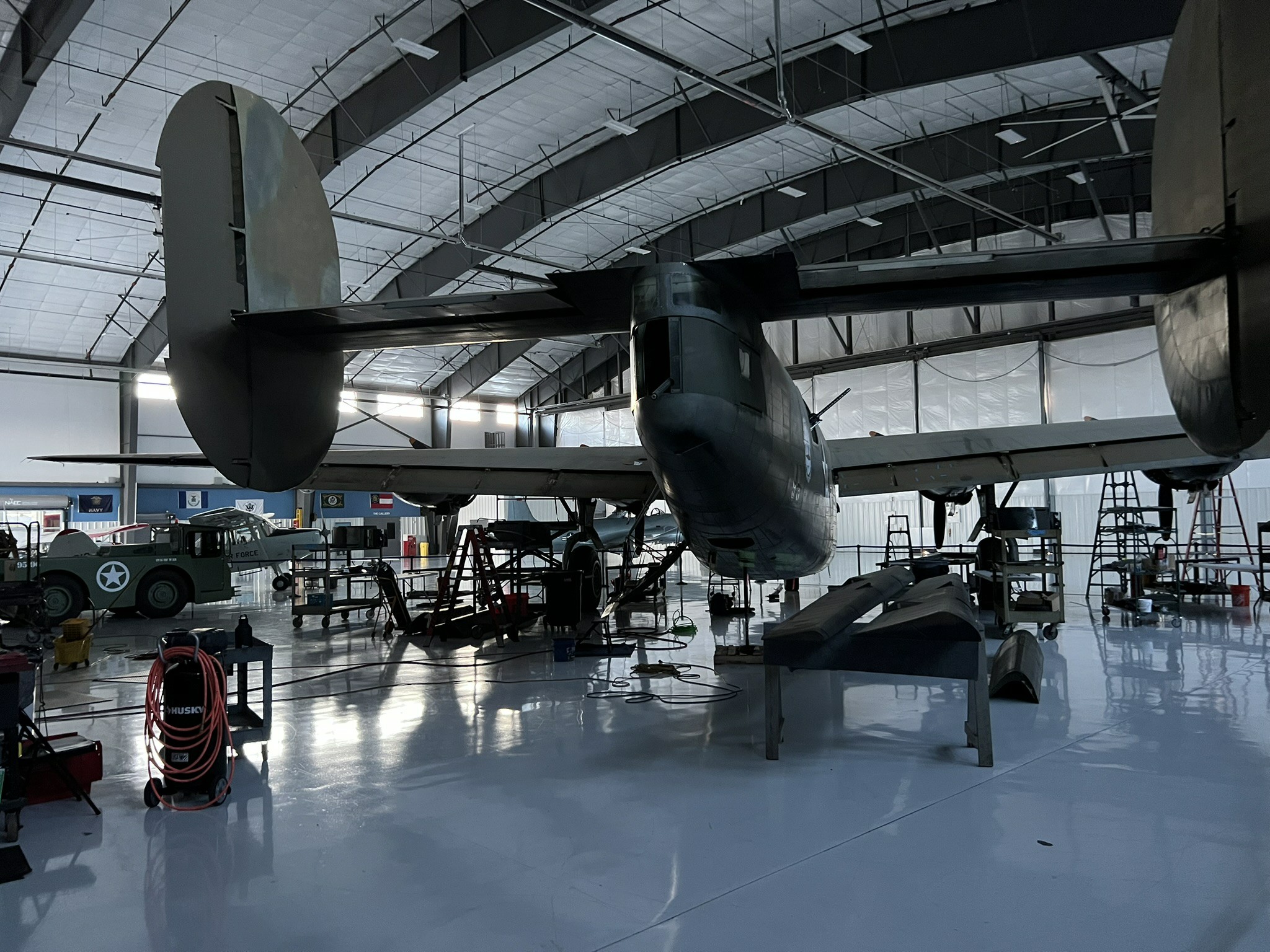
And with the lights turned out at the CAF museum, that concludes our travelogue.
Photos taken 16 August 2025.
Eric and I finally made it home on the night of 17 August 2025.
Altogether we had covered 4,869 miles in nine days, 14 hours of which were spent driving in Eric’s pickup truck.
An incredible experience to be sure. Still, glad to be back.
The Hangar Thirteen Foundation is a 501c3 nonprofit charity dedicated to bringing back a B-17F representative of the bloody counter-air campaign of June 1943 through March 1944. Donations to this project are tax deductible. If you can spare a little to help this project, you can guarantee that you will see the results on Facebook and here on our website.
You can contribute through the Donate page or, to avoid a PayPal fee, you can send something via the mail to:
Gerad Allen Blume
Hangar Thirteen Foundation
442 Old Chalk Bed Road
Batesburg, SC 29006
Volunteers are also always welcome. In fact, you need not be an Asheville resident – you can work from home! Persons skilled with metal fabrication, machining, CAD modeling, metal casting, 3D scanning, and laser/waterjet cutting, are particularly helpful. Just reach out to us to get started.
Keep the show on the road!