
We have been featured in an article by Vintage Aviation News!
To check it out, click here:

Now on to the update.
Since we dedicated the month of May to fundraising, update news has accumulated. In fact, there is more to cover than we can fit into a single update. But for now, here goes…
Work continues on the trunnion and hanger assembly for the Type A-2 Ball Turret, with another component finished and ready for installation: the cover plate for the turret’s brush assembly.
The Type A-2 Ball Turret featured a bulkier hanger assembly than the other variants, with a tall, ribbed housing at eye-level holding the turret’s electrical brushes. Remember, the turret was not hydraulic but electric, and this was where power came into the ball from the aircraft itself. Our brush assembly comes from from a midair collision which occurred over RAF Great Ashfield on 26 September 1943 – just 20 days after Lucky Thirteen was shot down. Dorsal Queen (42-30264) and Raunchy Wolf (42-3290) of the 385BG were in a holding pattern over the field, having returned from a strike, when the two collided.
We do not know for sure which aircraft the assembly came from, but we can tell that said turret was made by Briggs (as opposed to Emerson), just like one on Lucky Thirteen. Eric Miller of Project Warbird donated the missing brush holder bar and Fred Bieser was able to help with the missing cover plate. Fred was also kind enough to loan the missing placards for recreation, including the turret’s dataplate, which took some time to perfect. With help from Sean Berry and Eric Miller, these placards are now recreated and installed, with the cover plate fully restored and ready for installation.
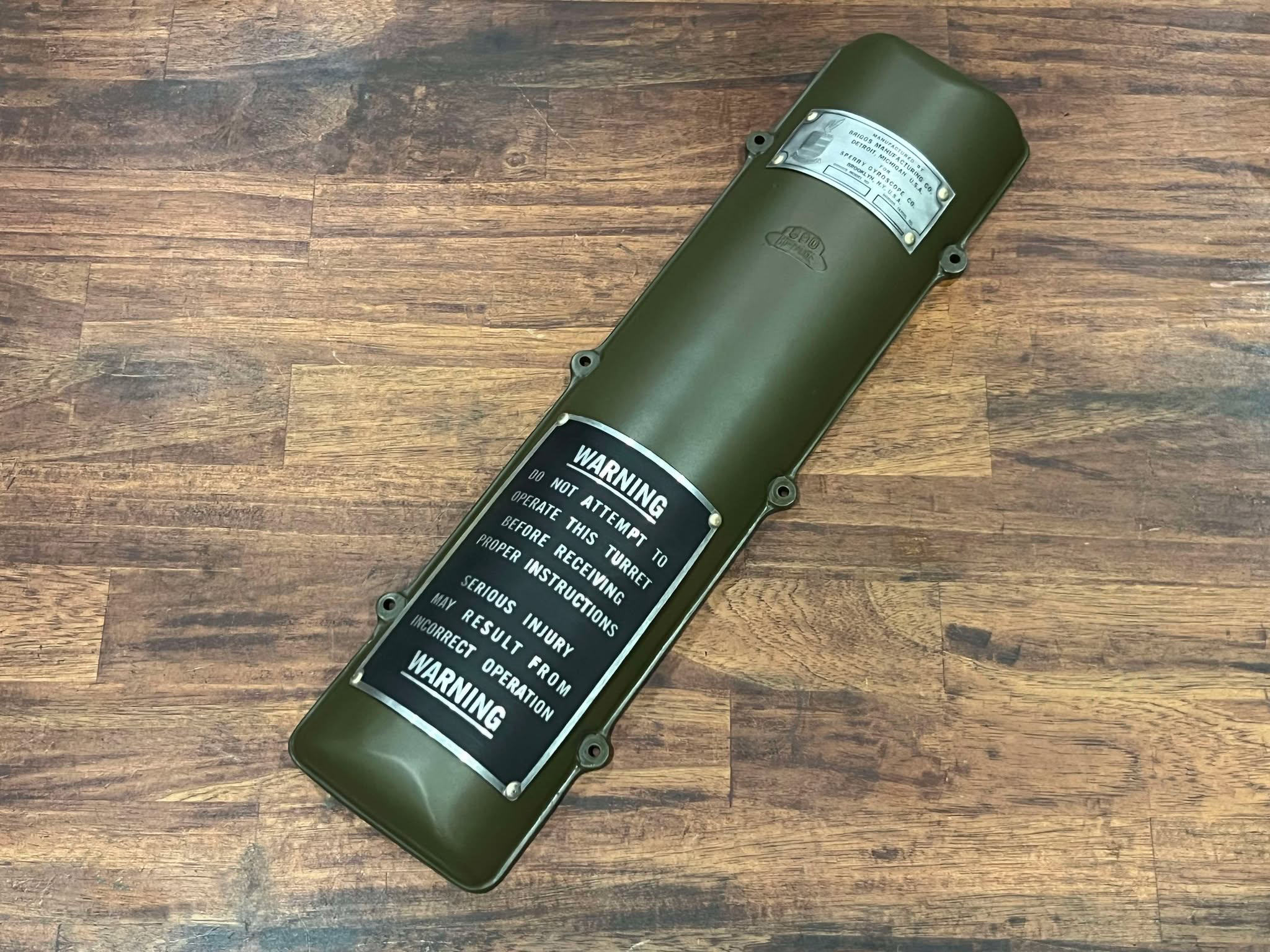
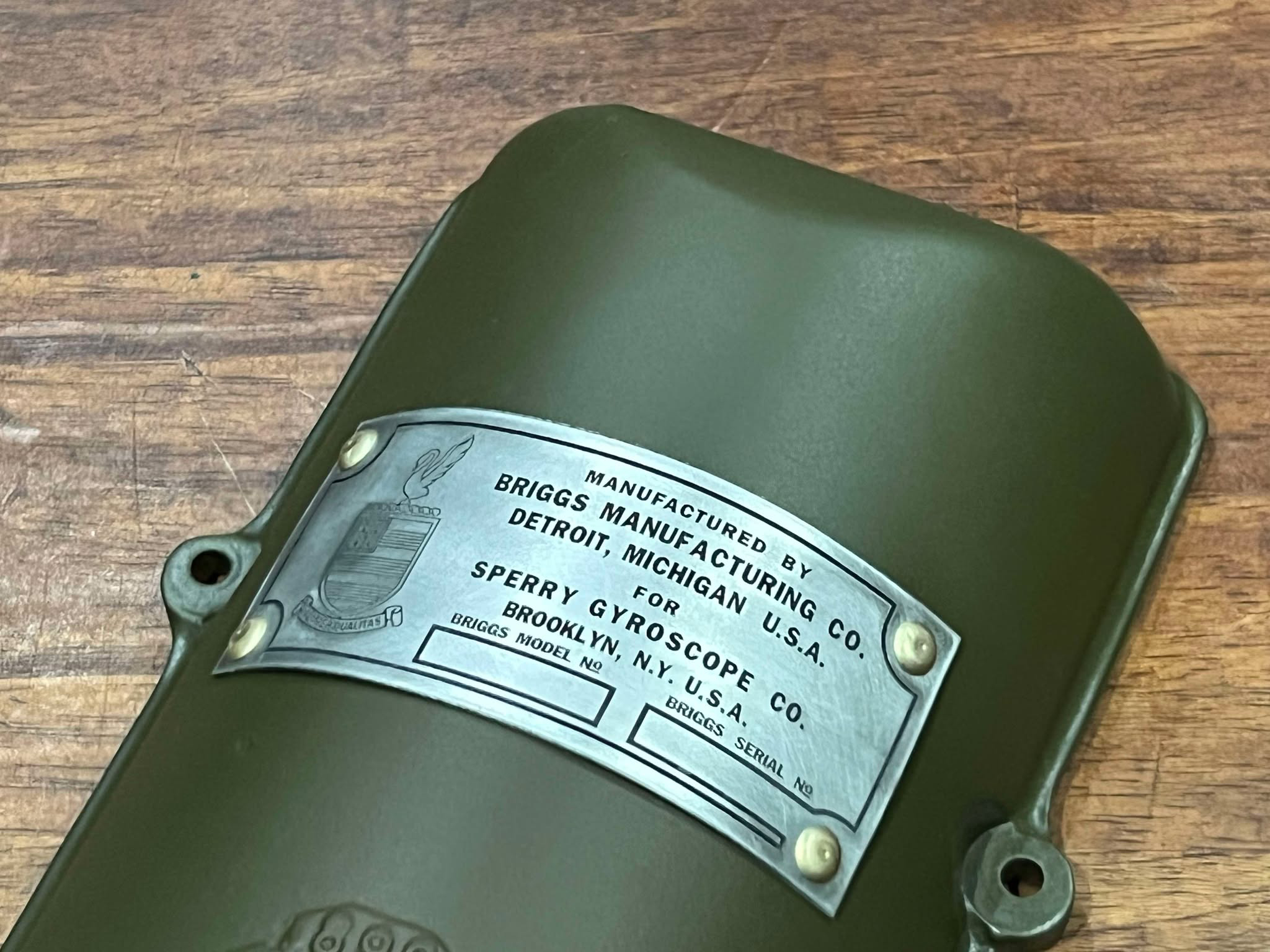
The newly completed brush assembly cover plate for Lucky Thirteen‘s ball turret.
Photos taken 6 June 2025.
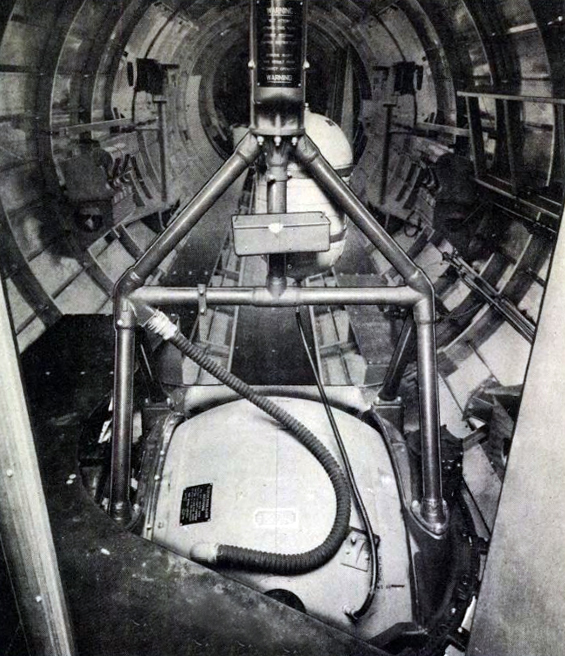
A Type A-2 ball turret aboard an E or early-B-17F, based on the waist configuration.
The ball on Lucky Thirteen was identical to what is shown here. The cover plate for the brush assembly can be see at the top of the photo.
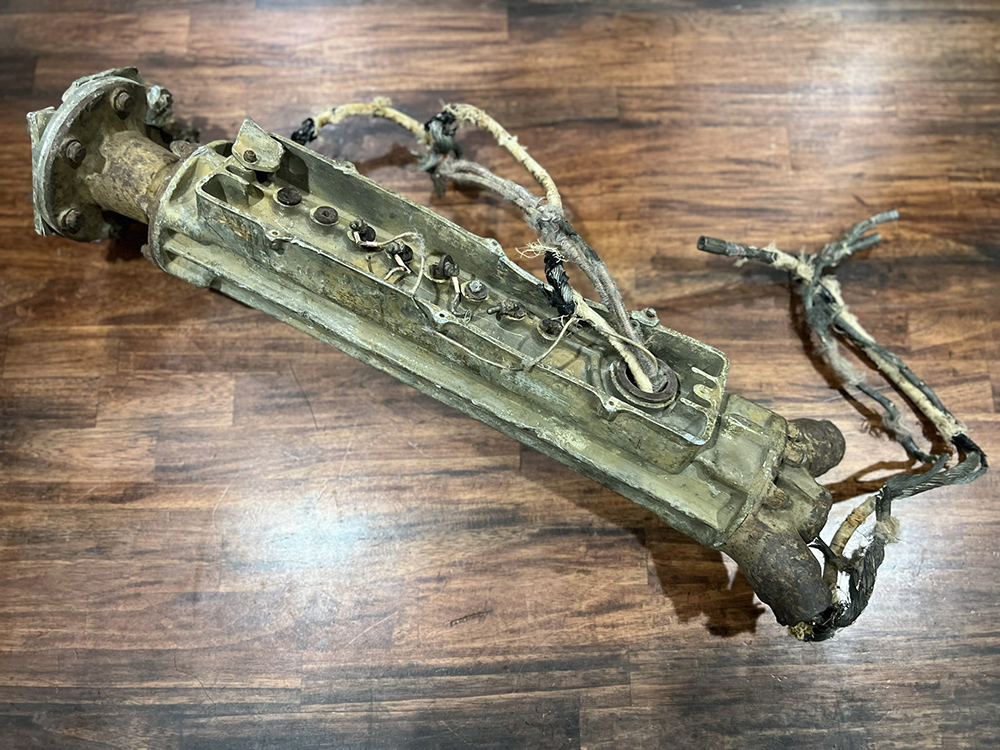
The brush assembly from the mid-air collision.
Photo taken 11 June 2023.

Hangar Thirteen’s ball turret brush assembly (right) with the one in Fred’s collection.
Fred’s brush assembly comes from an Emerson-built turret while our example comes from a Briggs-built turret. Note the difference in bronze green vs. olive drab paint.
Photo taken 11 July 2023.

The brush assembly stripped for restoration along with the cover plate, shortly after purchase.
The large brush housing was unique to the Type A-2 Ball Turrets found on E and F-model B-17s.
The next step will be to remove the dent from its midair collision.
Photo taken 17 July 2023.
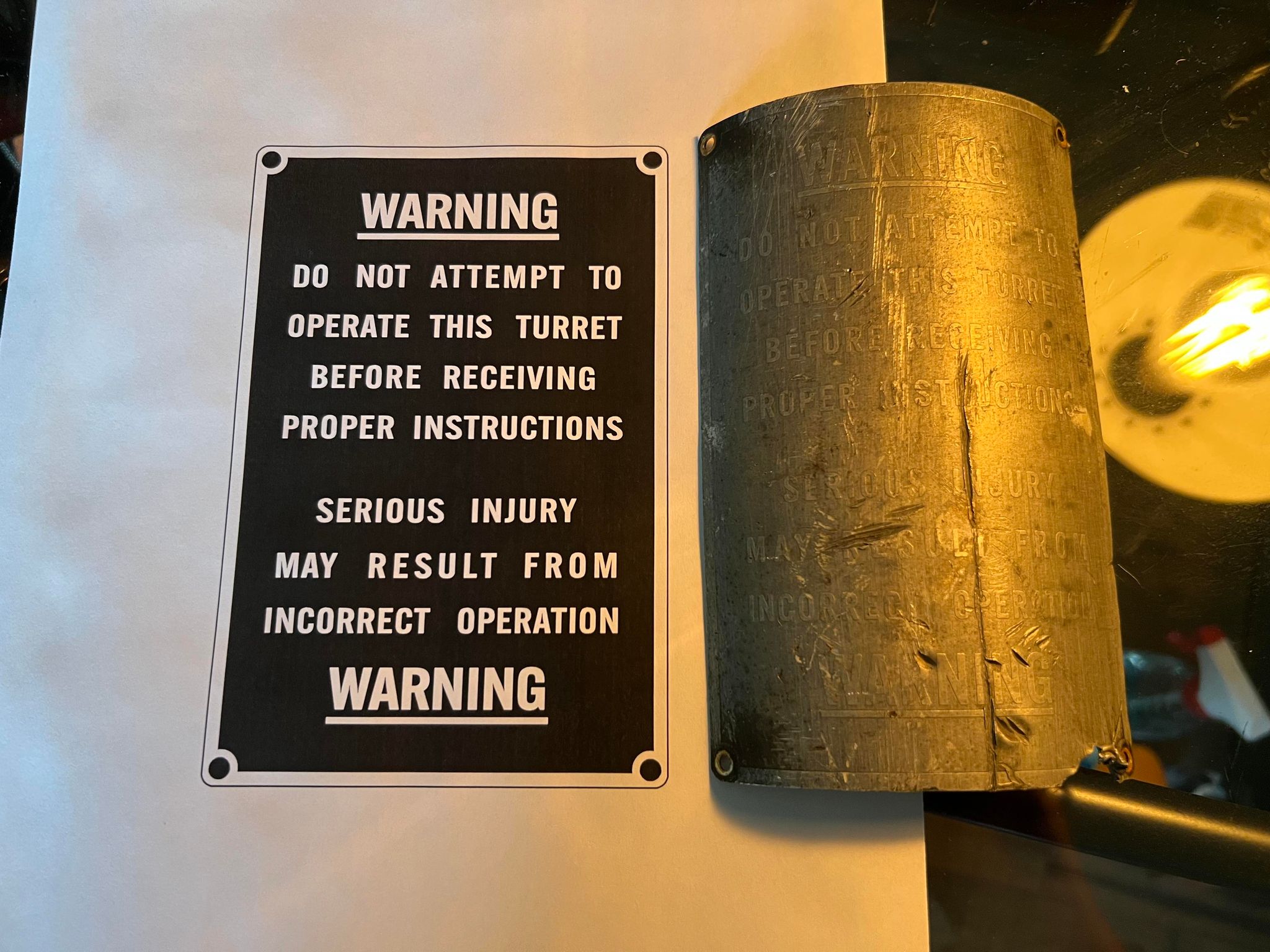
Progress recreating the warning placard originally found on the Type A-2 Ball Turret’s brush assembly cover.
Photo taken 16 July 2023.
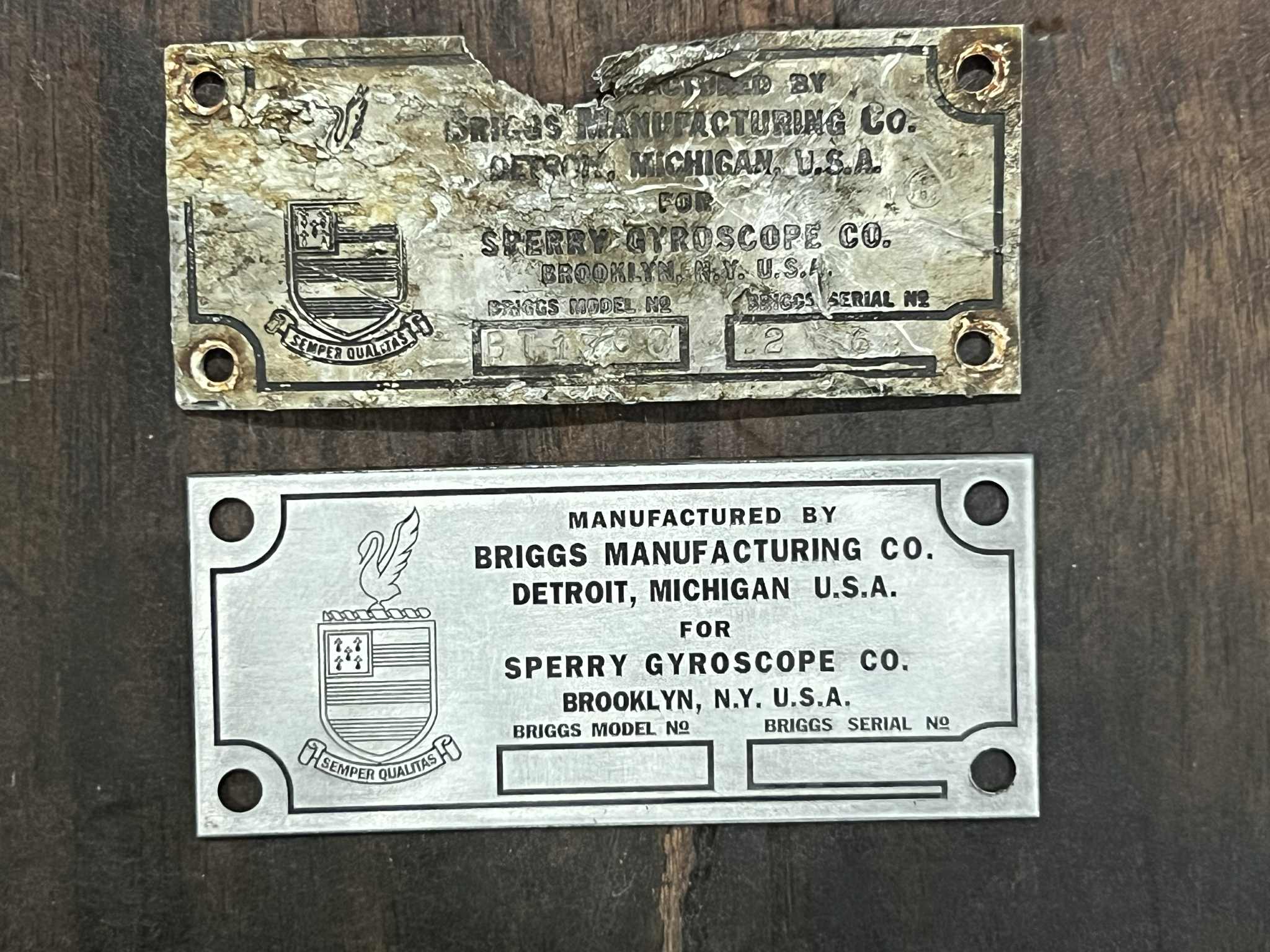
Progress recreating the turret’s dataplate which, on A-2s, was found on the brush assembly cover.
This was a rather difficult project, as it required the additional work of recreating the rather intricate Briggs company logo.
Photo taken 31 May 2025.
Speaking of the ball, another development is we have restored the turret’s oxygen tank.
Something often misunderstood in the museum community, only A-2s and early-A-13 ball turrets carried their own oxygen tank. A-2As and late-A-13s – the balls found on B-17Gs and most B-24s – had their oxygen supply piped directly in from the airplane.
A-2 ball turrets were equipped with the relatively small Type F-1 Oxygen Tank. We have a few of these in our collection and originally planned to restore them alongside the aircraft’s complement of eighteen Type G-1 tanks. Rather than wait, however, I decided to go ahead and restore this unit for display on the ball. A second, identical tank, was used as a pattern to ensure that the markings were faithfully recreated.
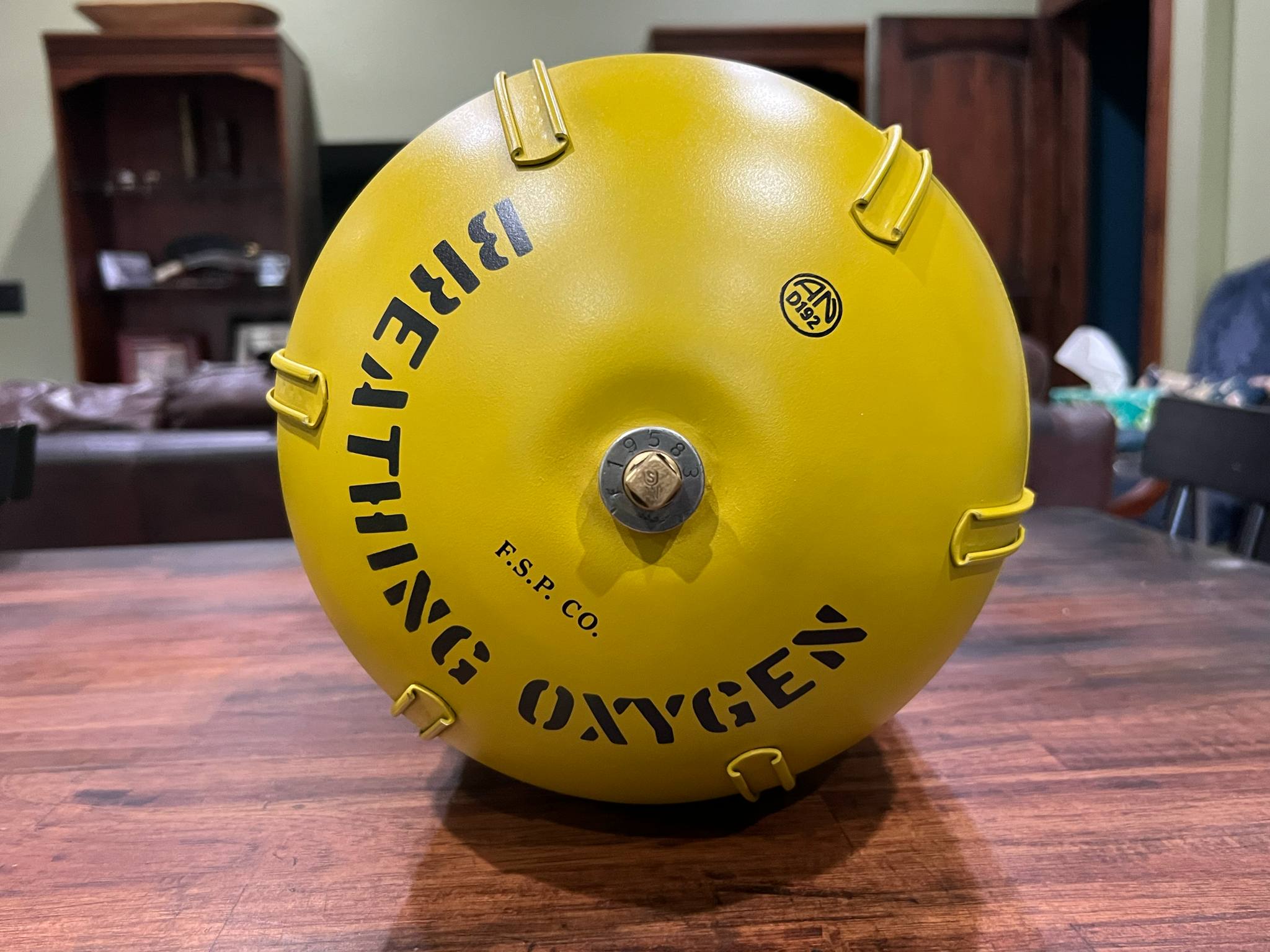
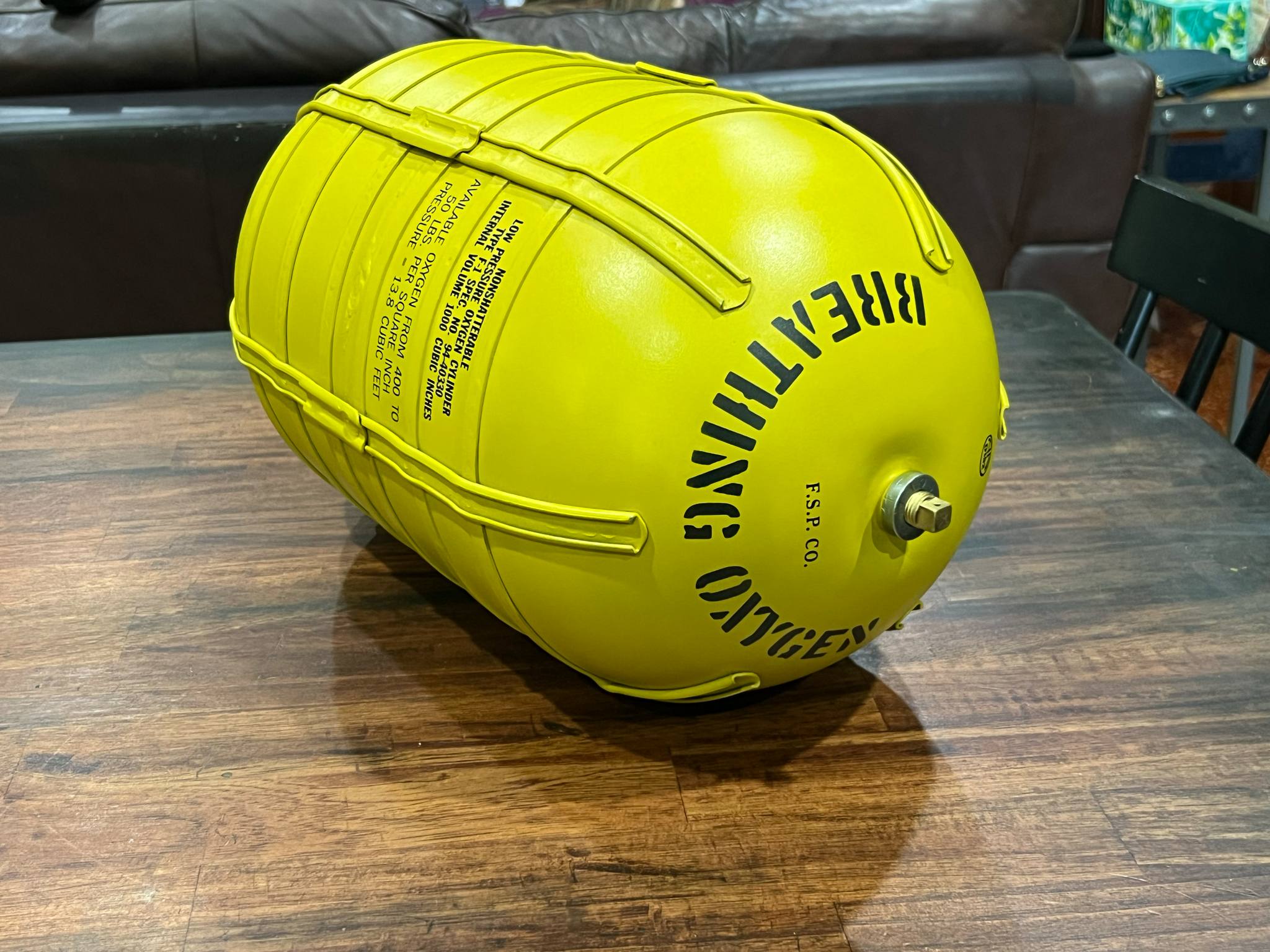
The Type F-1 Oxygen Tank weighed roughly nine pounds, being 17.5 inches in length and holding 13.8 cubic feet of oxygen.
This particular example was made by Firestone of Akron, Ohio and is dated July 1942.
The next step will be to locate the fittings which attach to the bottom of this tank, as well as find someone to recreate the hose which connects the tank to the turret below.
Photos taken 27 May 2025.
Work continues on the turret’s trunnion and we are hoping to have it finished sometime this month.
Priming of the exterior is completed and it wont be long that the interior will be similarly finished. Once it is painted and its attachments mounted back on, the next major step will be the restoration of the hanger assembly, with its prominent missing leg.
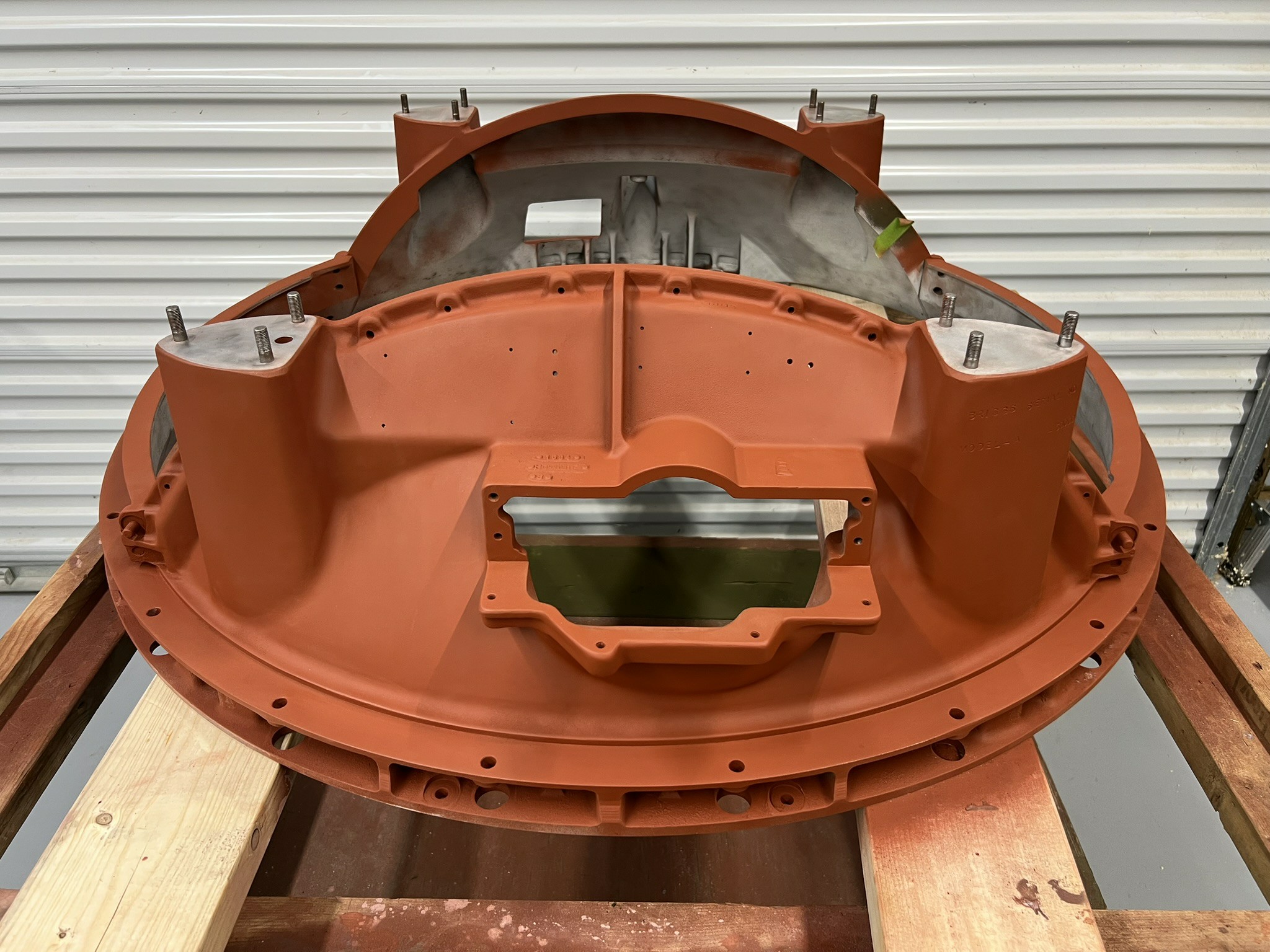
The ball turret trunnion for Lucky Thirteen is cleaned of any corrosion and primed.
This side of the turret housed the elevation hand crank.
Photo taken 18 April 2025.
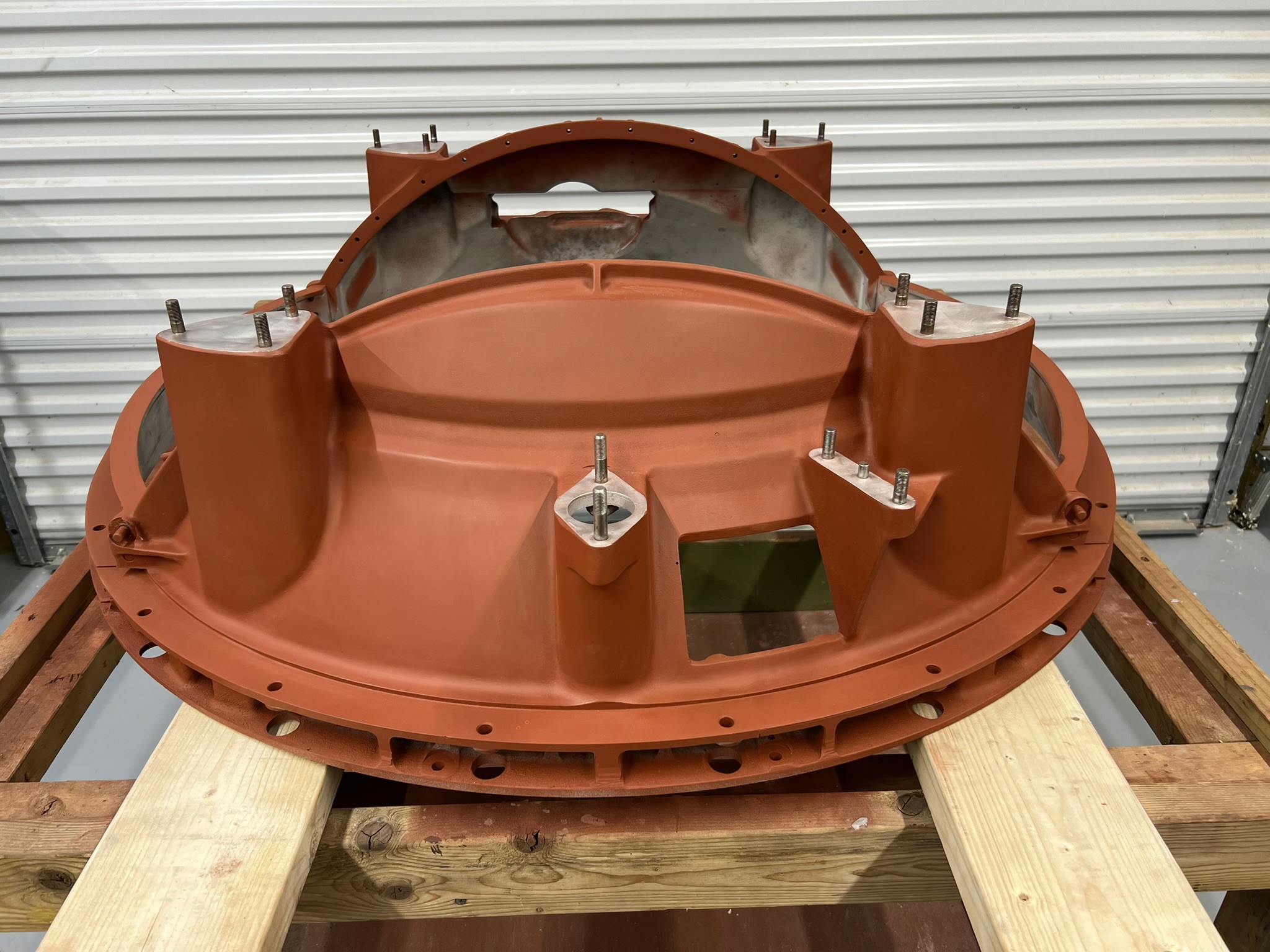
The ball turret trunnion for Lucky Thirteen is cleaned of any corrosion and primed.
This side of the turret housed the azimuth pinion gear.
Photo taken 18 April 2025.
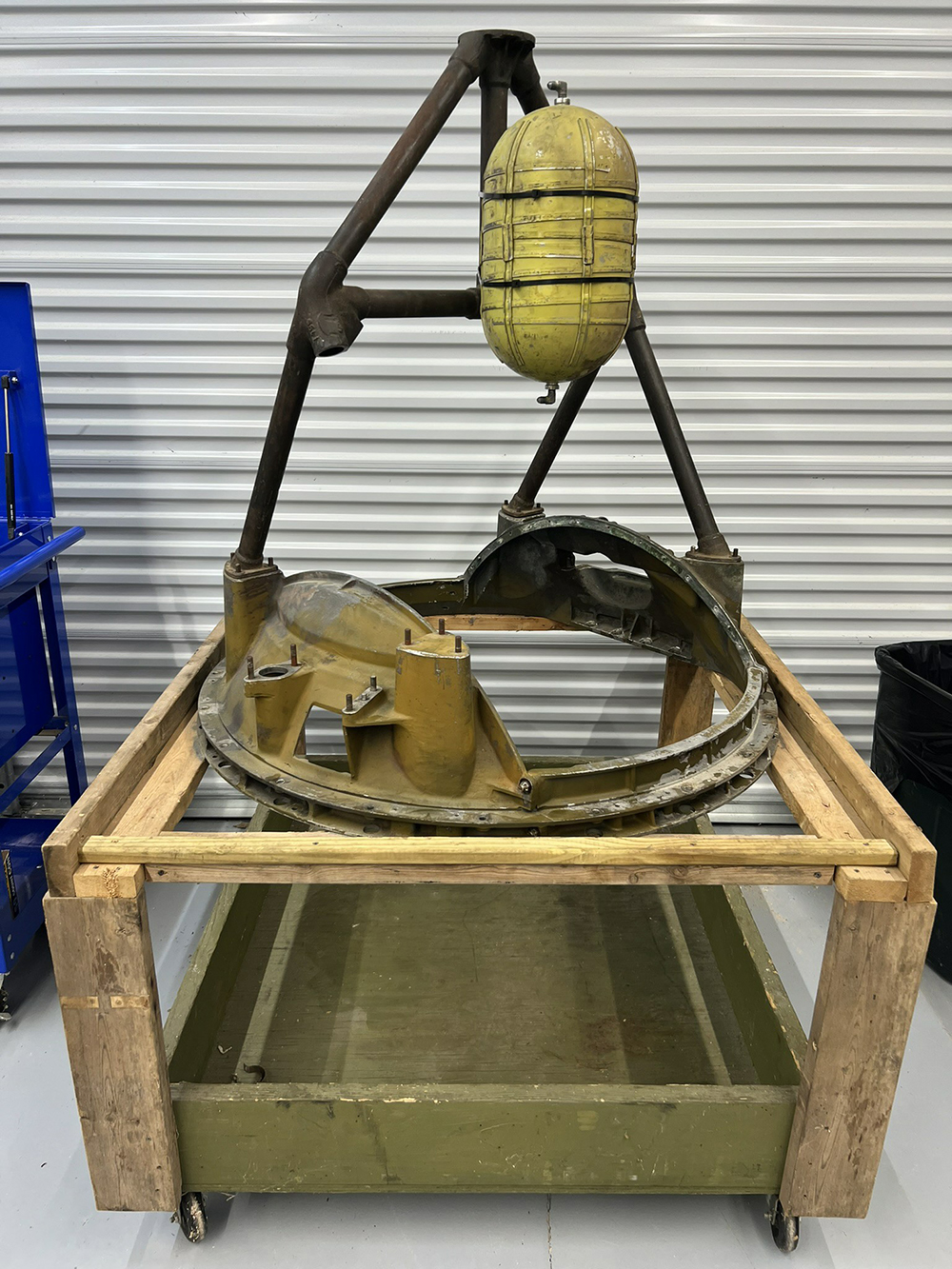
The turret and hanger assembly as it originally appeared.
Examining the trunnion, Briggs’ use of primer was inconsistent, being brown in some in places and completely absent in others. We elected to use red oxide primer (which has a brown color) on the trunnion as a whole to ensure better adhesion of the final paint. Briggs-built ball turrets had olive drab trunnion and hanger assemblies and, when ready, this one too will have its original color restored.
Photo taken 8 January 2025.
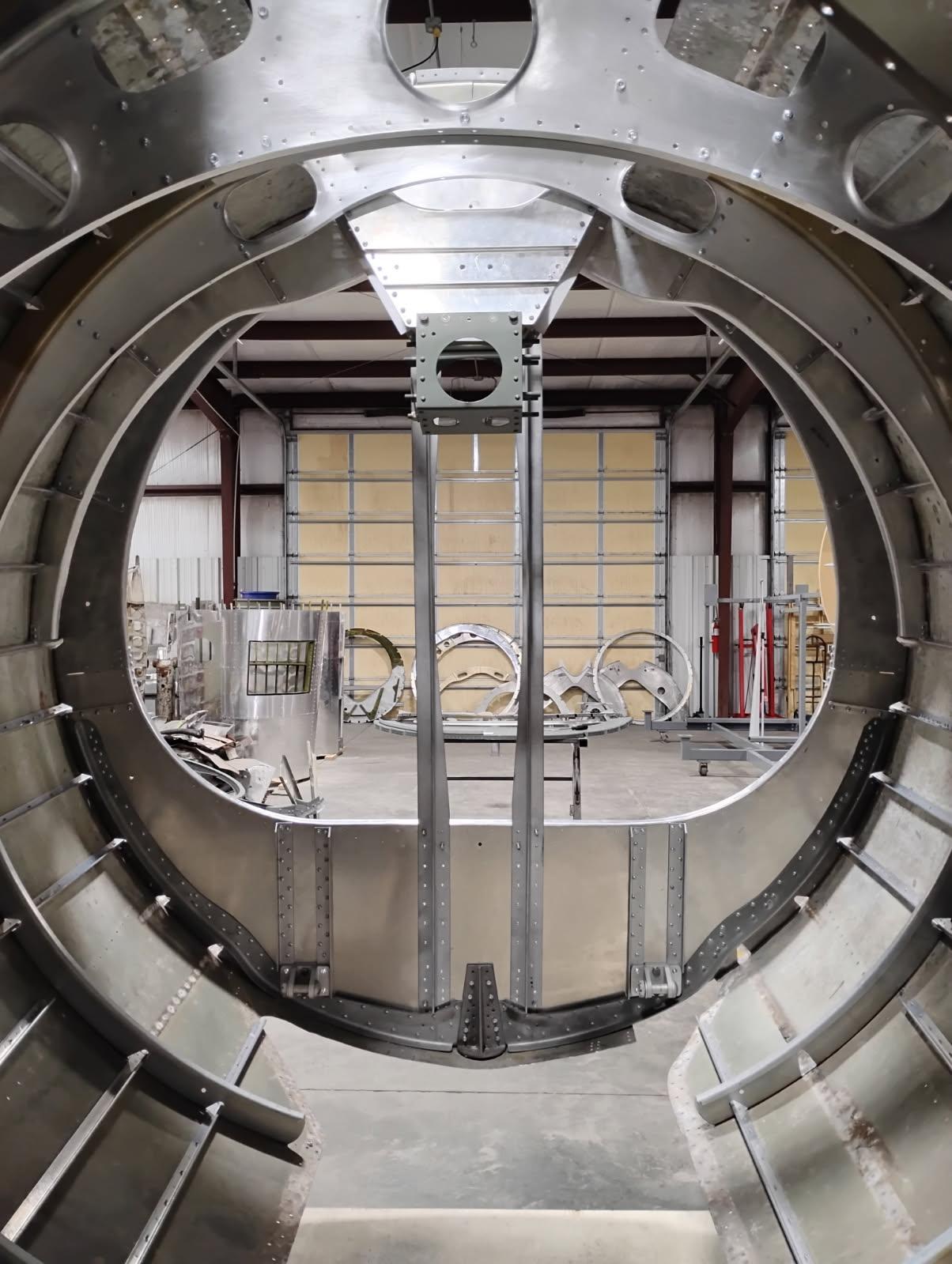
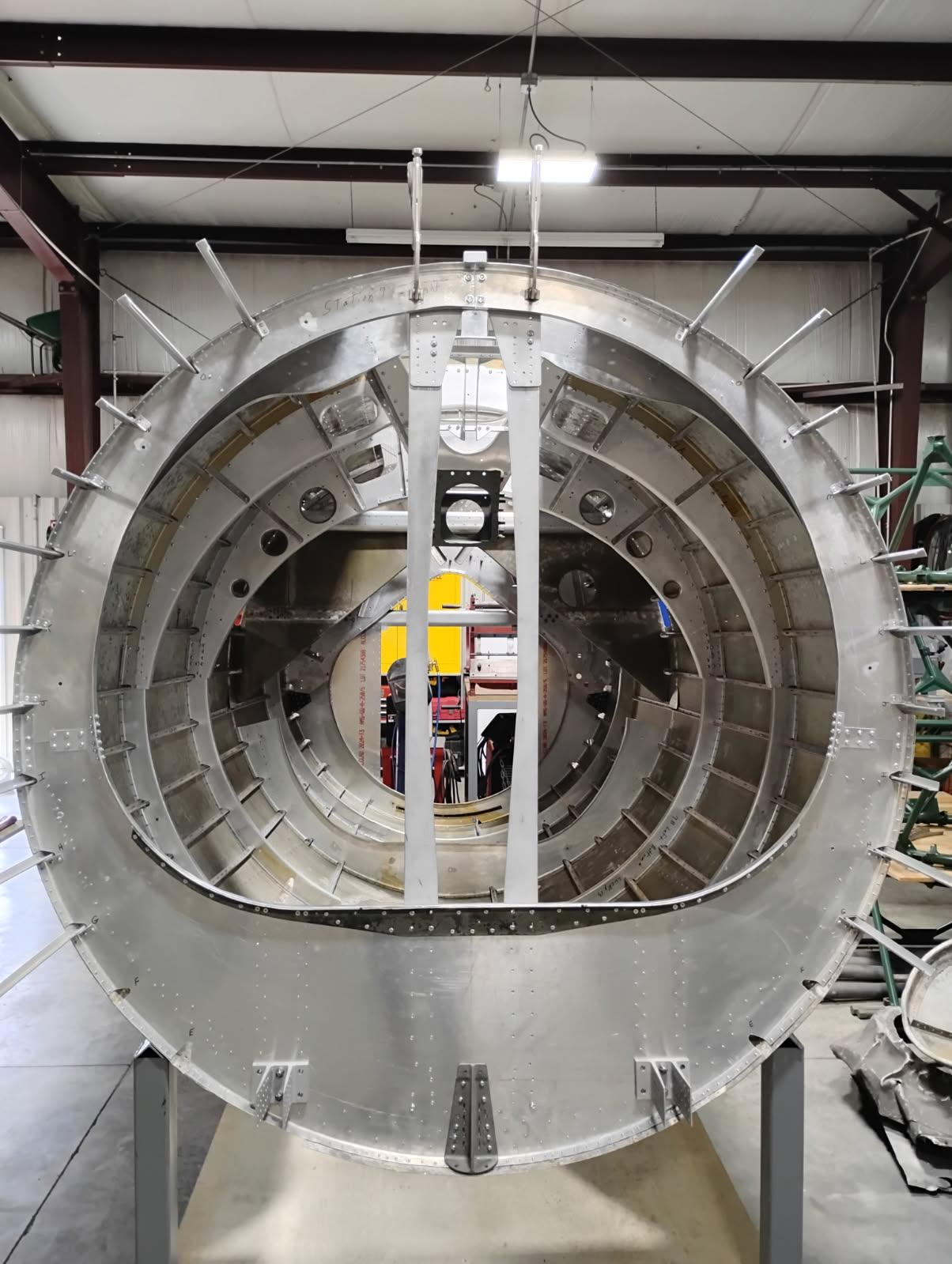
Ray has been making steady progress on the aft fuselage of Lucky Thirteen. Stations 9 through 11 are awaiting one final piece of skin while Stations 7 through 9 are being worked on.
Station 7 is the bulkhead which holds the aircraft’s tail wheel and is the first thing one sees when entering a B-17 through its waist entrance. A rather complicated piece, Ray has made excellent progress on it and the results are absolutely beautiful. Special thanks are due to our friends Randy Kemp, Jack Bailey, Ed Davis, and Halee Reddick.
We are so happy with how Stations 9 through 11 are coming out. Just wait till we dip the ribs in zinc chromate and put on the bare skins with the ALCLAD stamps – it is really gonna pop then!
Photos taken 28 May 2025.
We were actually able to acquire this piece during the week of Christmas 2023, but was only recently able to meet up and photograph it for an update. This is the power cable for aircraft’s Auxiliary Power Unit or APU.
Regular supporters might remember that we acquired the APU for Lucky Thirteen back in 2022.
Originally, the Boeing B-17 was designed to carry its APU in the waist compartment, directly across from the waist entry door beside the chemical toilet. However, since the APU was primarily used by the ground crews, the APU was generally treated as “fly-away” equipment, with Gs ultimately delivering the APU loose on the radio compartment floor. The B-17’s APU was the Type C-10, the Army designation for HRU-28 and HRU-28A generators. Similar to a large lawnmower engine, these units were appropriately manufactured by the Homelite Corporation of Port Chester, New York.
APUs are used to power aircraft systems without having to start the engines which, in flight, generally provide said power. Essentially, the B-17’s APU is a small, noisy generator – which is where it got its nickname, “Putt-Putt.” On the morning of a given operation, the first clue that something was happening was the sound of APUs starting on various hardstands around the field.
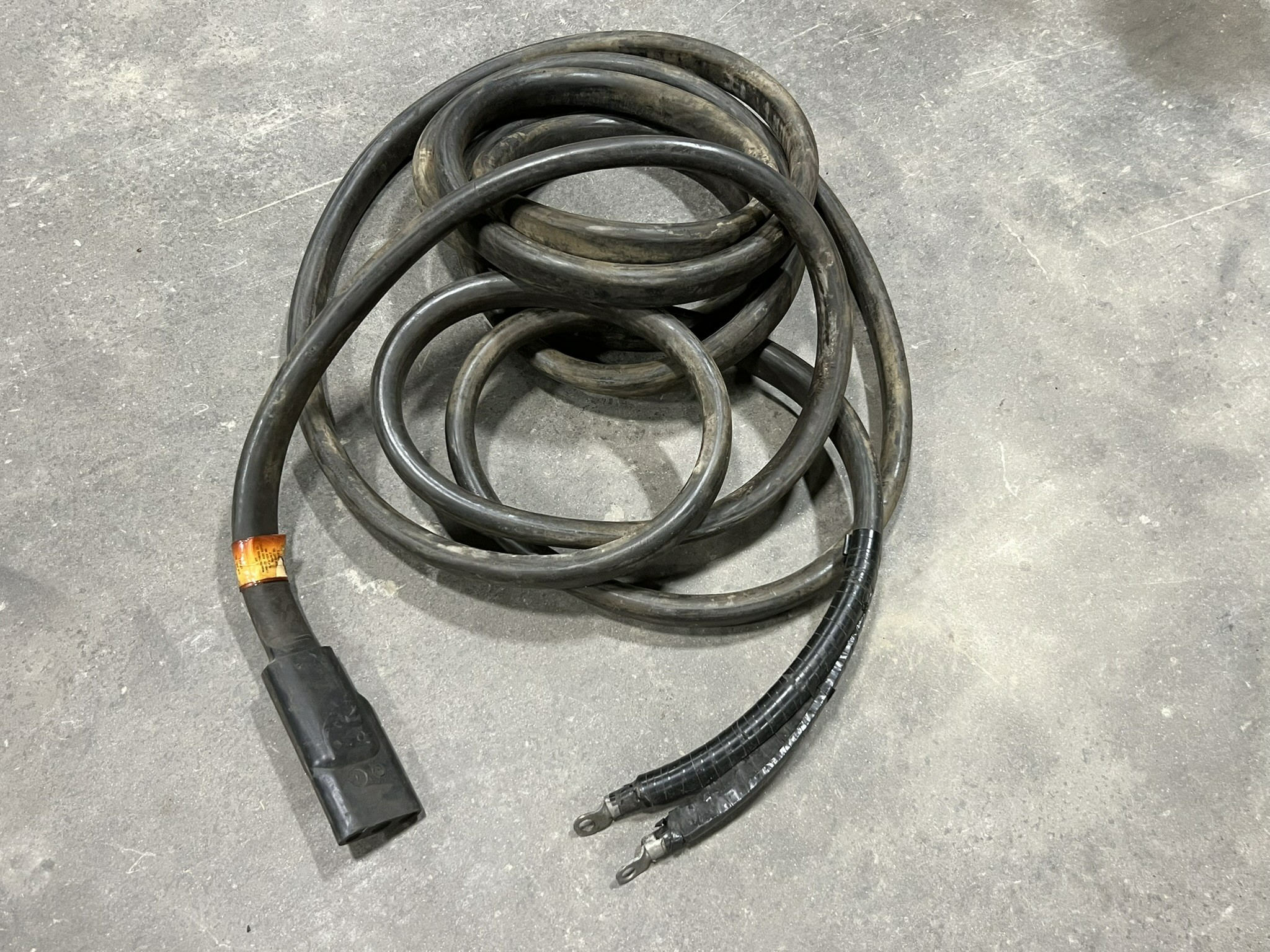
Lucky Thirteen‘s APU power cable.
Photo taken 9 May 2025.
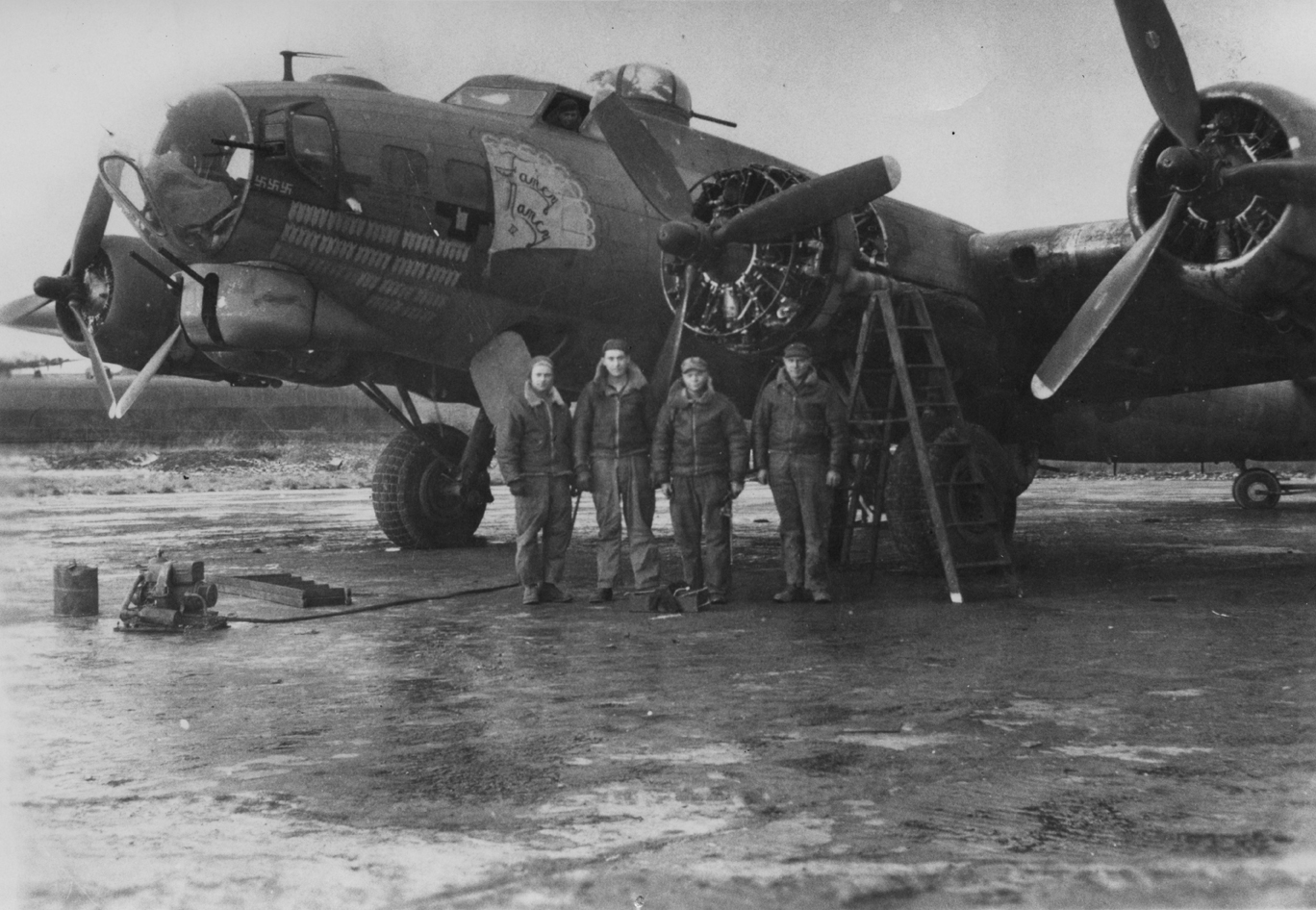
Ground crews pose with Fancy Nancy IV (42-31662, 401BG). Note the APU on the left and the power cable running from it to the electrical plug beside the nose hatch.
Due to Europe’s cold winters, ground crews were issued leather clothing similar to those issued to airmen, only being slightly thinner and having pockets.
Fancy Nancy IV was lost upon return from a strike on Hamm on 22 April 1944. This was unusual mission as the bombers returned to the UK after dark. As such, most of this day’s losses were over the UK. Part of this was that US airmen were rarely instrument rated. More importantly, US airmen were also not experienced in Luftwaffe intruder operations, which targeted Allied bombers attempting to land at night. While based at RAF Deenethorpe, Fancy Nancy IV was lost overflying RAF Polebrook. Her loss was categorized as a crashlanding as, like many lost this night, it was unclear whether or not an intruder had found her.
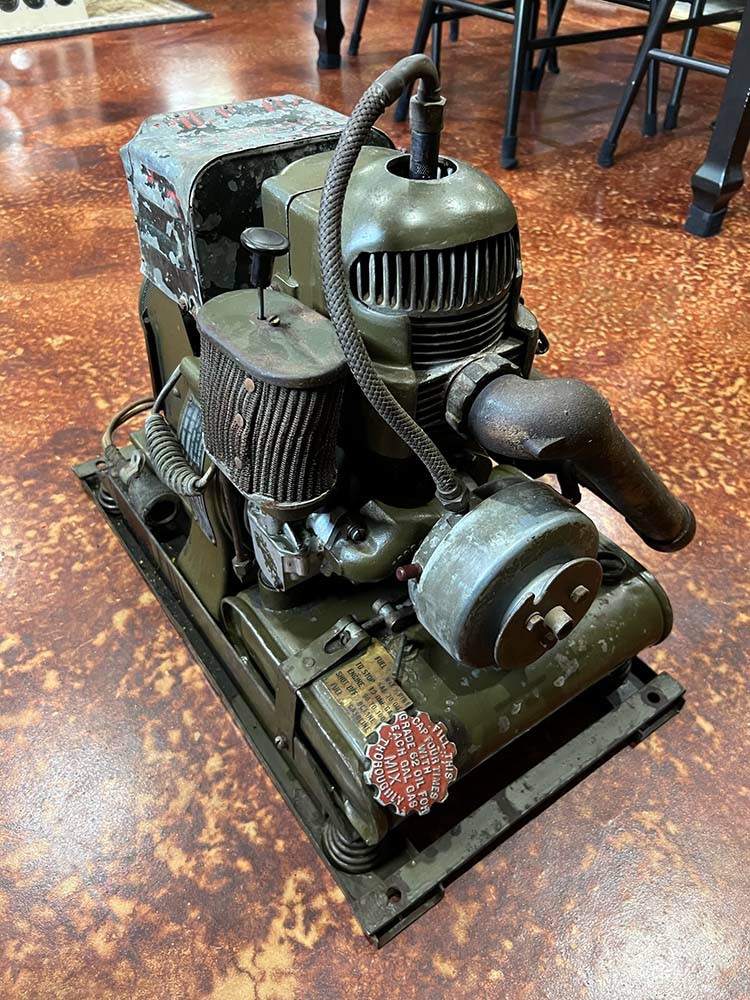
The HRU-28 acquired for Lucky Thirteen.
Note the air filter on the left. The late-war HRU-28A had a hard-shell air filter.
Photo taken 8 August 2022.
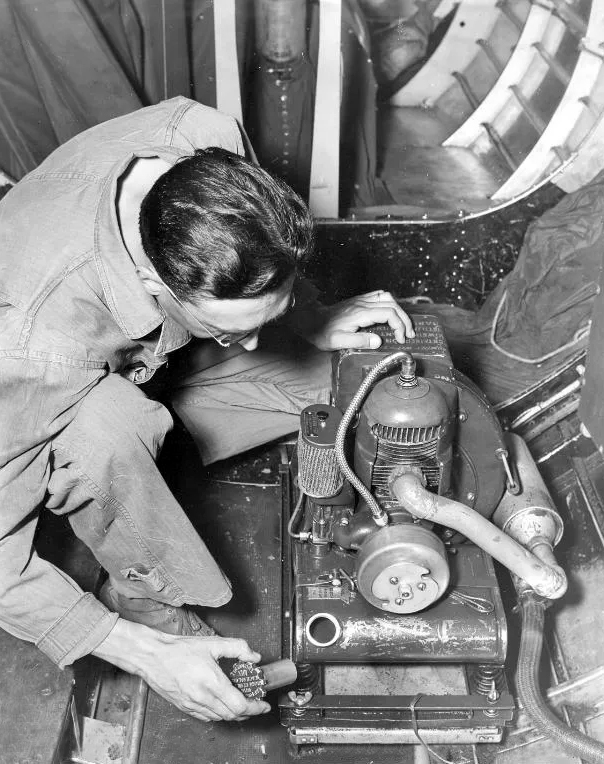
Ground personnel check the fuel of a B-17’s APU at Amarillo Field.
The black paint on Station 7 behind him is asphalt varnish, coated here to protect against spray from the APU’s oil and gasoline, and human waste from the chemical toilet.
Photo taken 23 June 1944.
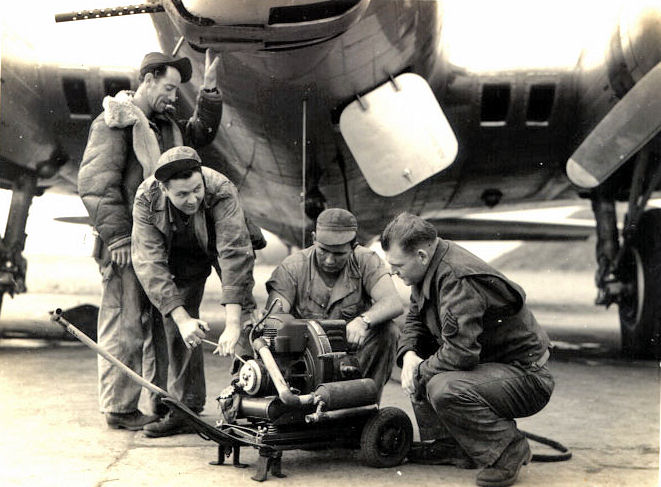
Ground personnel tend to Thru Hel’en Hiwater (42-39785, 303BG), having mounted her APU on a small cart. The power cable can be seen curling by the leg of the man on the right, and running up to the power socket by the nose hatch.
Like Fancy Nancy IV mentioned earlier, Thru Hel’en Hiwater was lost during the 22 April 1944 strike on Hamm. AAA fire set her aflame and six were able to get out before she exploded.
Believe it or not, I do sometimes make mistakes.
In 2021 we were able to acquire the amplifier box for Lucky Thirteen‘s Type C-1 Autopilot System. Said amplifier was missing the lid and side-cover assemblies, and thanks to our good friend Dom Serong, we were able to replicate them and the paper insert inside.
One of the pieces we replicated was the amplifier box’s dataplate, using Dom’s references. While Dom’s dataplate was on the top, we could see in photos that the dataplate was usually on the side, so we mounted it there.
Well, recently a seller posted online another surviving amplifier box and, lo and behold, the box had TWO dataplates: one on the side and one on the top. We had replicated the upper one and mounted it in the wrong spot.
So, with help from Sean Berry in Minnesota, the missing plate has been added and the other plate returned to its correct position. Special thanks to Luke Jones in Virginia for his help in providing reference photos and measurements!
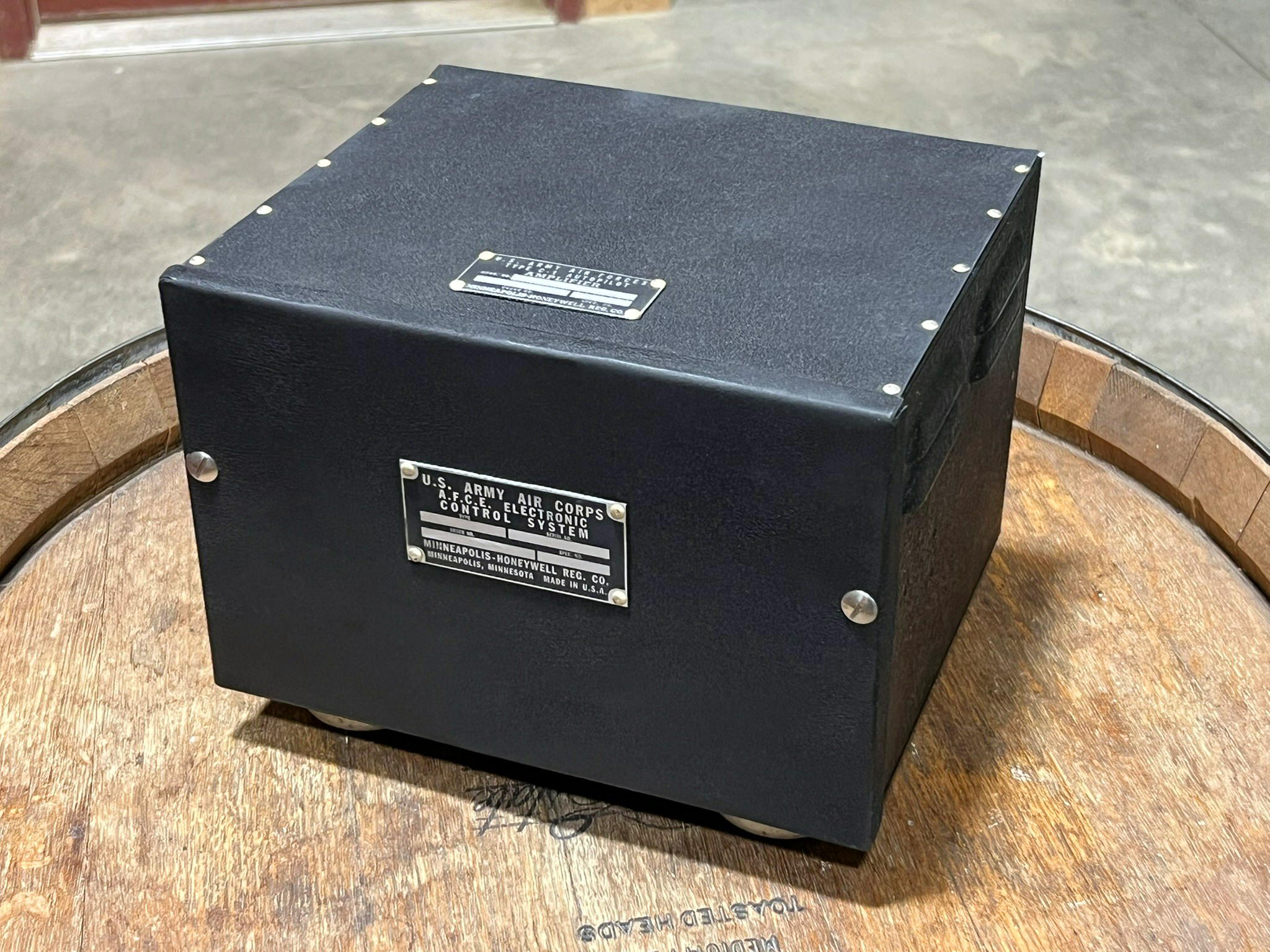
The corrected autopilot amplifier box.
Photo taken 9 May 2025.
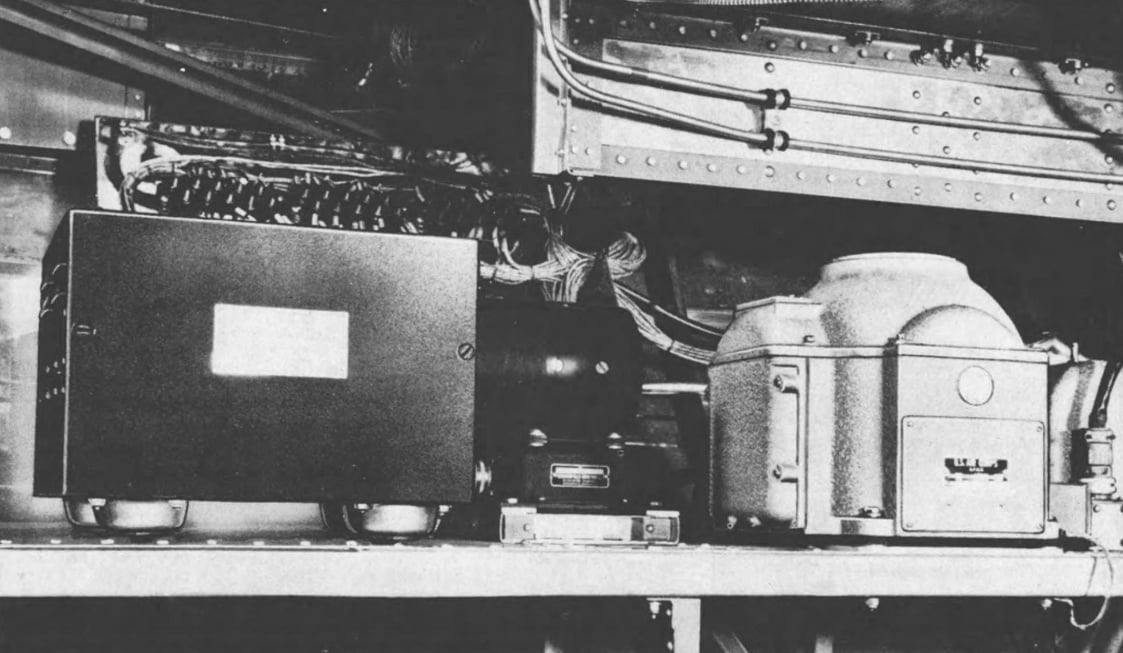
The amplifier box (left) was mounted the crawlway into the B-17’s nose, just underneath the cockpit. Above it sits the autopilot junction box, and to the right the system’s inverter and vertical gyro.
We have all of the C-1’s autopilot components except for the bombsight stabilizer. As far as we have found, there are only two, completely working C-1 systems in the world at this time: one in France and one in Australia. If you can help us bring forth one in the United States, please let us know!
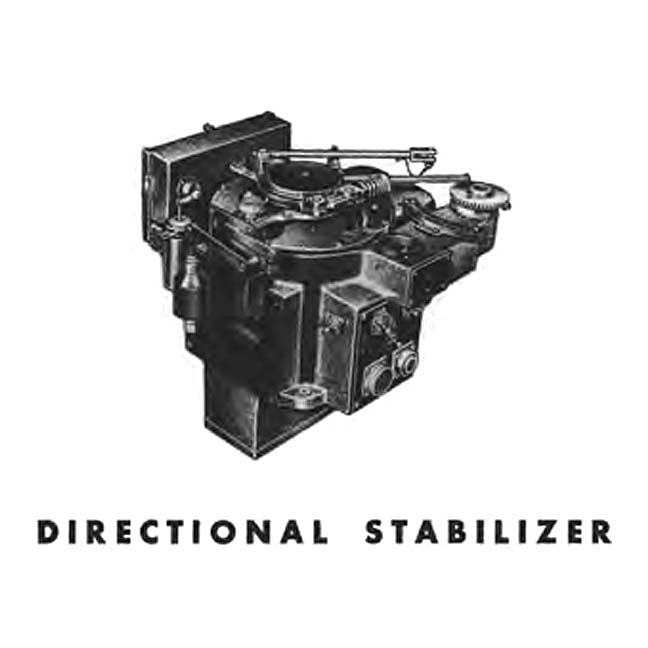
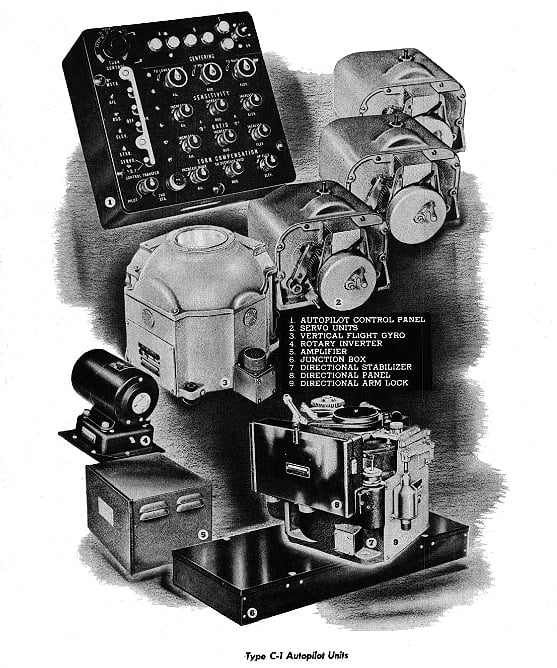
The C-1 Autopilot functioned thusly:
A control panel in the cockpit (1) activated a gyro (3) located in the crawlway near the entry hatch. This gyro fed information to an amplifier box (5) which, in turn, fed information to three servos (2) scattered about the airplane. The aircraft’s control cables ran through these servos – one for pitch, roll, and yaw – and, when active, kept the airplane in level flight. The rudder and elevator servos were located on a shelf above the tail wheel, while the aileron servo was in the crawlway beside the autopilot’s amplifier, vertical gyro, junction box (6), and power inverter (4). The final component was the directional stabilizer (7). This was an additional gyro tied to the Norden bombsight above. Whatever the sight aimed at, the stabilizer served to turn the airplane in that direction.
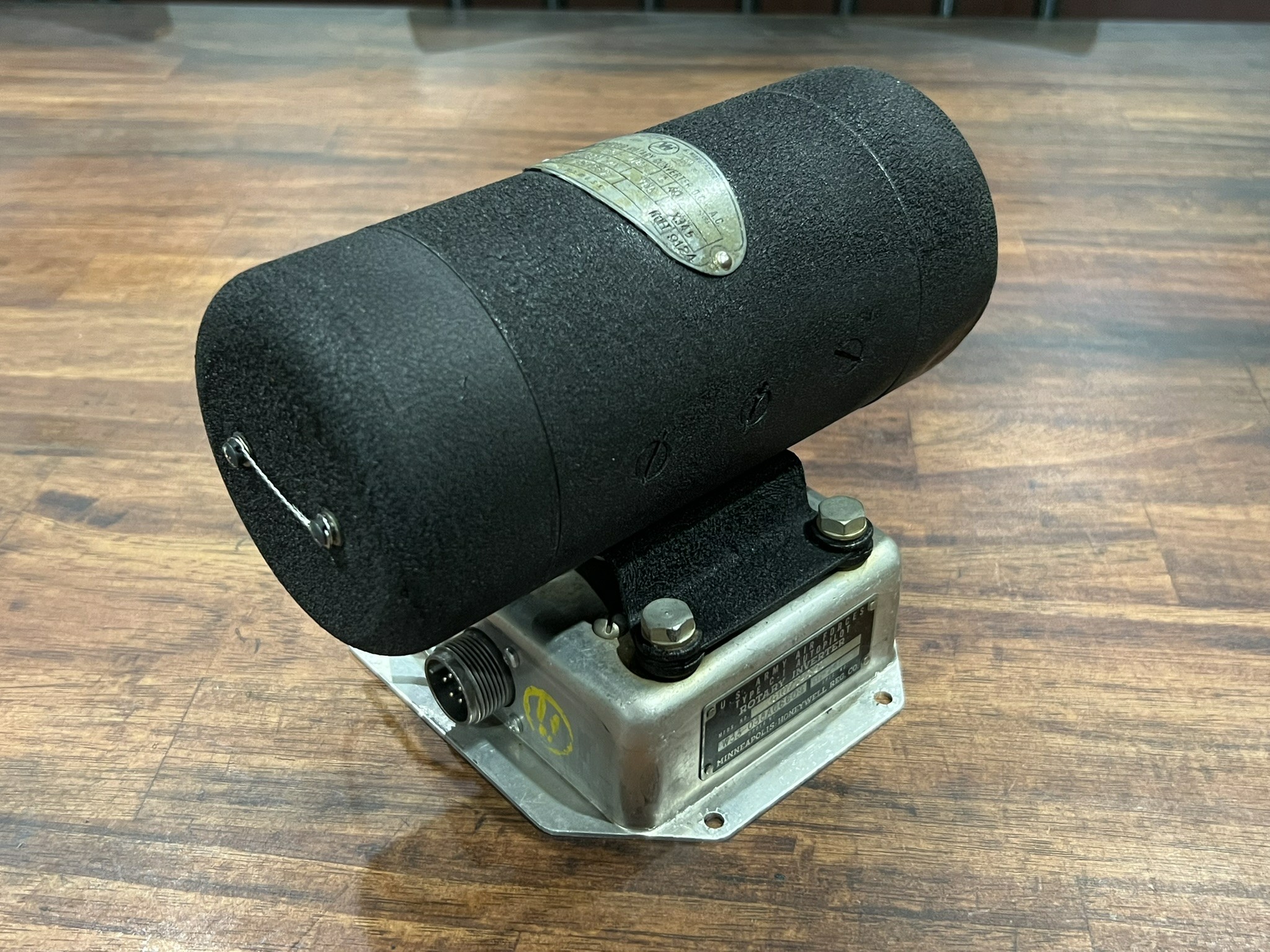
The newly restored Westinghouse Electric autopilot inverter.
This piece was donated by Joe McKowen of Gaffney, South Carolina and restored by John Castorina and Victoria Meier of Anthem, Arizona.
Photo taken 8 February 2025.
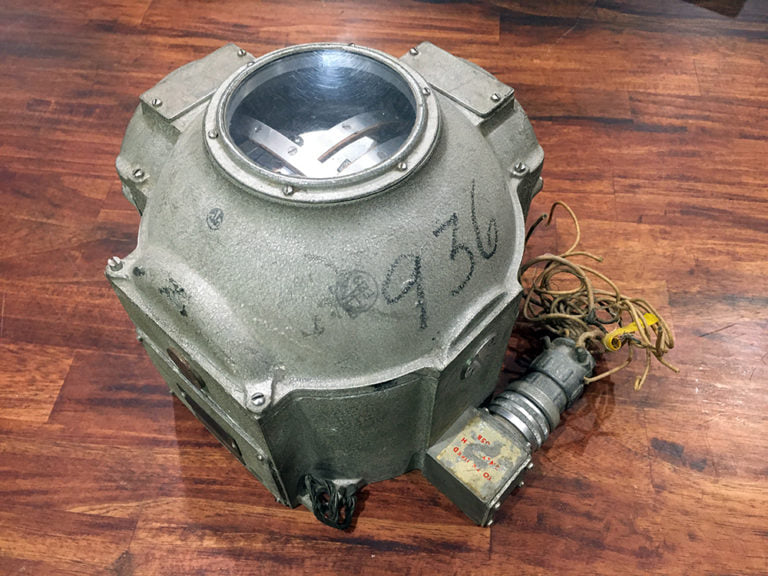
Lucky Thirteen‘s vertical gyro comes from “K-King” (44-6139, 351BG), which crashlanded near Namur, Belgium on 12 September 1944.
Photo taken 29 June 2021.
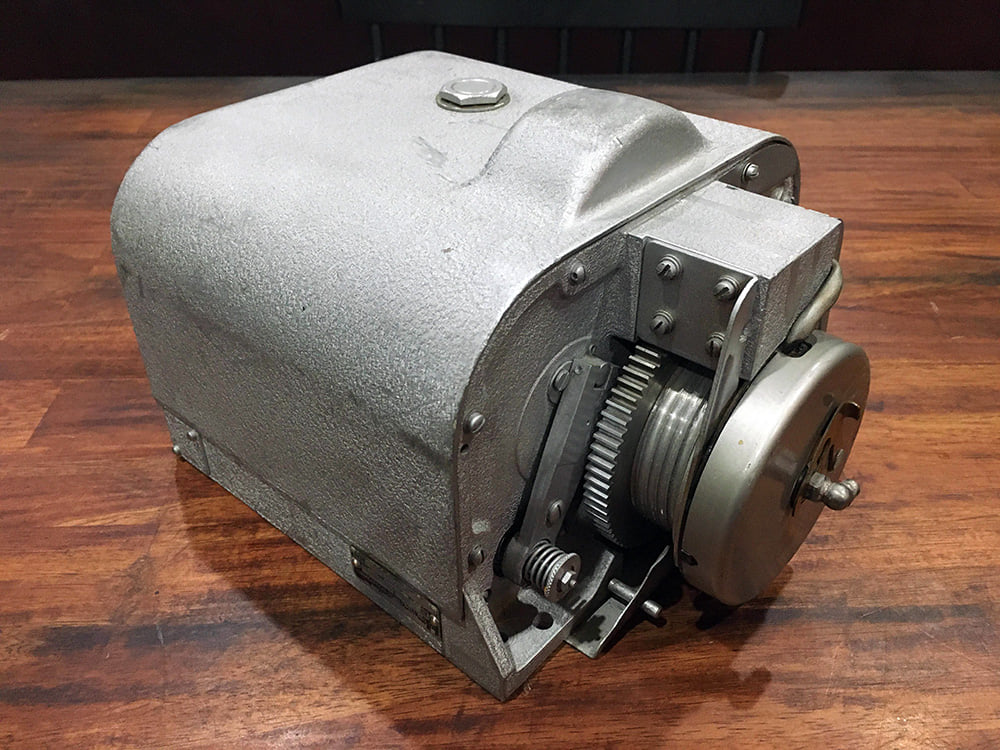
One of the servo units for the C-1 autopilot on Lucky Thirteen.
Photo taken 24 October 2021.
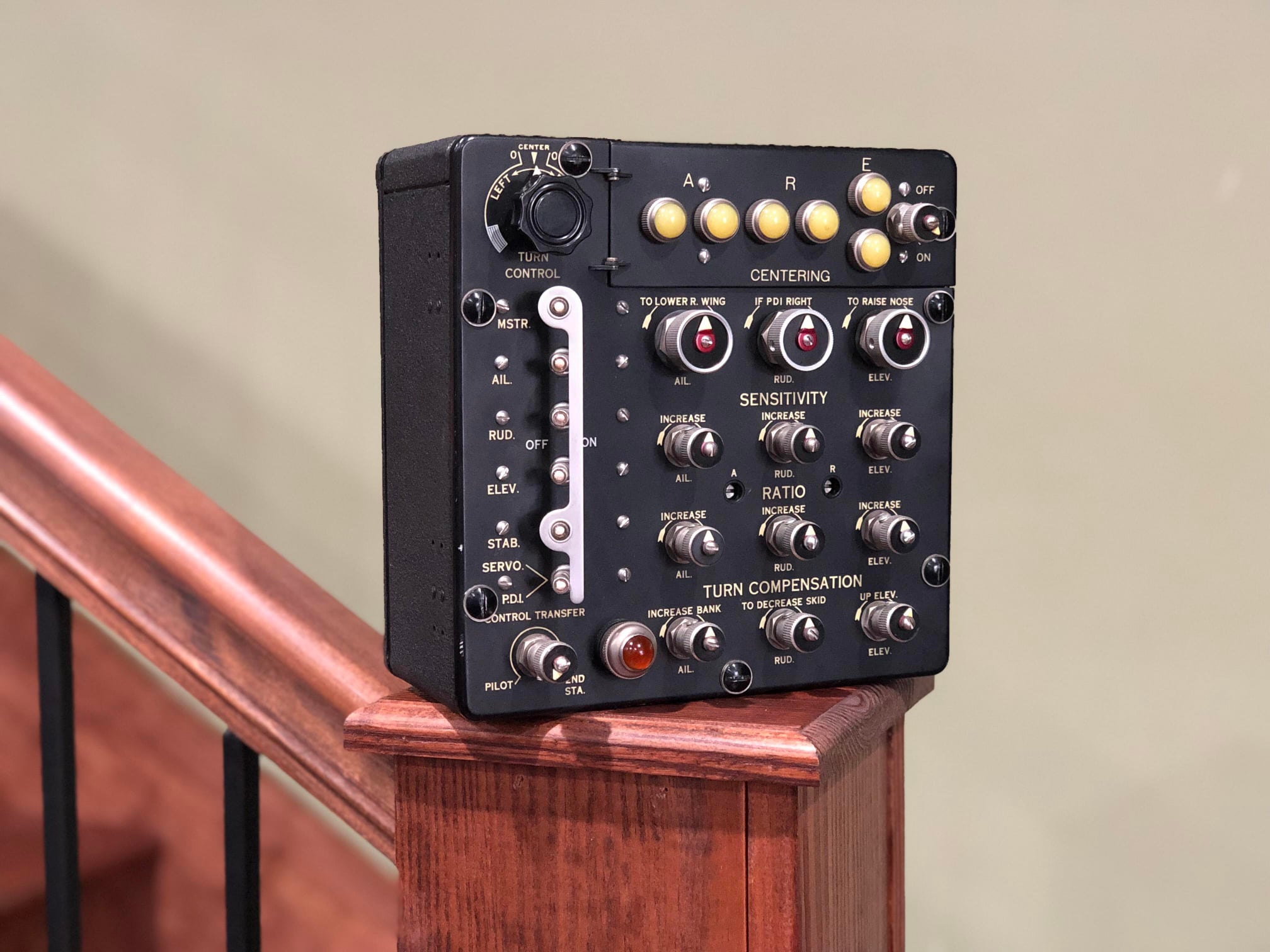
The C-1 Autopilot Control Box for Lucky Thirteen.
This unit came to us via Dom Serong in Australia, who even sent footage showing it in perfect operation.
Photo taken 27 December 2021.
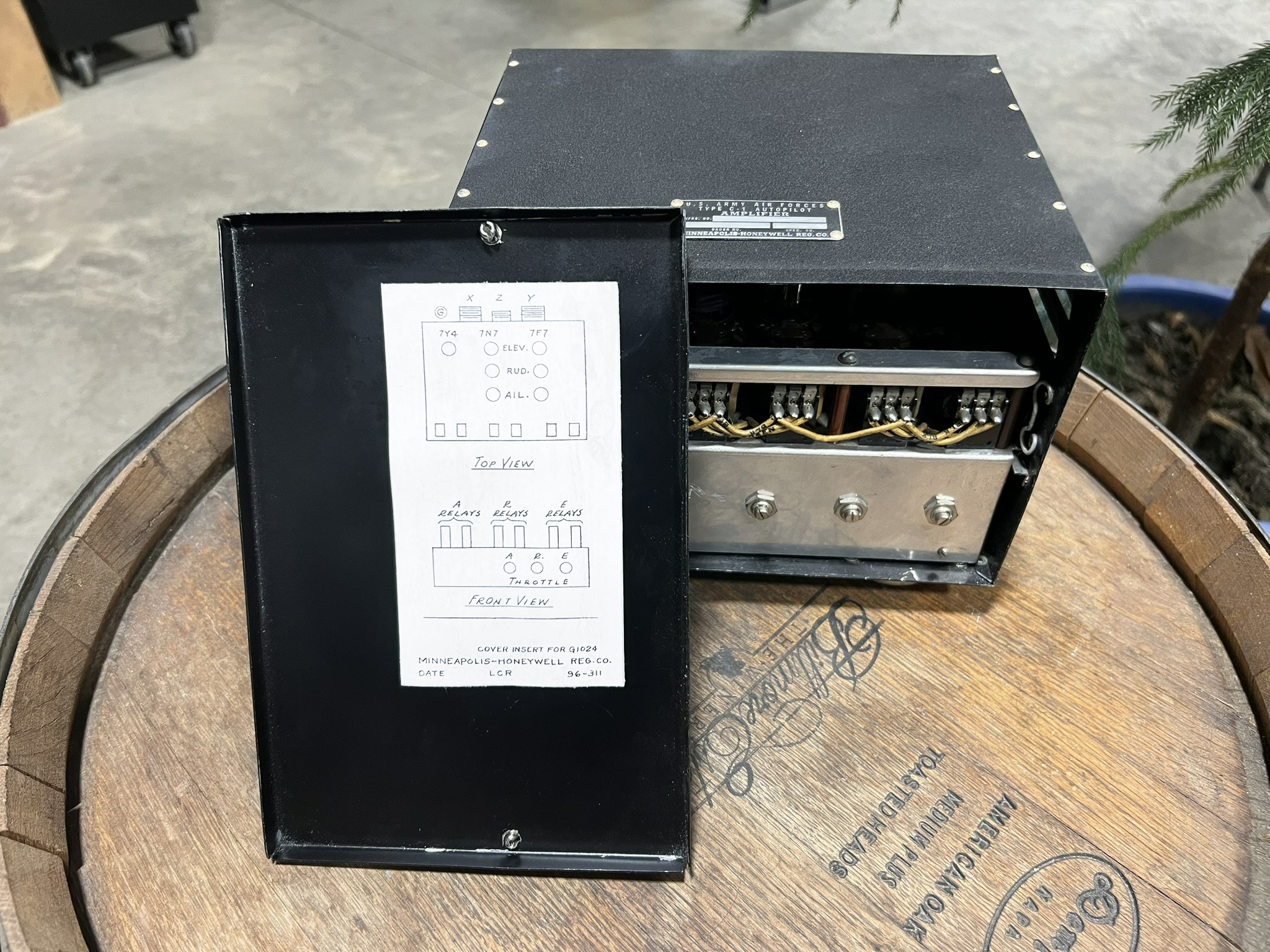
The side-cap removed from the autopilot amplifier box to show the paper insert, recreated thanks to reference photos and measurements from Dom Serong.
Photo taken 9 May 2025.
Got some cool pieces from our friend Colin Waterworth over in the UK.
First up is the SP-4131 Control for the gun camera in the tail position. To recap –
Stinger tail B-17s were capable of carrying a gun camera between its guns, doing so up to F Block-115. The camera was mounted vertically, with a 90° lens allowing it to face out. The control for this camera was mounted to the gunner’s left, immediately above his suit heater rheostat.
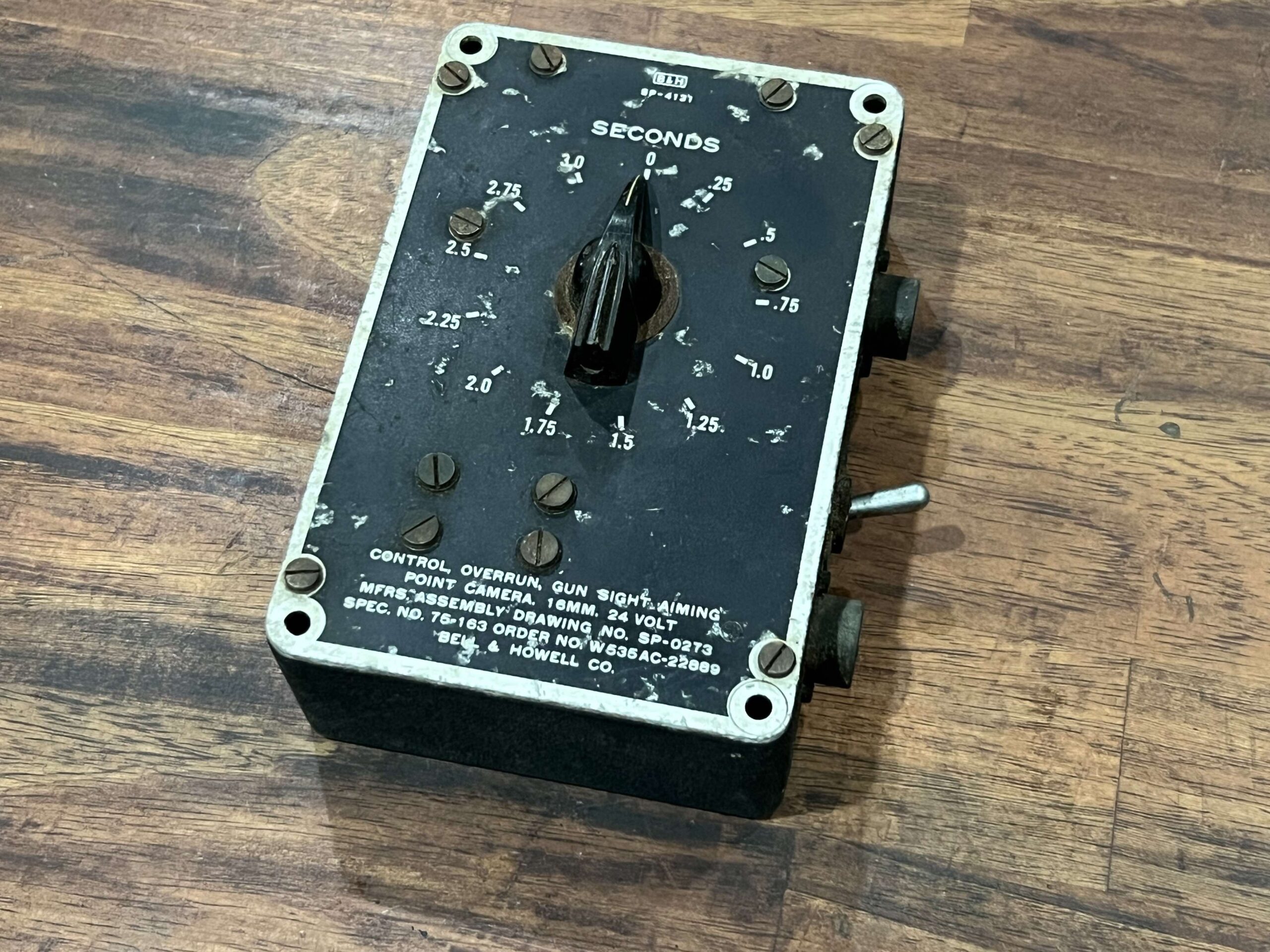
The recently arrived Gun Camera Control.
Photo taken 13 March 2025.
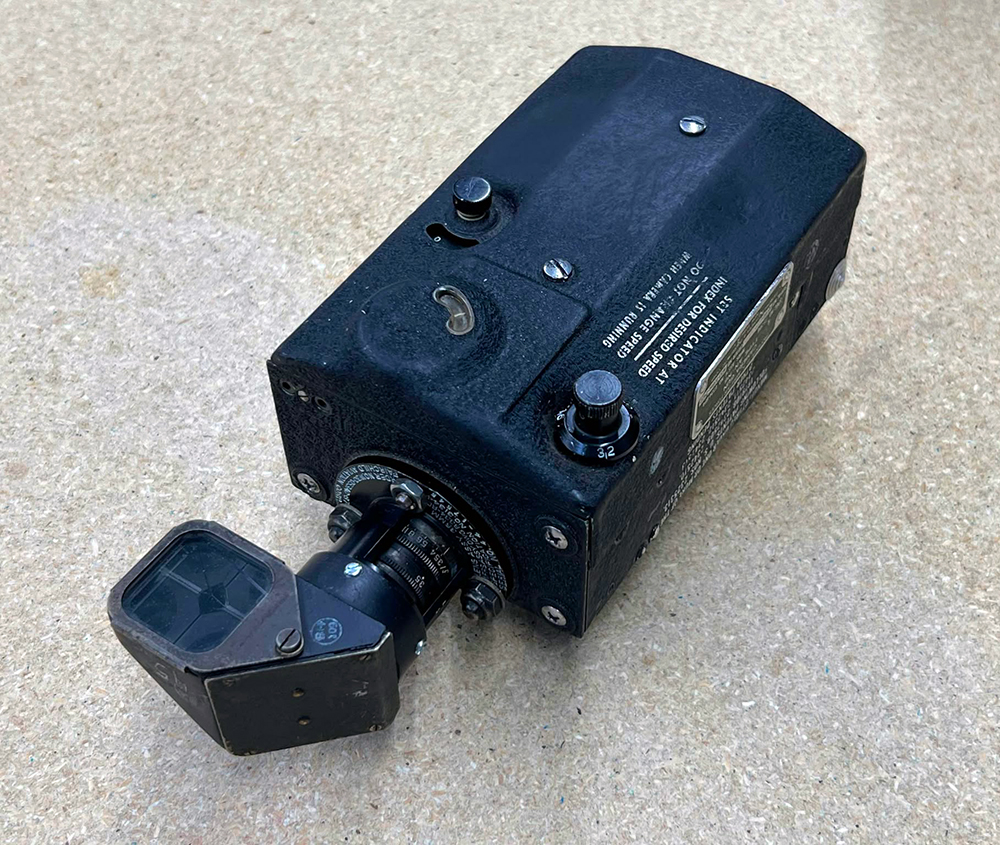
Lucky Thirteen‘s AN-N6 gun camera, donated by Howard Lawson of Jacksonville, Florida.
Notice the 90° lens.
Photo taken 1 February 2025.
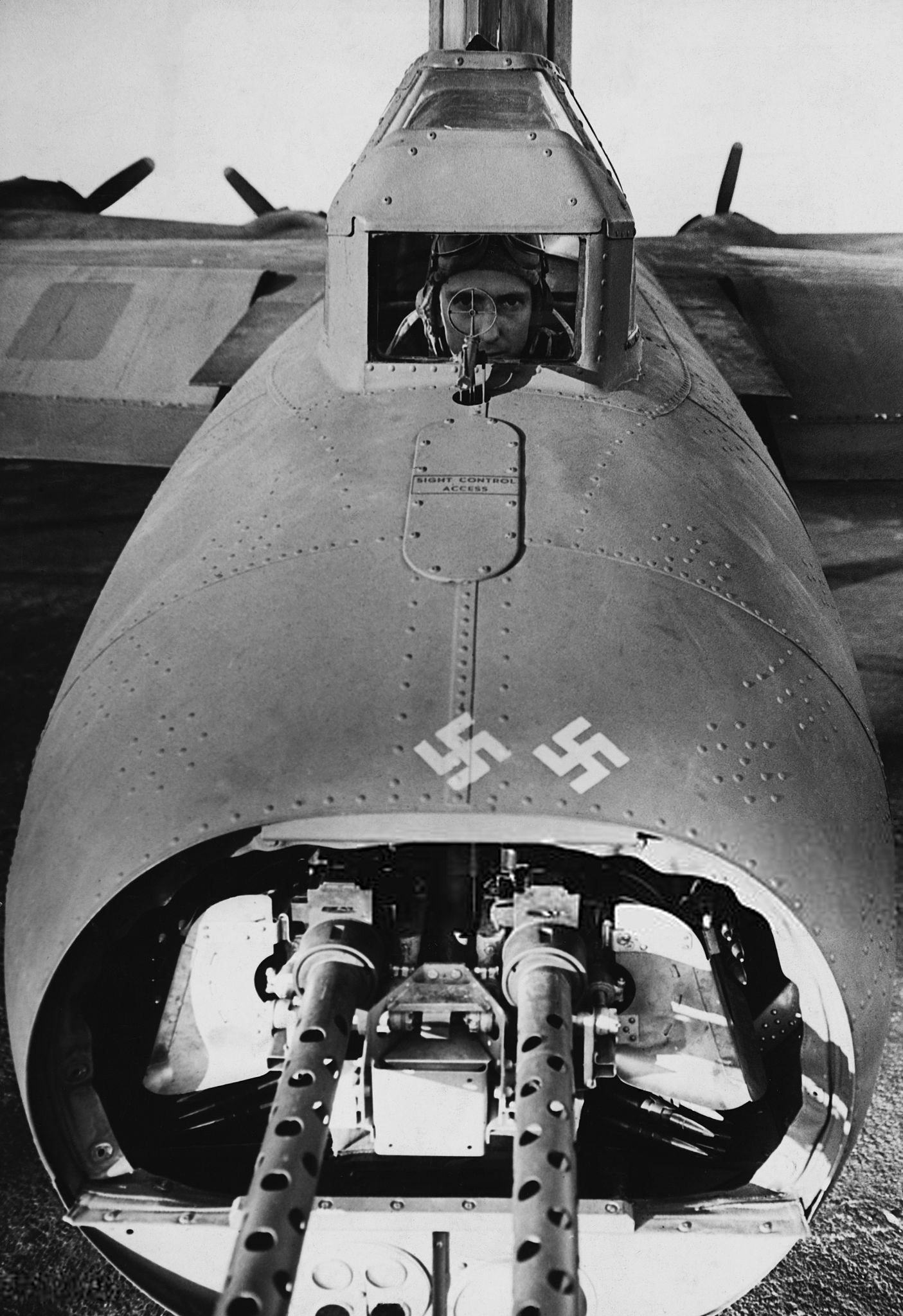
An example of a B-17F tail stinger, with the cover removed.
The bracket between the guns is where the gun camera can be mounted, though the camera itself is missing from this example.
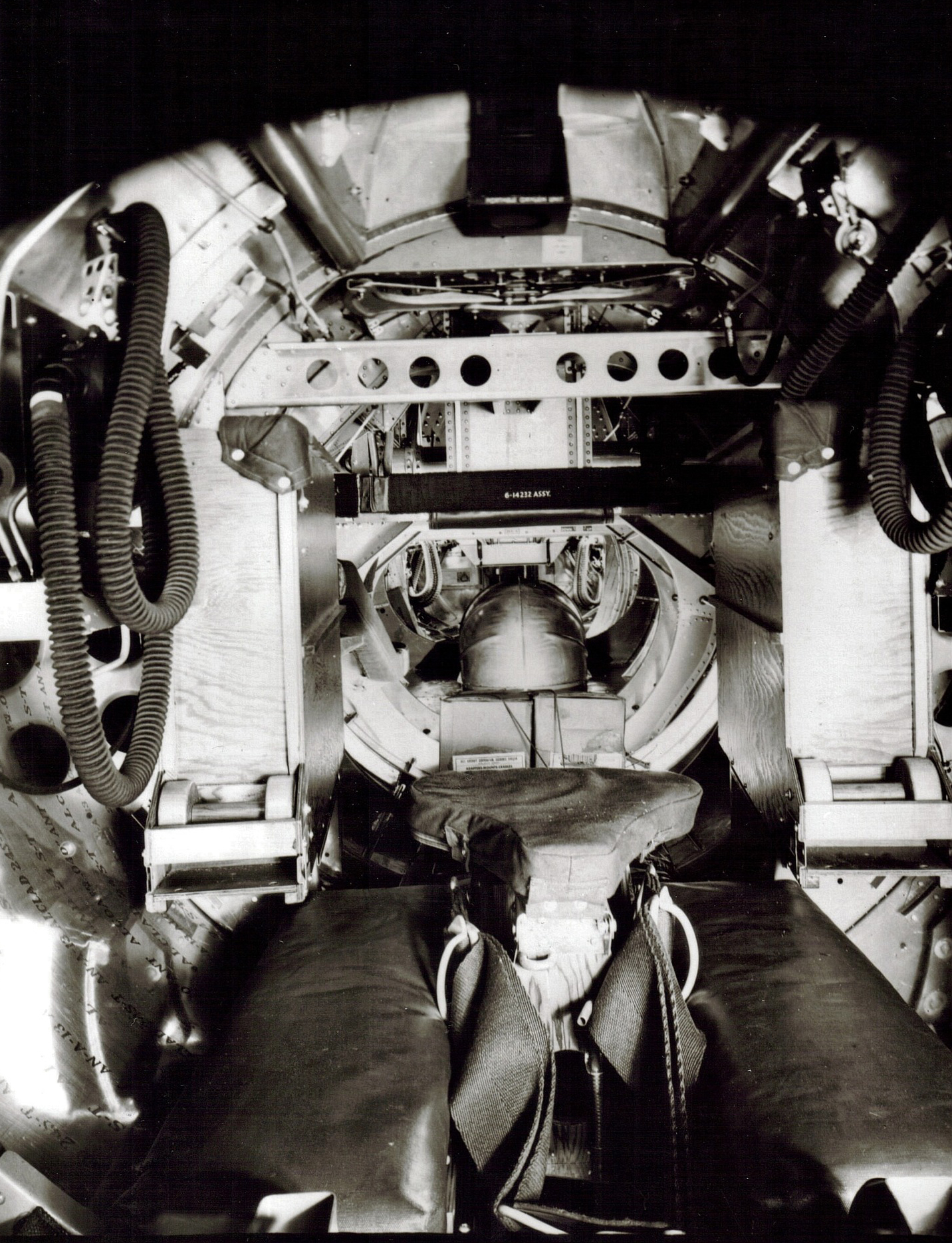
The interior of a B-17’s tail gun position, looking back from the guns themselves. Though not visible, the gun camera control was mounted just to the right of camera, beside the gunner’s heated suit rheostat.
The tail gunner was the only airman in the B-17’s crew to have an oxygen redundancy, having two oxygen panels both connected to separate banks of cylinders.
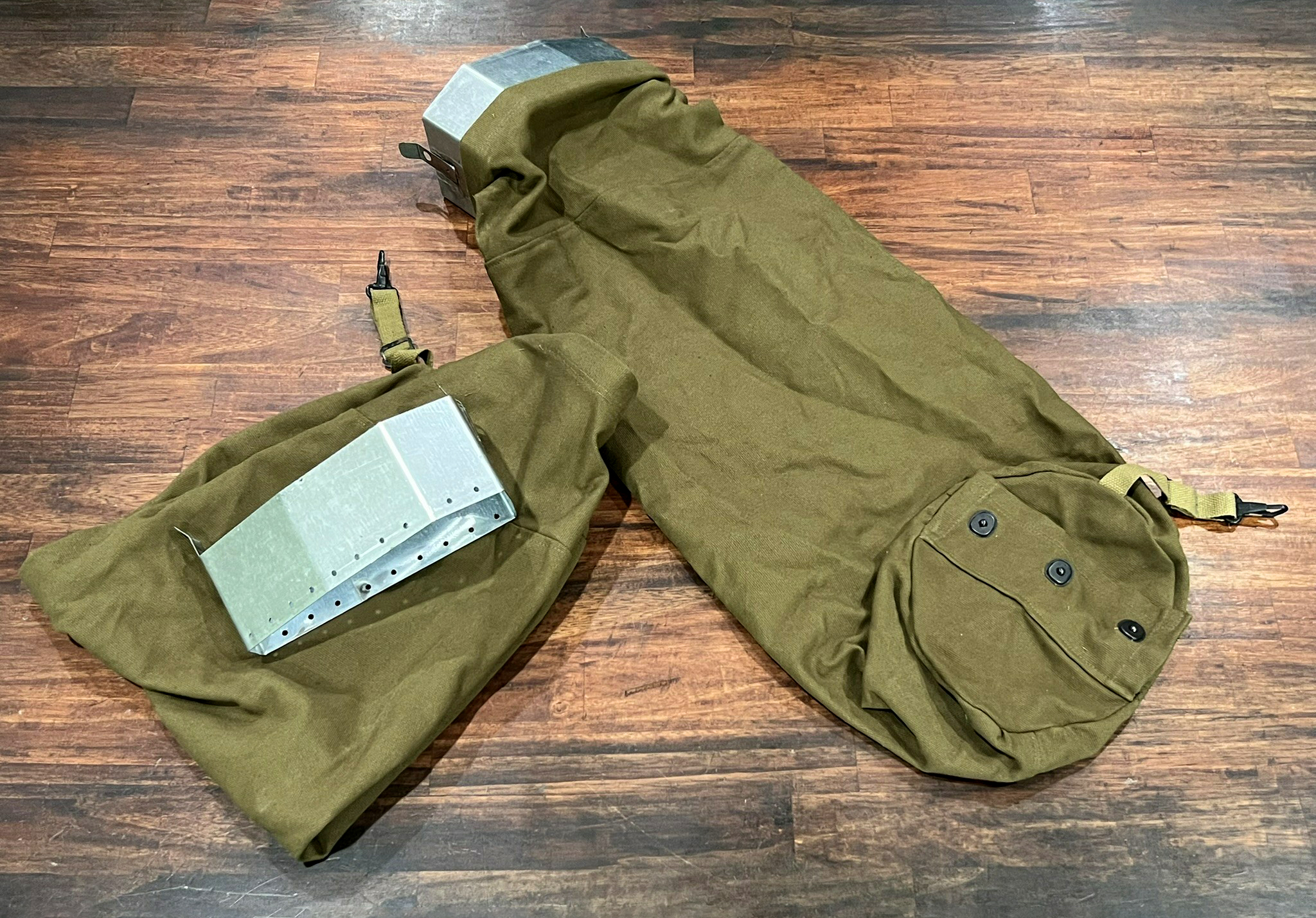
Another incredible piece from Colin are these ammunition bags for the Type A-1 Upper Turret.
Something rarely seen on restored examples, Sperry and Martin Upper Turrets actually came equipped with bags to catch the empty shells when fired. The bags clipped to a hopper underneath the gun cradle and featured flaps at the bottom for the ground crew to dump their contents upon return. Colin sent out bags with the upper brackets separate so that we can assure proper fit when we are ready to install them.
Special thanks are due to Collette Kinsman, who recreated the patterns and sewed these examples. Incredible job!
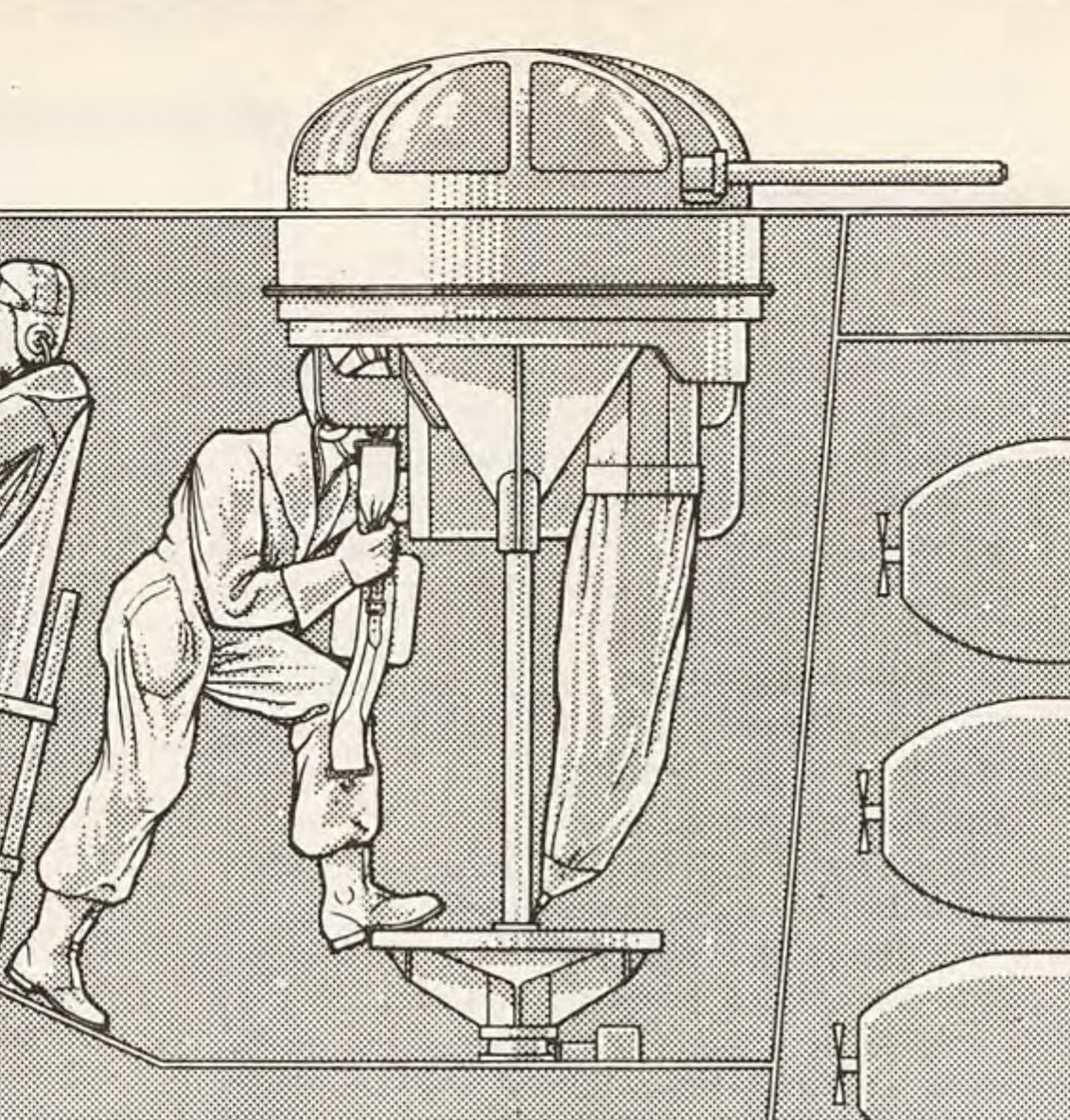
Manual illustration showing a Sperry Type A-1 Upper Turret in the cockpit of a Boeing B-17.
The shell bags, clipped at the top to their hoppers and at the bottom to the base assembly, can be clearly seen here.
This next piece came as a special surprise – it is a NOS handle for the B-17’s nose hatch.
Special thanks to our friend William McElhaney who tracked this awesome piece down!
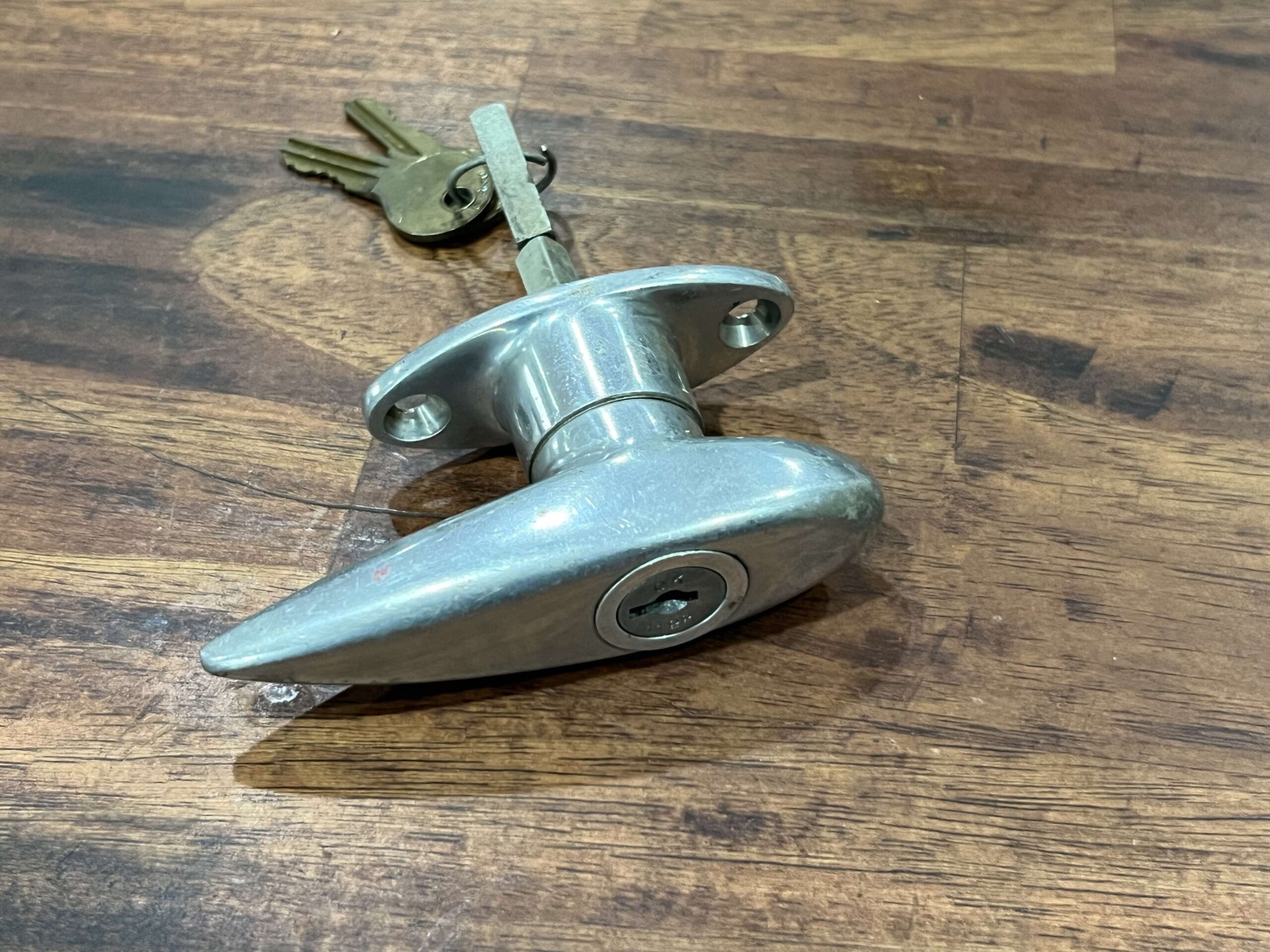
The newly arrived door latch assembly for the B-17’s nose hatch.
Note the keys – this is accurate. In fact, Boeing even provided a small, leather pouch by the copilot to stow the keys when in flight.
Photo taken 13 March 2025.
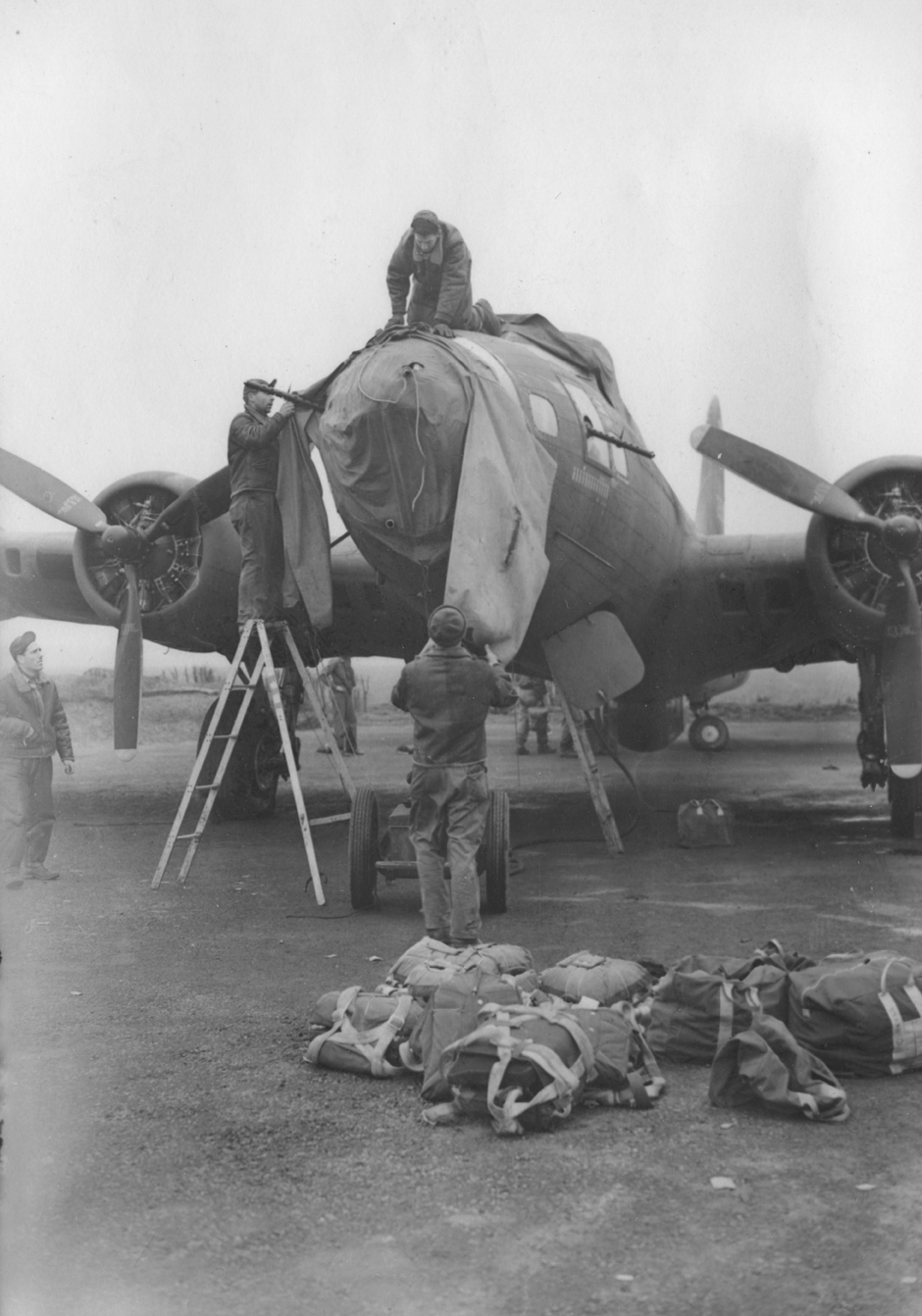
Ground crews tend to Invasion II (42-5070, 91BG), with her nose hatch prominently left open.
Fast approaching the end of their combat tour, the crew of Invasion II were the subject of a film production headed by Hollywood director William Wyler in early-1943. Lost on her 23rd mission – the 17 April 1943 strike on Bremen – Wyler was forced to shift his focus to another aircraft, Memphis Belle (41-24485), with another aircraft, Hell’s Angels (41-24577, 303BG), as his backup should anything happen to them.
There is more to share but I think we will stop here for now, lest the update be overly long!
The Hangar Thirteen Foundation is a 501c3 nonprofit charity and donations toward this project are tax deductible. If you can spare a little to help this project, you can guarantee that you will see the results on Facebook and here on our website.
You can contribute through the Donate page or, to avoid a PayPal fee, you can send something via the mail to:
Gerad Allen Blume
Hangar Thirteen Foundation
442 Old Chalk Bed Road
Batesburg, SC 29006
Volunteers are also always welcome. In fact, you need not be an Asheville resident – you can work from home! Persons skilled with metal fabrication, machining, CAD modeling, metal casting, 3D scanning, and laser/waterjet cutting, are particularly helpful. Just reach out to us to get started.
Keep the show on the road!